

Art Basel, Hong Kong, 2026
During Art Basel week, the city’s vertical intensity—its towers, harbours, malls, and late-night conversations—reorients itself around contemporary art, shaping a distinct cultural tempo. Here are my favourite works and booths from the fair.
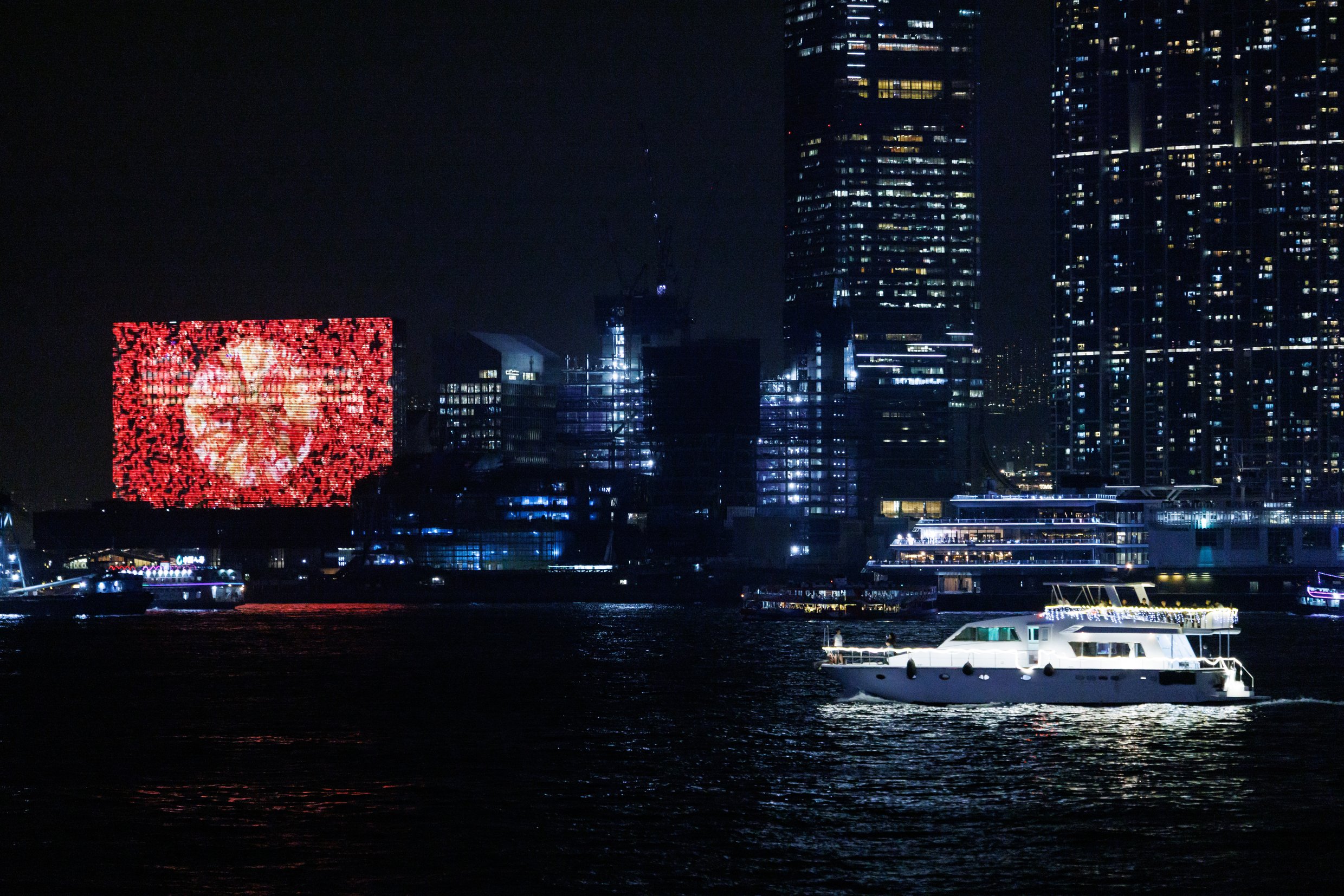
Returning to the Hong Kong Convention and Exhibition Centre from March 25–27, 2027, Art Basel Hong Kong once again becomes a kind of diagnostic lens through which the art world’s shifting power structures can be read. Major Western galleries sit alongside a formidable presence from across Asia-Pacific, underscoring a cultural realignment in which Asia is no longer peripheral, but central to the conversation. Yet the fair is only the most visible node in a denser system. Across the city—within museums, auction houses, independent spaces, and private collections—other rhythms unfold in parallel, so that Hong Kong during these days ceases to be merely a backdrop to the market and instead becomes an active, humming field of exchange, speculation, and attention.
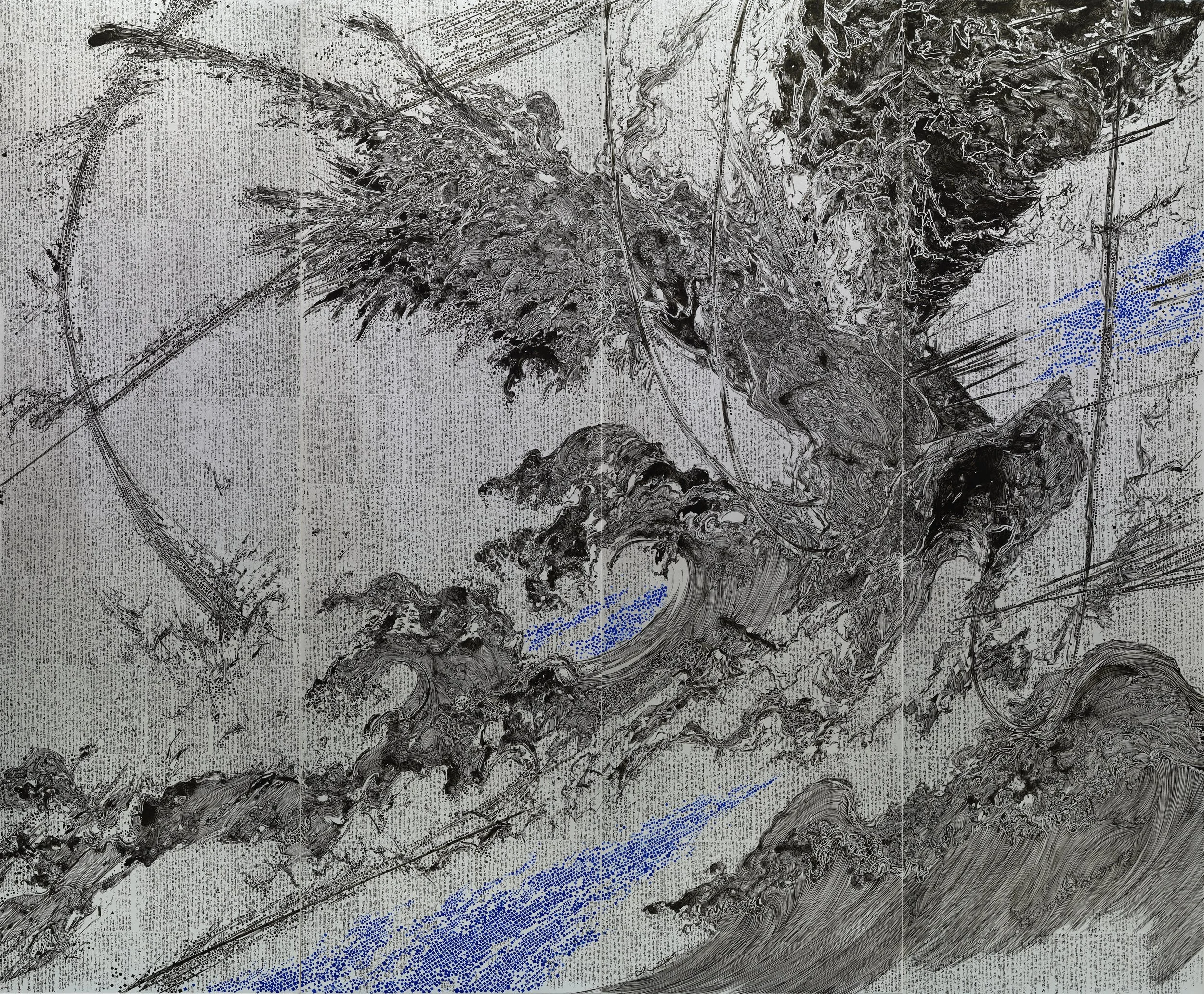
At the Edge of the Speed of Sound, We Weave the Heavens by Takafumi Asakura, black ink and azurite on aluminium leaf. Image credit: the artist and A Lighthouse called Kanata.
A Lighthouse called Kanata: Tokyo
In the glare and acceleration of Art Basel Hong Kong 2026, A Lighthouse called Kanata proceeds almost against the grain—quietly, deliberately, like a refusal to compete for attention. Presented by Kanata, the exhibition gathers a field of Japanese abstraction that privileges restraint over spectacle, and perception over image. Works by Takafumi Asakura, Ayane Mikagi, Kentaro Sato, and Kiyo Hasegawa unfold through mineral pigment and calligraphic gesture, producing states rather than scenes—paintings that feel atmospheric, unsettled, and inwardly lit. In sculpture, Niyoko Ikuta, Satoru Ozaki, Kan Yasuda, Joseph Walsh, and Nobuyuki Tanaka extend this language into marble, wood, glass, and lacquer, where form is held as something breathed rather than built. Alongside these contemporary positions, post-war artists Hisao Domoto, Kumi Sugai, and Takeo Yamaguchi reappear not as historical anchors but as continuing frequencies, having shaped abstraction in Japan as an ethics of attention rather than an absence of image. What the exhibition ultimately offers is not argument but duration: a sustained insistence that looking, properly understood, is still a slow and disciplined act.
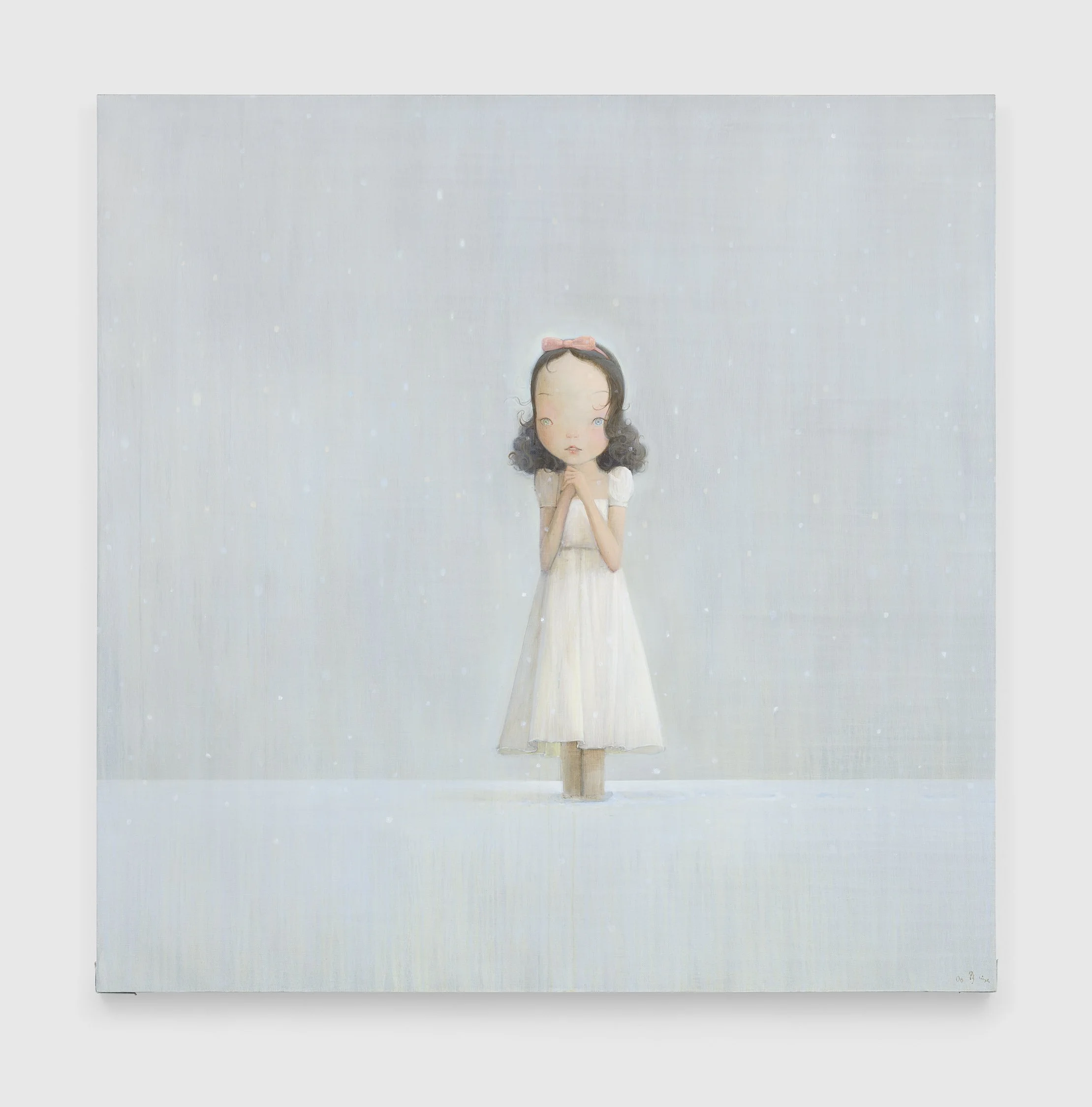
Snow White by Liu Ye, acrylic on canvas. Image credit: David Zwirner.
David Zwirner: New York, Los Angeles, London, Hong Kong, Paris
A young girl stands beneath falling snow, as though the world around her has paused. In pale, almost translucent tones, a figure stands in mist and winter light. Her hands are clasped gently, her gaze calm, creating a stillness that softens the noise of the outside world. Snow drifts across the canvas like a veil, dissolving the edges between body and atmosphere. The painting’s power lies in its restraint. Tiny flecks of light and subtle tonal shifts slow the act of looking, inviting viewers into a space of reflection. Fragility becomes its own kind of strength.
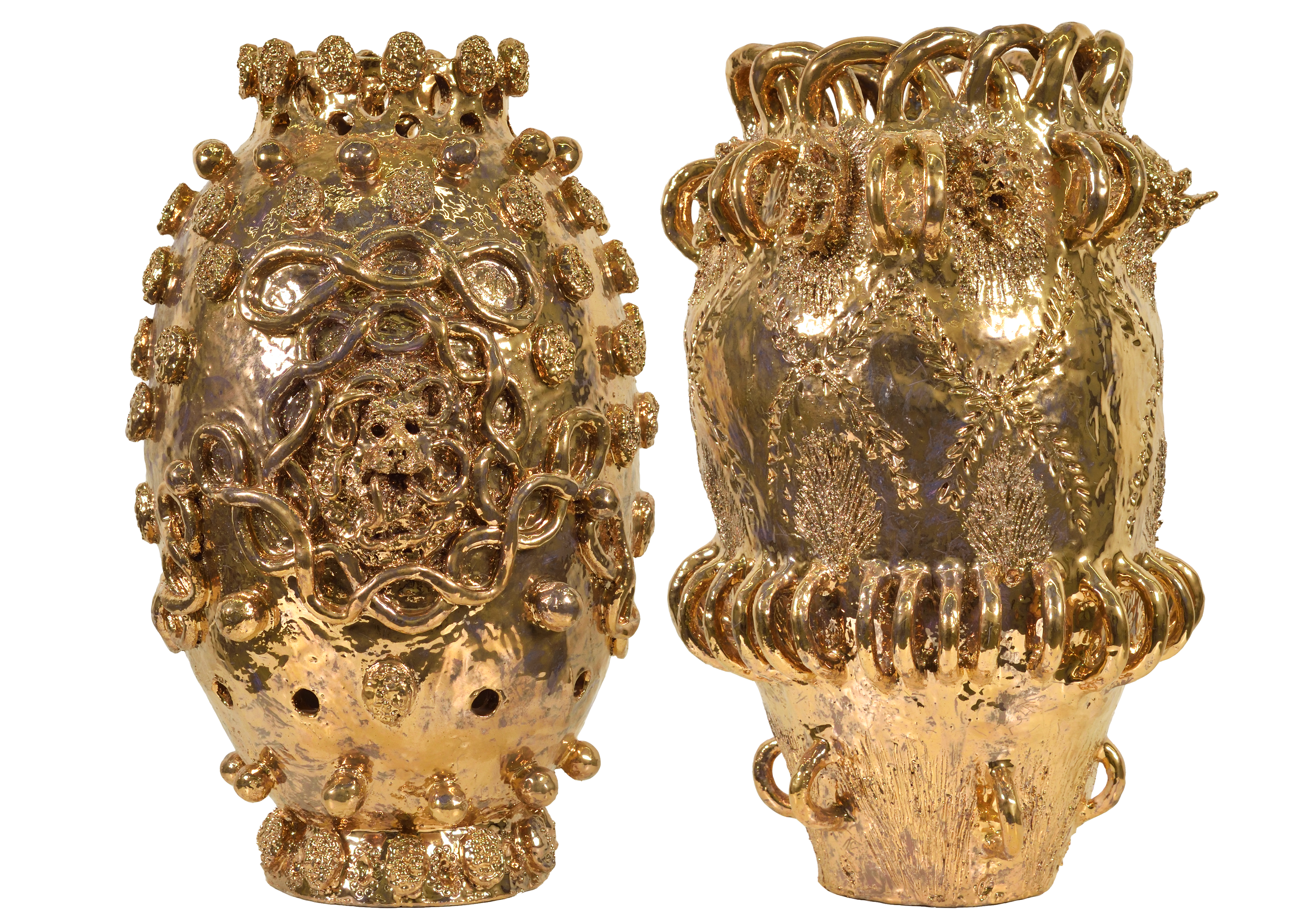
Trésor de guerre XI and IX by Hélène Delprat, enamelled ceramic. Image courtesy: the artist, Galerie Christophe Gaillard, and Hauser & Wirth; Adagp, Paris, and photography by Rebecca Fanuele.
Galerie Christophe Gaillard: Paris and Brussels
A golden vessel rises like a relic from an imagined civilisation—part archaeological fragment, part speculative future object. Its surface coils with clustered forms and molten textures that catch the light like unearthed ore still warm from pressure. Despite its metallic intensity, the work resists aloofness; the gold feels oddly porous, as though it retains the memory of touch. Ornament here operates less as decoration than as accumulation—a way of gathering light, space, and presence into dense material language. The two ceramic works emerge from Hélène Delprat’s recent engagement with a medium long associated with both intimacy and historical weight, resonating with the broader contemporary “ceramic revival” and the legacy of the Sèvres National Porcelain Manufacture. Within this framework, ceramics become for Delprat a field of memory and transformation rather than pure craft. Ancient relics, grotesque masks, and anthropomorphic vessels surface throughout her work, carrying a sustained tension between fragility and excess, where image and object remain deliberately unsettled.
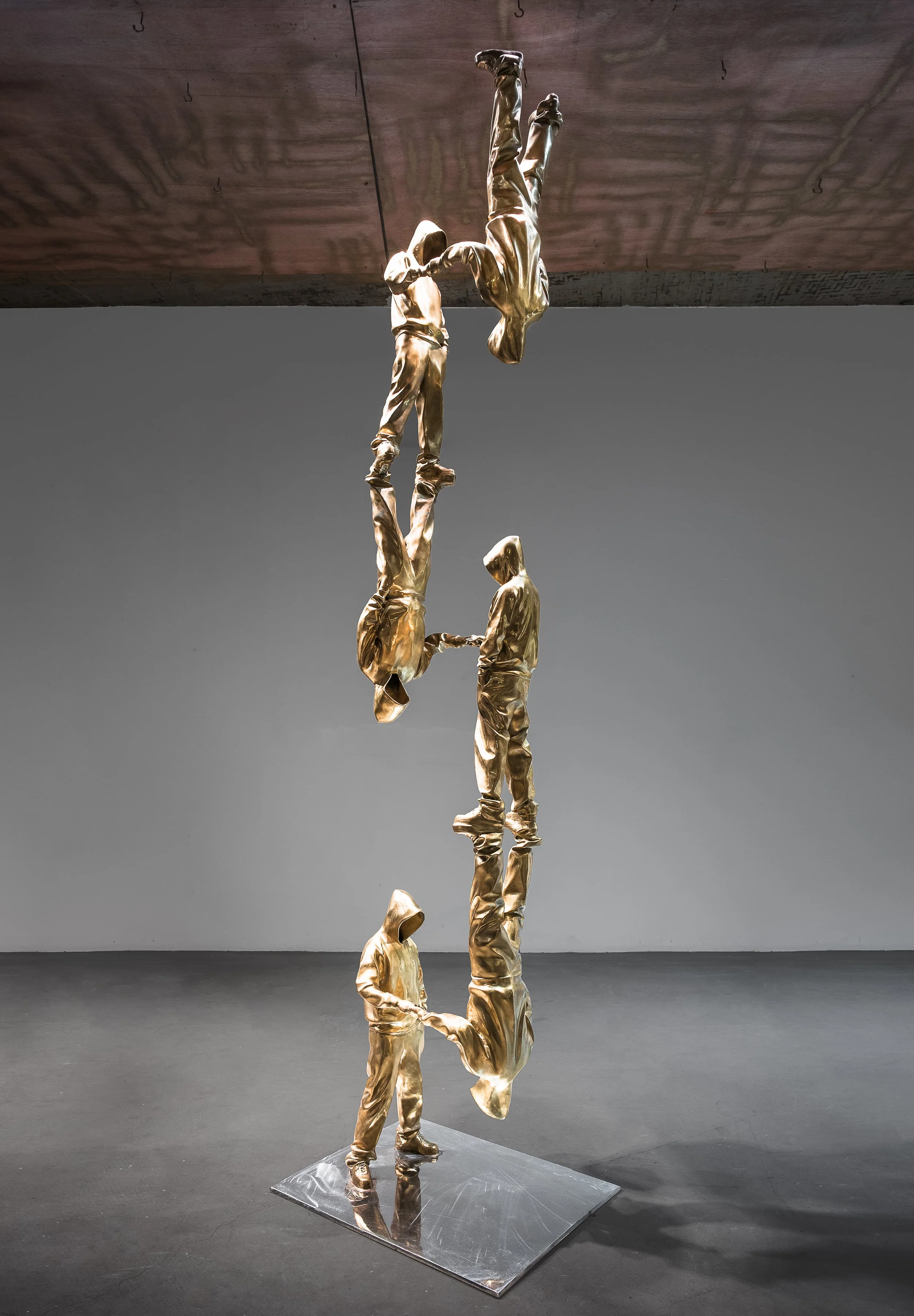
Yo Bro !! by Huang Yulong, bronze. Image credit: Ora-Ora.
Ora-Ora: Hong Kong
A tower of hooded figures rises towards the light, each body balanced upon another in a precarious architecture of trust. In The Peak, Huang Yulong translates the visual grammar of street culture into something closer to myth, casting his stacked figures in a luminous gold that hovers between monument and apparition. Individual identity recedes; what remains is relation—hands gripping hands, weight distributed across bodies in a chain of collective ascent. Born in Anhui, Huang returns repeatedly to the hoodie as a global signifier of anonymity and belonging, its emptiness operating less as absence than as open field. In You Bro 2, six figures are superimposed front to back, embodying an Eastern philosophical register in which opposites are held in suspension rather than resolved—yin and yang, virtue and transgression, existing not as fixed poles but as shifting states of coexistence. Across these works, repetition becomes structure and philosophy alike. The sculptures propose no singular heroism; instead, they stage a quietly radical proposition—that elevation is never solitary, but always contingent, relational, and shared.
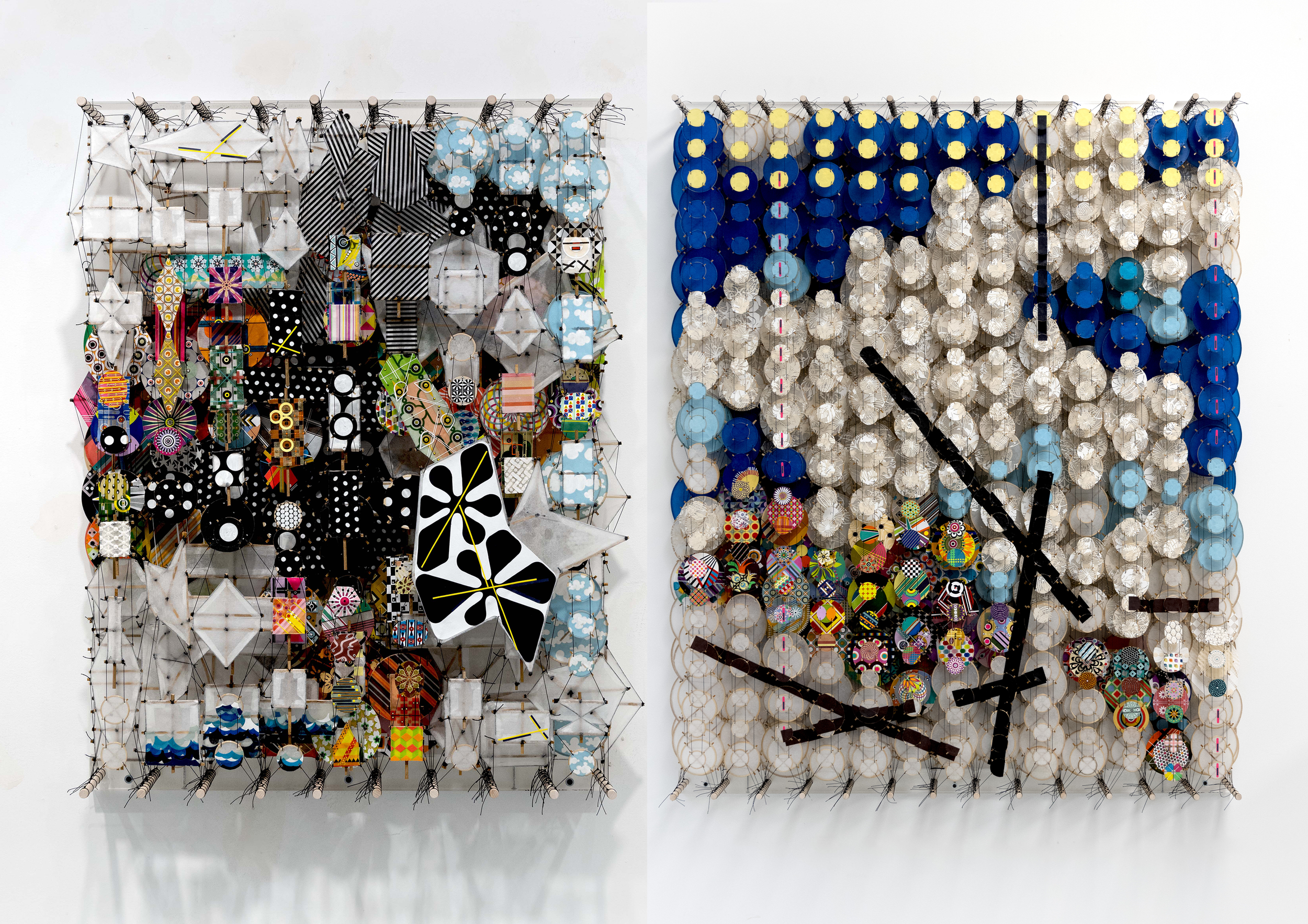
The Groundwater Compass by Jacob Hashimoto; acrylic, bamboo, wood, and dacron. Image credit: Ronchini Gallery.
Ronchini Gallery: London
In Jacob Hashimoto’s work, perception drifts rather than advances—clouds slide laterally, maps falter mid-formation, and colour hovers in states of near-remembering. Drawing obliquely from Japanese pictorial traditions, yet rooted in a contemporary sensibility, he constructs vast suspended environments from hundreds of bamboo-and-paper kites. These fragile units accumulate into shifting fields that behave less like objects than atmospheric conditions. At moments the work reads as landscape, at others as digital residue or fragmented cartography, but it never stabilises into one register. Instead, it continuously unthreads itself as it forms. What emerges is a quiet instability in which image, structure, and memory remain deliberately porous, allowing meaning to drift without settling.

Bradley Ertaskiran booth, works by Stephanie Temma Hier. Imade credit: Bradley Ertaskiran.
Bradley Ertaskiran: Montreal
In Stephanie Temma Hier’s theatrical world, the everyday slips just beyond recognition, as though internet imagery has settled into myth. A lobster hums beside a fan, an octopus clasps figs, and a half-eaten burger lingers like residue from a half-remembered dream. Commissioned for Art Basel Hong Kong 2026, Discoveries sector, the works read as afterimages of digital culture hardened into ceramic fact. Hier’s sculptural frames entangle painting rather than contain it, collapsing image and object into a single uneasy surface. What remains is a slowed, tactile field where excess, desire, and absurdity turn unexpectedly fragile and intimate.
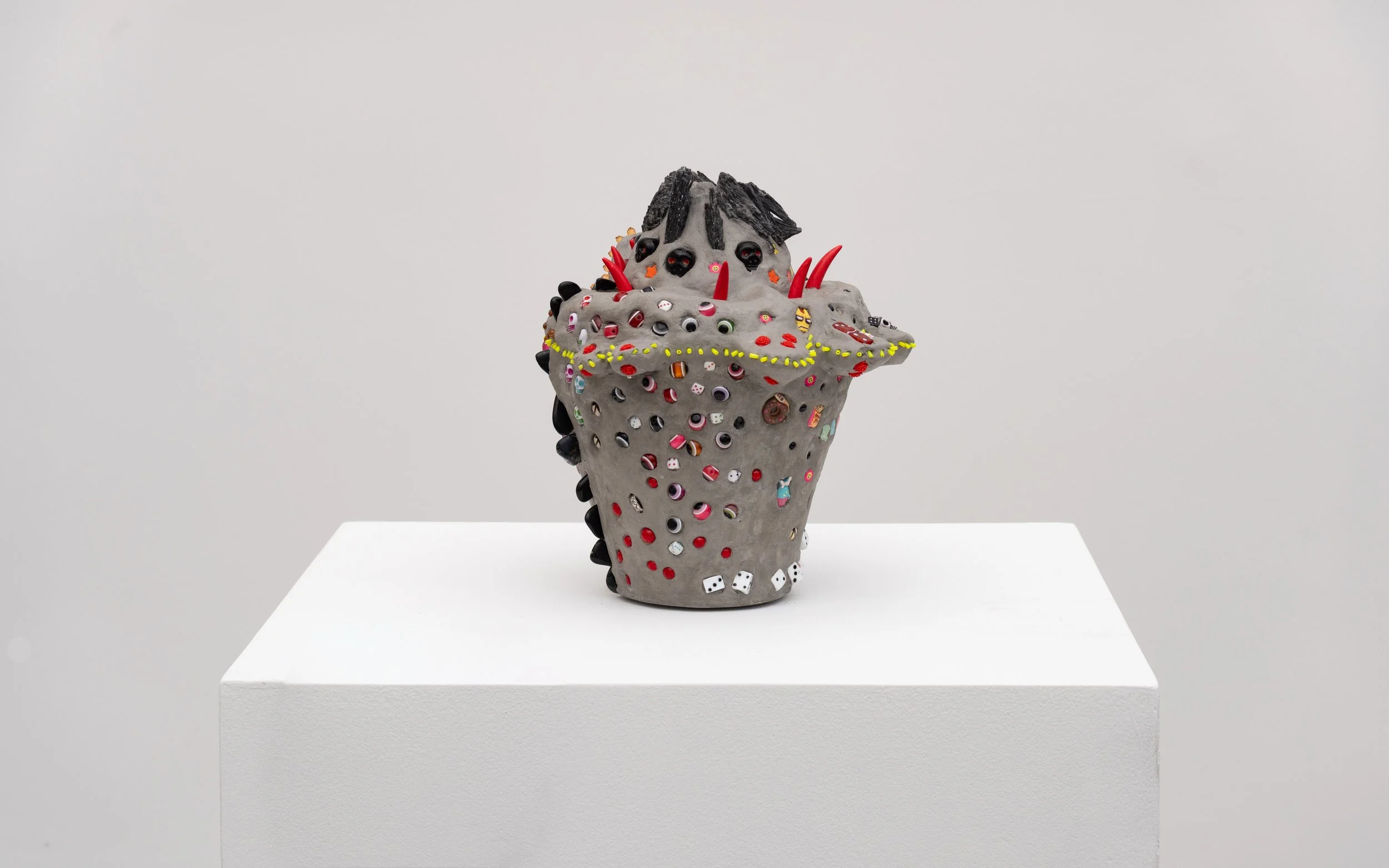
Credit image: Almeida & Dale.
Almeida & Dale: São Paulo
In Sara Ramo’s practice, meaning is not asserted but assembled—an unstable field where intuition and context continually reconfigure one another. Her installations operate through a logic of coexistence rather than resolution, holding contradiction and plurality as lived conditions. The ordinary and the estranged circulate through each other, exchanging positions until neither remains fixed. Collage, in her hands, becomes less a technique than a mode of perception: fragments, residues, and discarded matter are drawn into delicate yet visceral arrangements that hover between intimacy and collective memory. What emerges is a quiet revelation of the unseen structures that bind experience together, where creation itself appears as an ongoing act of rearrangement.

Image credit: Gajah Gallery.
Gajah Gallery: Singapore
At Gajah Gallery, Suzann Victor’s City Lantern unfolds as a rotating architecture of perception, where the city is no longer a stable record but a continuously unspooling field of images. A ten-metre photographic mural is set in motion with Fresnel lenses, producing a shifting panorama in which architectural fragments across Asia fracture, align, and dissolve. What initially reads as a coherent visual geography—spanning colonial and postcolonial sites from Hong Kong to Manila, Beijing to Singapore—quickly destabilises into optical interference. Victor draws on colonial-era photographs and postcards not to preserve them, but to unsettle their authority, exposing the hierarchies embedded within their framing. As the structure turns, vision itself becomes provisional: the city appears, withdraws, and reconstitutes elsewhere. There is no fixed vantage, only a disciplined disorientation in which history refuses closure and remains insistently in motion.
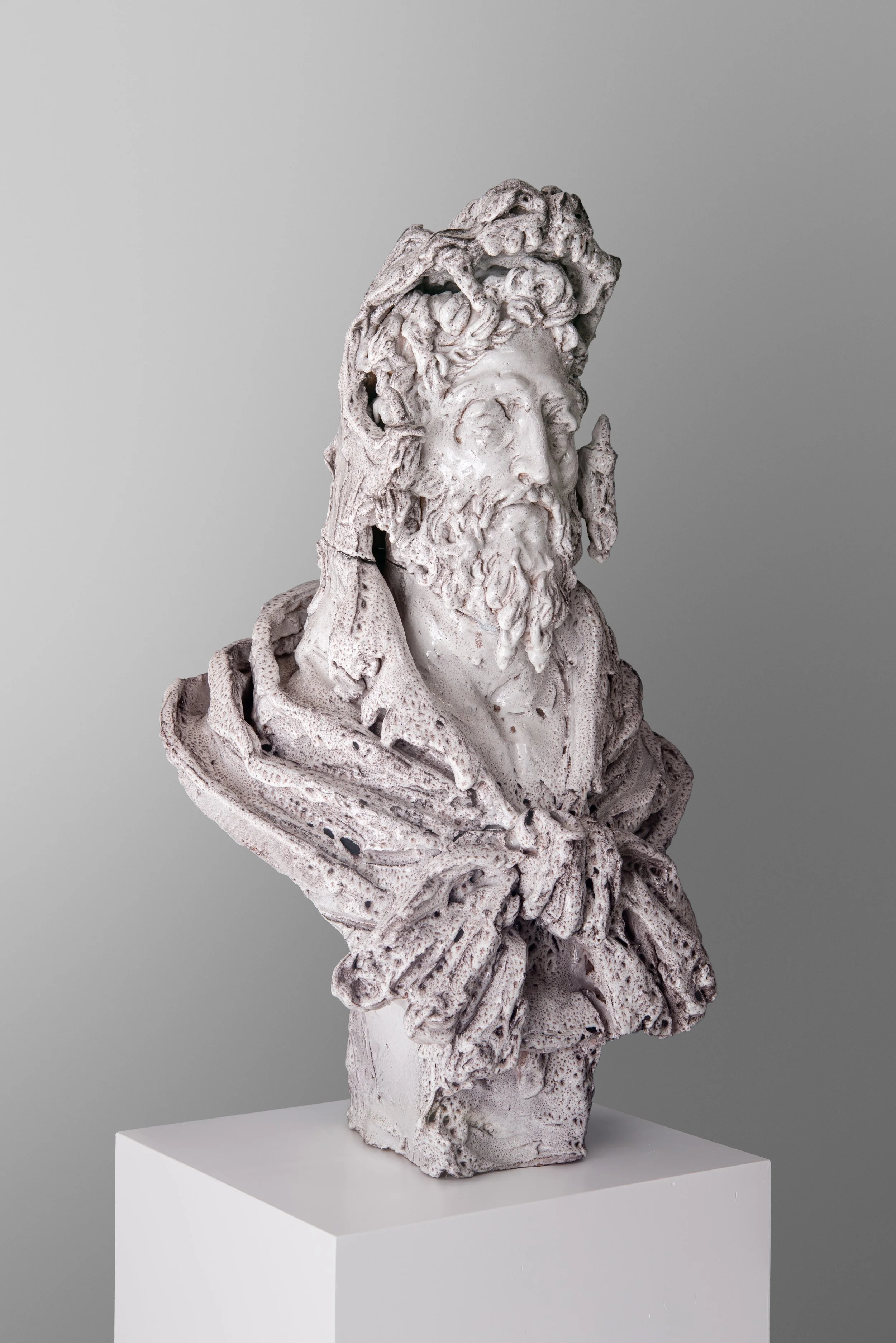
Image credit: Galleria Lorcan O’Neill.
Galleria Lorcan O’Neill: Rome, Venice
The bust reads as though it has surfaced from deep time, recently relinquished by earth rather than finished by hand. Its face carries the composure of antiquity, yet the surface resists resolution—porous, irregular, insistently in-process. Drapery falls in heavy folds, not idealised through polish but softened by erosion, as if time itself had modelled the form. There is no heroic certainty here, only material contingency. At eye level, the figure holds a quiet, suspended attention, shifting subtly with each change of light and position. The unfinished passages are not absences but invitations, drawing the viewer into co-authorship of perception. What emerges is less a monument than a state of endurance, where incompletion becomes its own fragile kind of stability.
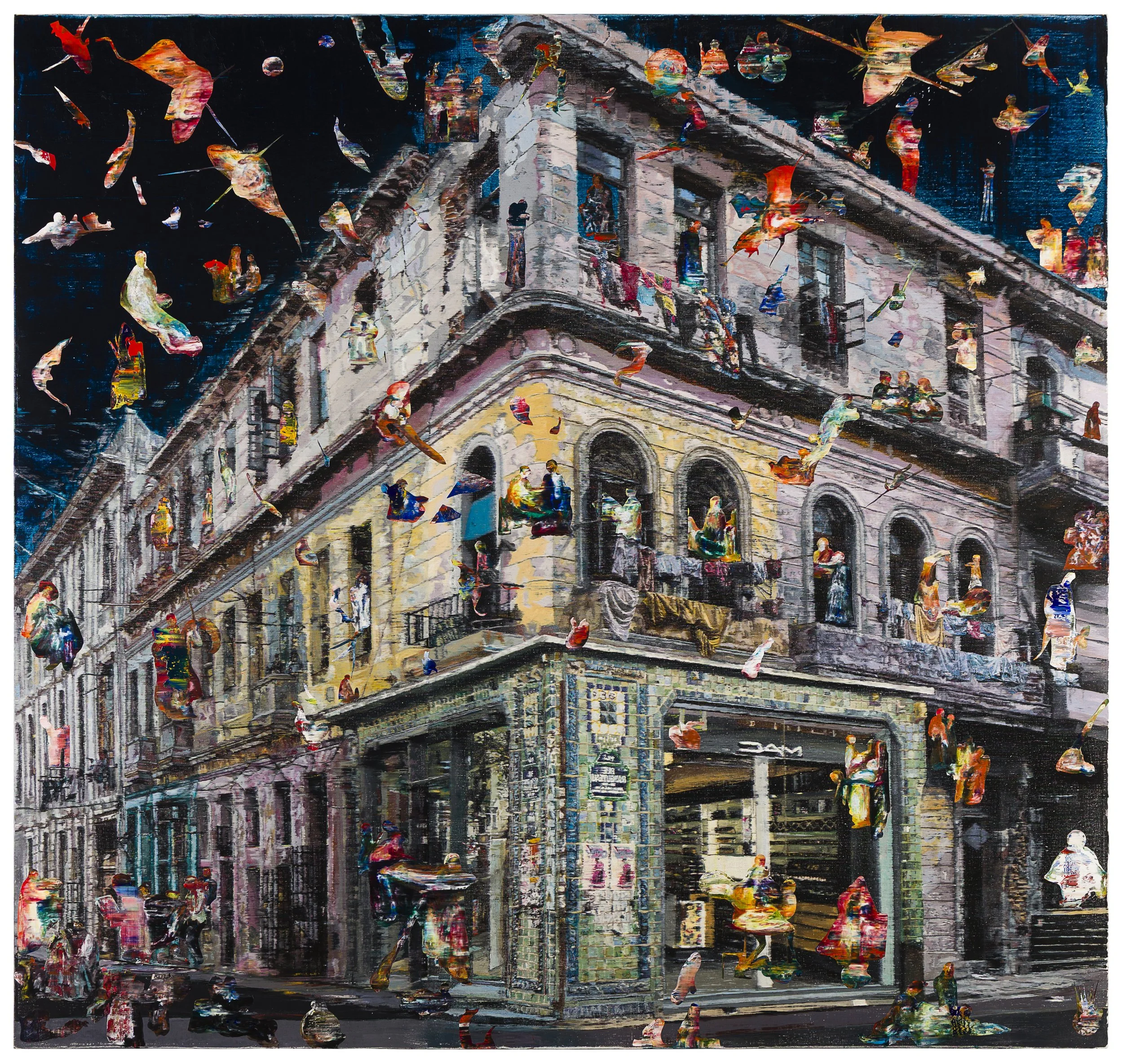
Image credit: Kiang Malingue.
Kiang Malingue: Hong Kong
In Yuan Yuan’s operatic canvas, a weathered apartment block assumes the gravity of a haunted stage set, its fractured façade holding the residue of innumerable, unrecorded lives. Decay is rendered without spectacle or pity; peeling surfaces and broken apertures are observed with an almost archival tenderness, as though the building itself were still in the process of remembering. Amid this erosion, sudden chromatic intrusions and spectral traces of presence interrupt the stillness, refusing closure. The city is not depicted as ruin so much as duration—time sedimented into matter. Yuan’s work lingers in this accumulation, where architecture becomes a vessel for persistence, and even disintegration retains a quiet, stubborn dignity.
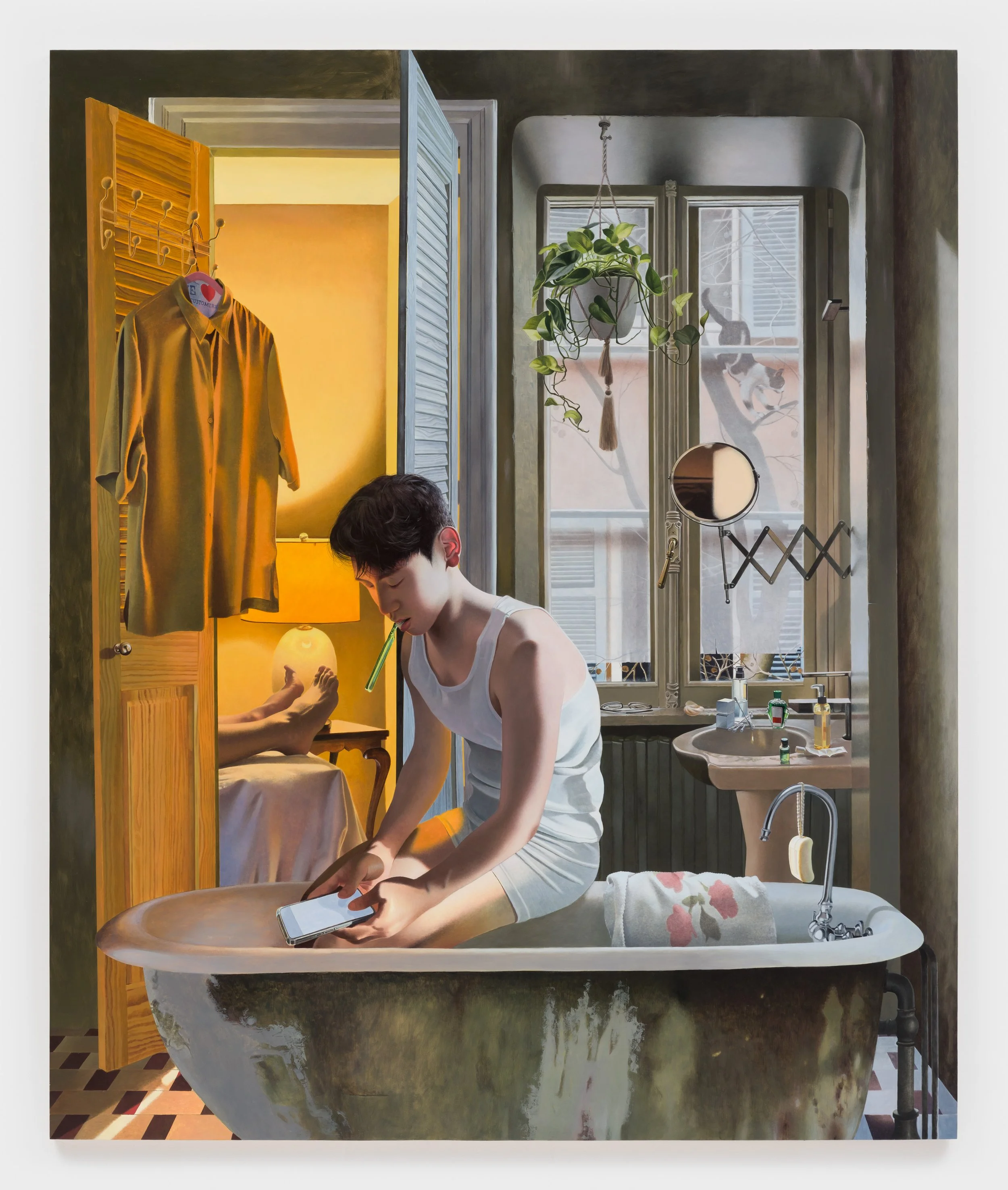
Image credit: PPOW Gallery.
P•P•O•W Gallery: New York
In Anthony Cudahy’s painting, the domestic interior is stripped of ordinariness and allowed to flicker into something quietly numinous. A dim bathroom becomes a stage for intimacy withheld from spectacle: a figure seated on the edge of a bathtub, held between the cold glow of a phone and the warmer spill of adjacent light. The chromatic tension reads almost like emotional weather—solitude tempered by proximity, distance softened by care. A partial presence in the background resists narrative clarity, instead suggesting shared existence without declaration. Cudahy’s restraint is crucial here; nothing is heightened beyond its natural pitch. What remains is a suspended hush, where looking feels less like observation than discreet participation in someone else’s fragile, ordinary grace.
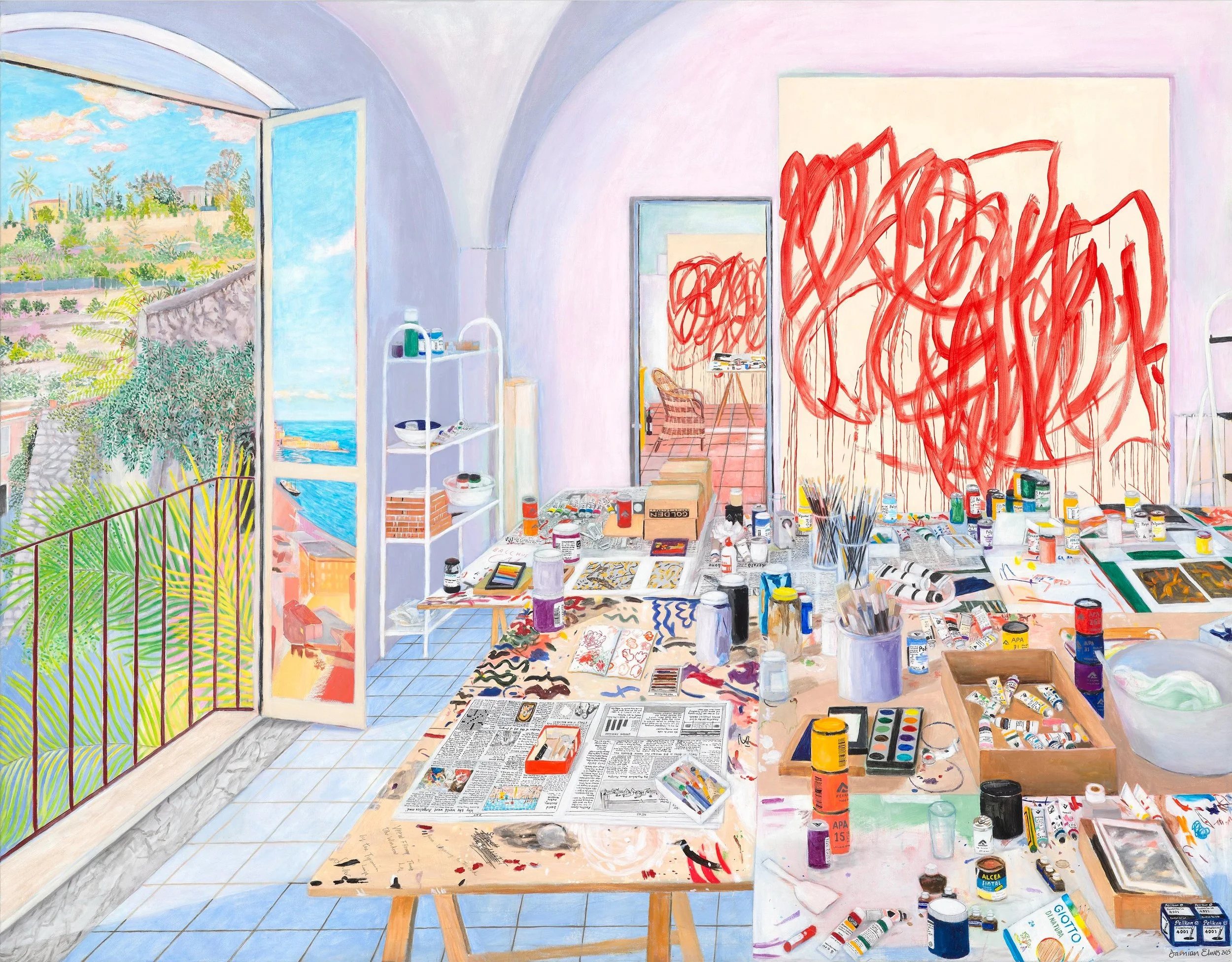
Image credit: Pearl Lam.
Pearl Lam: Hong Kong, Shanghai
Damian Elwes turns the artist’s studio into a threshold rather than a retreat, a space where making spills effortlessly into world. Tubes of paint lie scattered like afterthoughts, brushes hover in suspension, and a canvas burning with red asserts itself at the centre with an almost bodily urgency. Through an open archway, Mediterranean light floods in, collapsing the distance between interior labour and exterior vastness. Nothing is staged into sanctity; instead, the mess, the hesitation, the residue of process are allowed to remain visible. Elwes resists mythologising the studio, offering instead a lived-in intimacy where creation feels immediate, porous, and quietly shared.

Bosco Sodi, Mixed media on linen, 200 x 280 cm. Image credit: the artist and Axel Vervoordt Gallery.
Axel Vervoordt Gallery: Hong Kong, Belgium
Bosco Sodi, Mixed media on linen, 200 x 280 cm. Image credit: the artist and Axel Vervoordt Gallery. Bosco Sodi, Mixed media on linen, 200 x 280 cm. Image credit: the artist and Axel Vervoordt Gallery. Bosco Sodi, Mixed media on linen, 200 x 280 cm. Image credit: the artist and Axel Vervoordt Gallery. Bosco Sodi, Mixed media on linen, 200 x 280 cm. Image credit: the artist and Axel Vervoordt Gallery. Bosco Sodi, Mixed media on linen, 200 x 280 cm. Image credit: the artist and Axel Vervoordt Gallery. Bosco Sodi, Mixed media on linen, 200 x 280 cm. Image credit: the artist and Axel Vervoordt Gallery. Bosco Sodi, Mixed media on linen, 200 x 280 cm. Image credit: the artist and Axel Vervoordt Gallery. Bosco Sodi, Mixed media on linen, 200 x 280 cm. Image credit: the artist and Axel Vervoordt Gallery. Bosco Sodi, Mixed media on linen, 200 x 280 cm. Image credit: the artist and Axel Vervoordt Gallery. Bosco Sodi, Mixed media on linen, 200 x 280 cm. Image credit: the artist and Axel Vervoordt Gallery.Bosco Sodi, Mixed media on linen, 200 x 280 cm. Image credit: the artist and Axel Vervoordt Gallery.
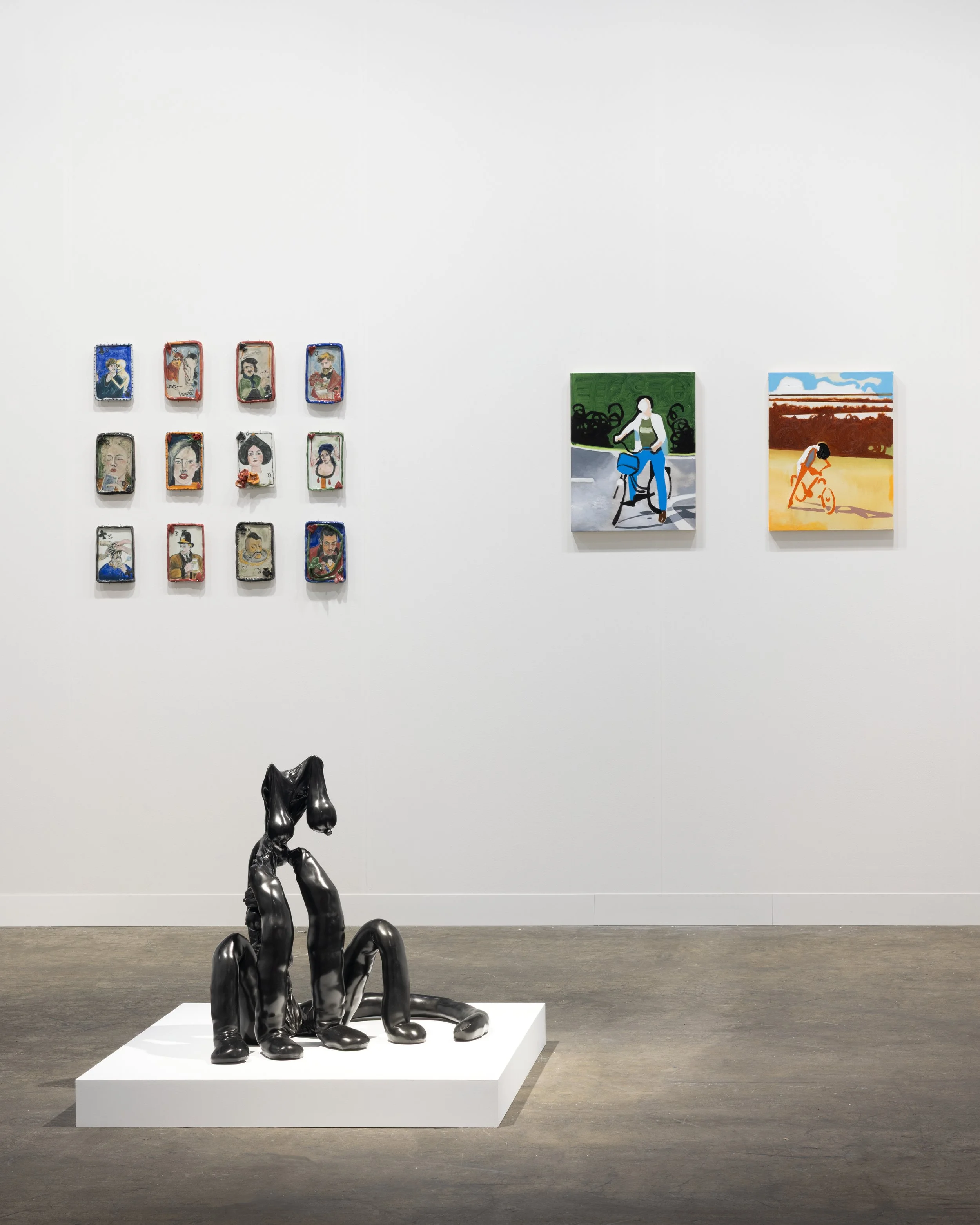
Image credit: Sadie Coles.
Sadie Coles: London
In Paloma Proudfoot’s ceramic relief, the image behaves less like illustration and more like a staged excess of feeling held in clay. A serpent threads through a crowded theatre of hearts and symbols, binding desire to a kind of orchestrated disorder. The crowned figure reads as both icon and fragment, caught somewhere between myth and performance. Proudfoot refuses polish; instead, she lets distortion, humour, and abrasion remain visibly active on the surface. What emerges is a tactile fable where meaning is not resolved but continually staged, undone, and reassembled.

Image credit: Silverlens.
Silverlens: New York, Manila
Bernardo Pacquing renders industrial collapse with an unexpected restraint, as though ruin itself has been slowed to a contemplative register. A spindle-like form pierces the surface, releasing dense, cemented flows that descend with deliberate inevitability—at once forceful and controlled. Against a muted, parchment field, a sudden flare of canary yellow interrupts the austerity like a warning that refuses to fully declare itself. The language of construction and decay is never resolved; instead, it is held in suspension. Pacquing’s work dwells in this in-between state, where fracture becomes a form of endurance and erosion acquires an austere, almost reluctant grace.
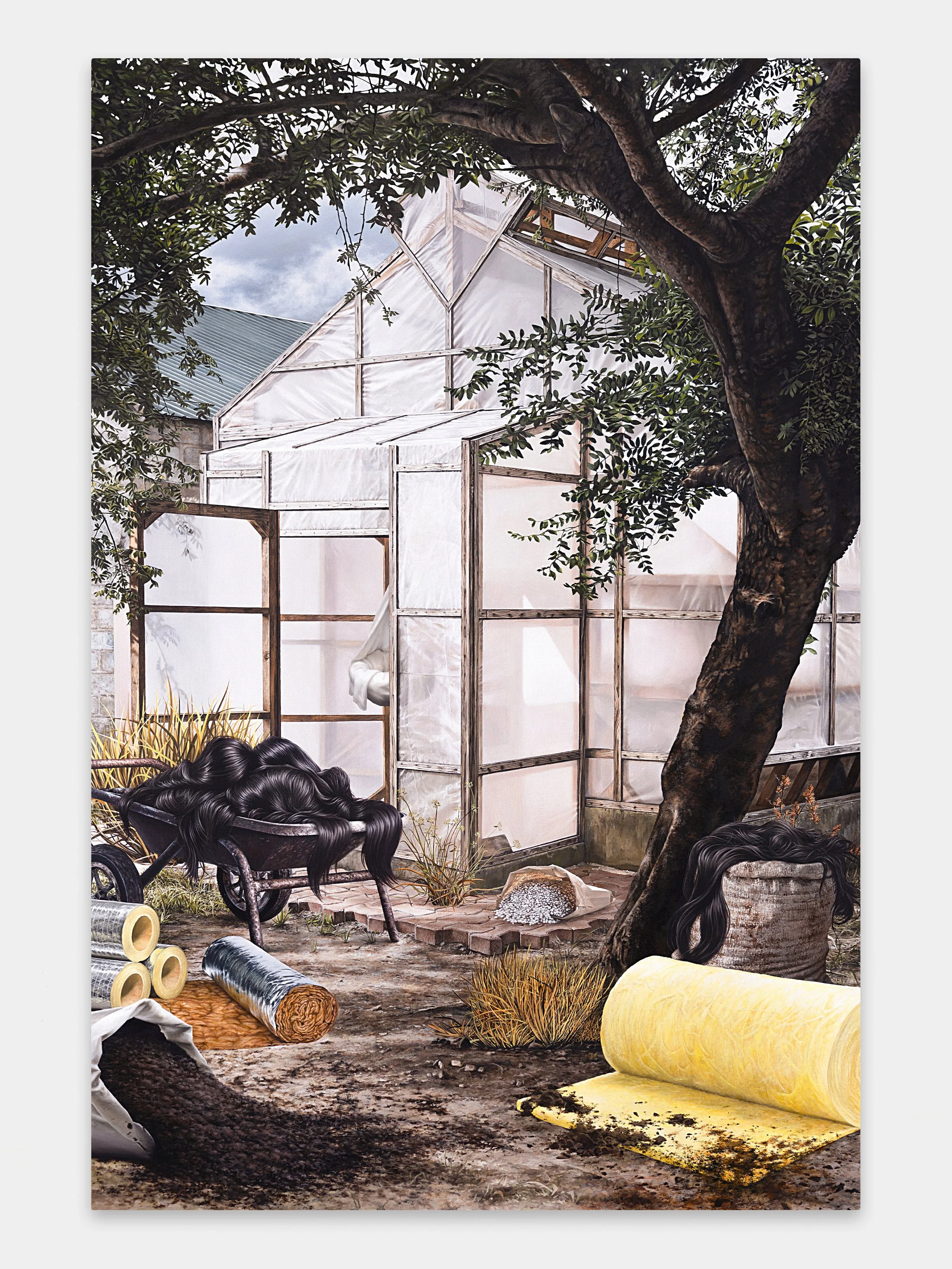
Image credit: Gallery Vacancy.
Gallery Vacancy: Shanghai
Zhiwei Pan turns a rural tableau into something faintly disquieting, as if the pastoral has been quietly rerouted into dream logic. A greenhouse glows like a stranded lantern, while beneath it wheelbarrows brim not with produce but with human hair—an uncanny crop of bodily residue. The effect is both seductively composed and materially unsettling, a tension between cultivation and discard. A lone tree stands in crisp articulation, less botanical detail than witness, holding the scene in a state of suspended charge. Pan’s painting lingers in this ambiguity, where vacancy is never empty but quietly, insistently alive.
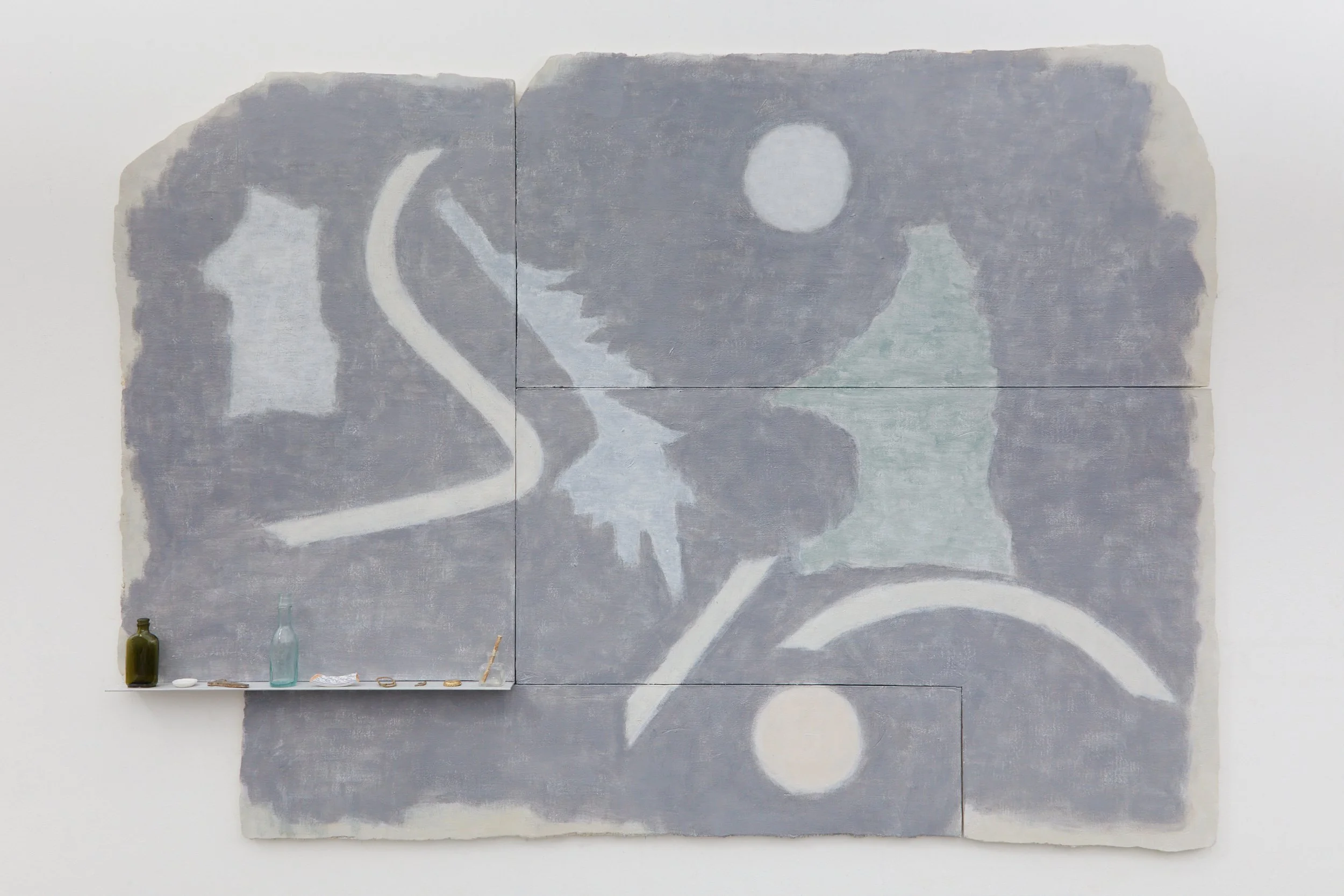
Image credit: Yutaka Kitutake Gallery.
Yutaka Kikutake Gallery: Tokyo
Kenjiro Okazaki renders the everyday slightly unmoored, as if it has slipped into a slower cosmological register. Across a subdued grey field, forms hover—moonlike, fragmentary, half-thought—balanced between image and cognition. Beneath this suspended space, a narrow ledge of modest vessels and objects quietly reasserts the material world, as if insisting on gravity. The tension between these registers is deliberate but unforced: perception is asked to oscillate rather than resolve. What emerges is less an image than a provisional habitat for looking, where thought moves at the pace of silence.
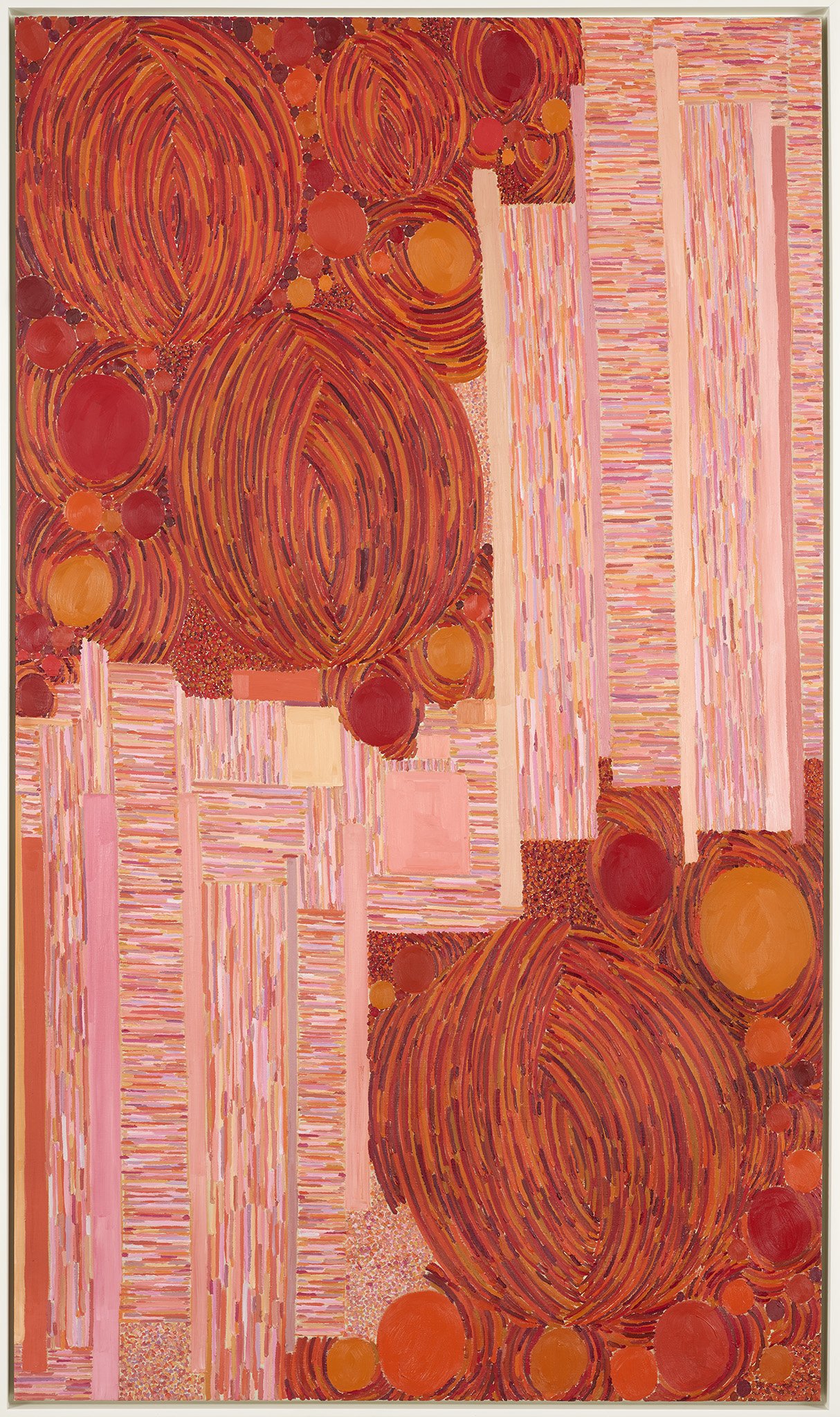
Image credit: Berry Campbell.
Berry Campbell: New York
In Lynne Drexler’s paintings, colour ceases to describe and begins to inhabit. Built from innumerable strokes of ochre, coral, sienna and apricot, her canvases pulse with an internal rhythm that feels less composed than grown. Forms never fully settle; they gather, dissolve and re-emerge within fields of light and colour. While indebted to the freedoms of Abstract Expressionism, Drexler rejects its grand gestures in favour of something quieter and more enduring. Her paintings unfold like weather systems or geological formations, accumulating slowly across the surface. One does not simply look at these works; one enters them, surrendering to a space where repetition becomes cadence and colour becomes atmosphere.
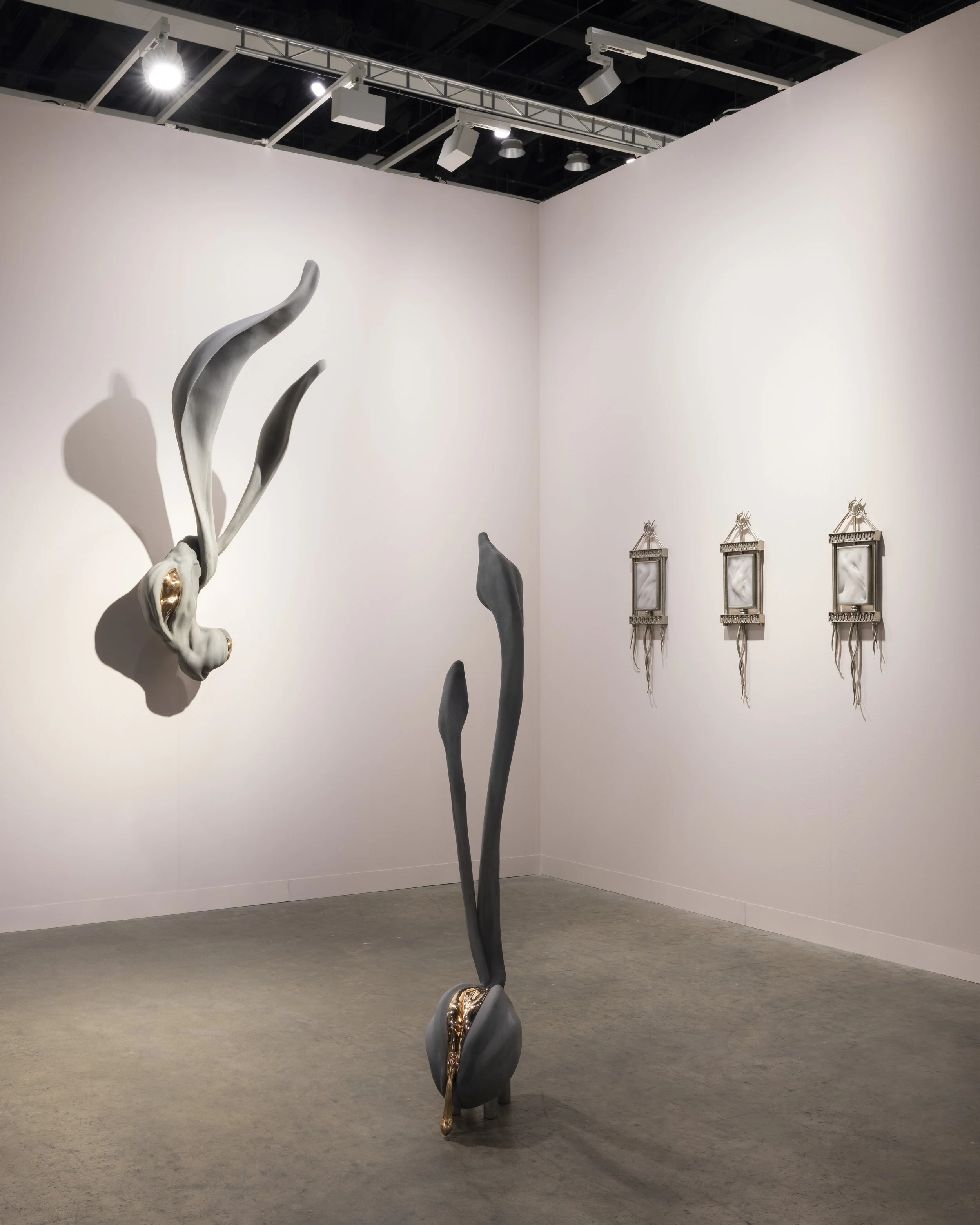
Image credit: Francesca Minini.
Francesca Minini: Milan
Born in Belgrade and based in New York, Ivana Bašić has forged a sculptural practice shaped by displacement, transformation, and the instability of being. Emerging from the psychic wreckage of post-Yugoslav collapse, her works inhabit a threshold where body, matter, and consciousness appear perpetually unfinished. Working across glass, wax, bronze, stone, and steel, Bašić constructs forms suspended between dissolution and transcendence. In Fantasy Vanishes in Flesh, celestial and corporeal forces converge in an unsettling vision of metamorphosis, where material presence seems to edge towards the immaterial.