

What Holds Us, Antony Gormley
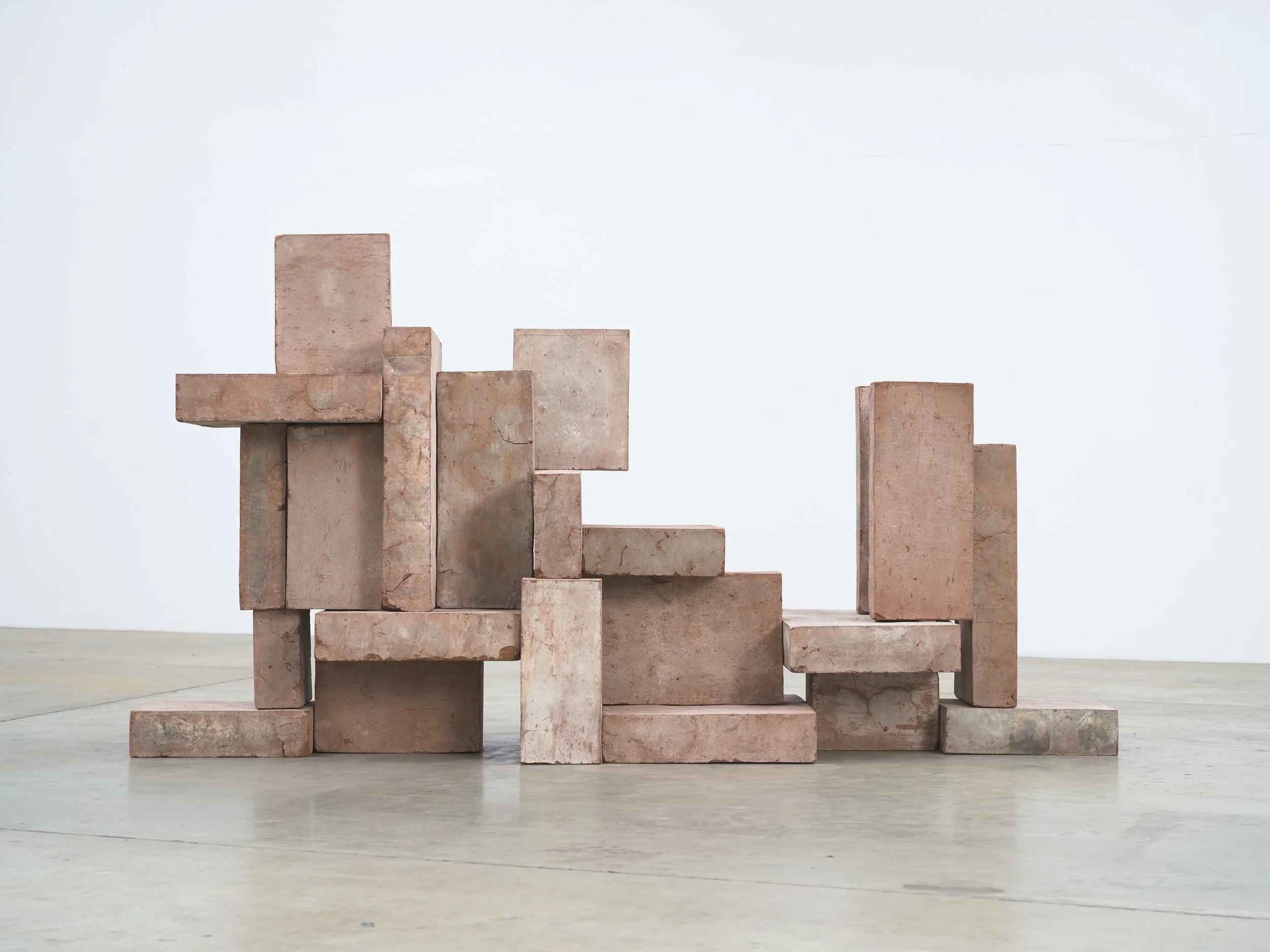
There is something almost monastic about encountering What Holds Us by Antony Gormley. The works wait—still, patient, suspended somewhere between architecture and the body, between gravity and breath.
At GALLERIA CONTINUA in San Gimignano, the exhibition unfolds not simply as a presentation of sculpture, but as an immersive meditation on the fragile architecture of contemporary life. Occupying the gallery’s historic spaces, Gormley transforms the building into a living organism—one that asks what sustains us physically, emotionally, spiritually, and collectively in an increasingly unstable world.
For decades, Gormley has returned obsessively to a single question: what does it mean to inhabit a body in space? His sculptures have never treated the body as portraiture, but rather as a vessel—a measure of vulnerability, memory, solitude, weight, and presence. In What Holds Us, that long-standing inquiry expands outward into the city itself. The exhibition examines our condition as urban animals through a striking dialogue of materials, moving from primordial stone and clay to industrial concrete and iron, before culminating in perhaps the most universal and insubstantial medium of all: cardboard.
At the centre of the exhibition lies Innercity (2026), a monumental site-specific installation that completely occupies the gallery’s central theatre space. Fifteen towering body-buildings constructed from cardboard rise like a temporary metropolis. Together, they form an urban labyrinth through which visitors must navigate carefully, moving between narrow corridors, open thresholds, and sealed chambers. Some structures deny entry entirely; others seem to invite the viewer inward.
Here, Gormley reinvents anatomy through the language of architecture.
The effect is at once playful and deeply unsettling. These looming cardboard structures resemble apartment towers, shelters, ruins, and bodies simultaneously — as though the modern city itself has become an extension of human vulnerability. The choice of cardboard is deliberate and quietly political. Ephemeral and disposable, it is the same material through which billions of packages circulate globally every year. Through it, Gormley gestures toward the precariousness of contemporary systems of consumption, labour, and domestic life. The “city” we inhabit begins to feel far less permanent than we imagine.
And yet, within this fragility, there is tenderness.
The setting of San Gimignano intensifies this tension. With its medieval towers rising dreamlike against the Tuscan landscape, the city has long embodied ideas of permanence, refuge, and civic identity. Gormley responds to that history not by replicating it, but by destabilising it. His cardboard metropolis becomes a temporary echo of those stone towers: softer, collapsible, transient. A city held together not by certainty, but by collective faith.
Throughout the exhibition, Gormley activates the entire architecture of the gallery, inside and out. At the entrance, basalt Blockworks establish an immediate tension between balance and collapse. Built through acts of stacking, the sculptures depend upon the fourteenth-century walls for support, reversing the traditional logic of the caryatid. Rather than carrying architecture, the sculptures themselves are carried by it. The result is a profound sense of interdependence — sculpture, building, and viewer existing within the same precarious equilibrium.
Elsewhere, the monumental terracotta Slabworks introduce another emotional register: intimacy. Constructed from stacked deadweight, the twice life-size forms appear to lean into one another like bodies attempting to remain upright together. They resemble houses of cards on the verge of collapse, yet they also suggest tenderness, companionship, and the quiet necessity of support.
A concrete Bunker, Skew II (2026), occupies the remains of a collapsed tower. A dark opening positioned at the mouth offers a glimpse into its shadowed interior, transforming the sculpture into something simultaneously bodily and architectural, protective and claustrophobic. Across the labyrinth, life-size and half-scale works in concrete, stone, terracotta, and iron continue Gormley’s enduring exploration of mass and void, enclosure and openness, presence and absence.
Even the drawings within the exhibition seem to breathe with this same tension. Recent works on paper explore thresholds, apertures, and passages between darkness and light — moments of transition that mirror the physical experience of moving through the labyrinth itself.
What makes What Holds Us so affecting is its refusal of excess. There is no theatrical flourish, no imposed narrative resolution. Instead, the exhibition unfolds as a sequence of encounters: confrontation giving way to exploration, uncertainty opening into reflection. Gormley trusts the viewer to bring their own interior world into the experience.
Walking through the exhibition, one becomes acutely aware of one’s own body — the rhythm of footsteps, the sensation of balance, the tension between solidity and collapse. Air circulates through the structures; light fractures across surfaces; emptiness itself becomes tangible. The sculptures seem less like objects occupying space than presences listening to it. Gormley transforms volume into emotion. The spaces inside the works begin to echo the spaces within ourselves.
In many ways, What Holds Us feels especially resonant now, in an era defined by fragmentation and acceleration. Gormley slows perception down. He reminds us that the body remains our first architecture: fragile, temporary, vulnerable, yet profoundly capable of connection.
The title itself ultimately lingers as a philosophical question disguised as a statement. What holds us together as individuals, communities, and cities? Memory? Love? Habit? Fear? Faith? Endurance?
Gormley leaves the answer unresolved — suspended somewhere between stone and cardboard, permanence and collapse, body and shelter. In his world, even the most monumental structures appear vulnerable. Yet within that vulnerability lies the possibility of connection: a reminder that perhaps what truly holds us is not solidity, but our shared capacity to endure together.