

Kyoto recalibrates time the way an old-school clockmaker resets his watch: patiently. One may arrive planning in bullet points and a bucket list—sites to tick off, trains to catch, photographs to take before the light tilts, but Kyoto automatically slows you down. Pavements narrow; corners bend; a wooden gate interrupts your hurry.
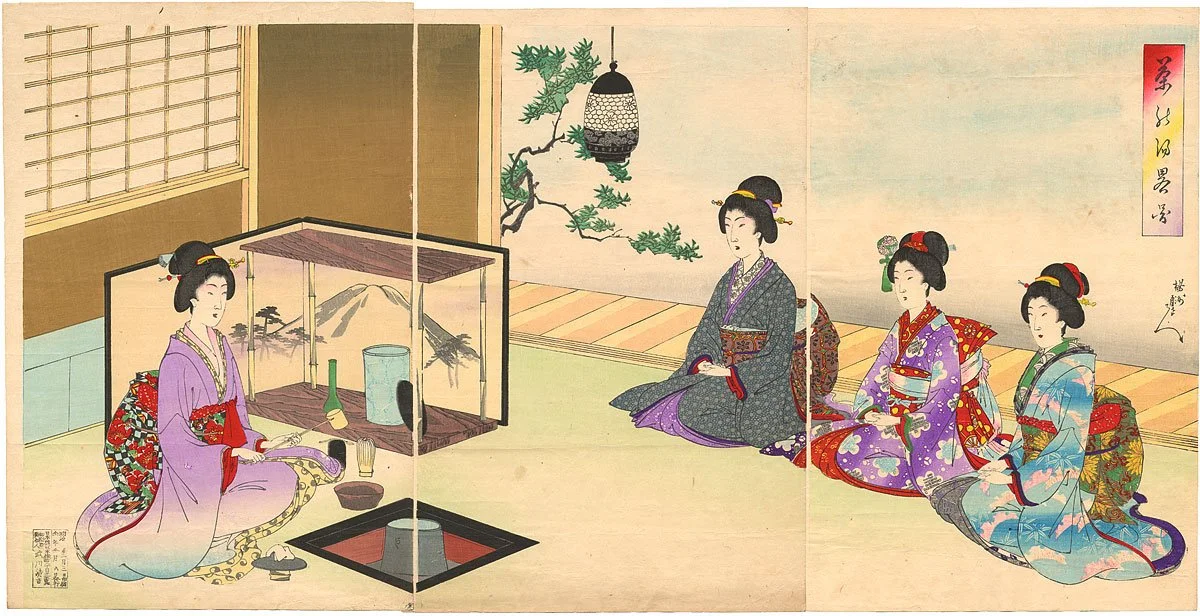
A traditional Japanese tea ceremony known as Chadō or Chanoyu. Image credit: Arts and Designs Japan.
There are the expected spectacles: geishas moving through Gion at dusk, silk slipping into shadow; maple leaves falling across stone paths worn smooth by generations of footsteps. But the picture changes when one stays longer. The city’s character begins to reveal itself in smaller sounds and gestures: water poured into a cast-iron kettle, releasing a low, hollow note; bamboo brushing against clay with a dry, intimate rasp; steam lifting from a porcelain bowl as familiar movements are repeated with quiet precision. This is where Kyoto’s story becomes more interesting—not in matcha tiramisu arranged on cafe counters, or cups styled for photographs, but in the ways the city actually drinks its tea. There is morning sencha poured at kitchen tables, a neighbour stopping at a century-old shop for a paper packet of roasted hojicha, and the measured choreography of the tea room, where matcha is prepared with an attention that borders on ritual. Here, tea is not a trend or an accessory to the city’s aesthetic; it is part of its daily grammar, passed from hand to hand and generation to generation.
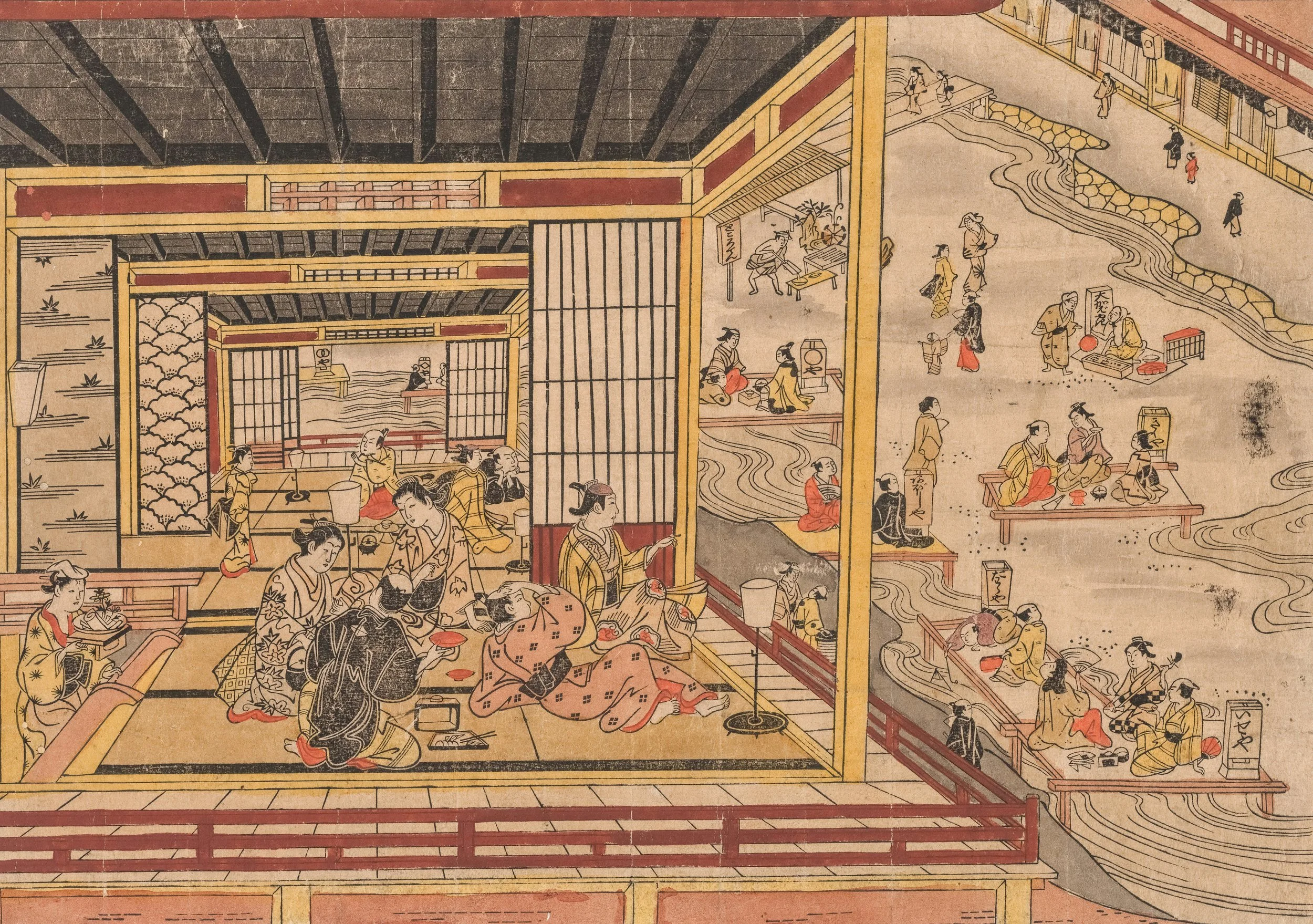
Tea house near the Kamo River (1740s), Edo period, woodblock print by Nishimura Shigenaga, JH Wade Collection. Image credit: The Cleveland Museum of Art, Unsplash.
A Tea-Time Story
The story of Japanese tea begins with a monk and a long journey home. After years abroad, Myōan Eisai returned to Japan carrying something small in size but immense in consequence: tea seeds. Tea had entered Japan centuries earlier through monks such as Kūkai and Saichō, who brought it back from China, but Eisai helped establish its cultivation and popularise its use, particularly around Uji, south of Kyoto. Kyoto in those centuries was repeatedly scarred by fire, famine, disease and political upheaval. Against this unsettled backdrop, tea offered something more than refreshment. Eisai wrote of its medicinal properties and saw in its disciplined preparation a way of bringing steadiness to both body and mind. He planted tea seeds, and cultivation took root. From there, tea moved steadily beyond the monastery. It entered aristocratic and warrior circles, where drinking it became an occasion for display, connoisseurship and ceremony. Leaves were assessed, origins discussed and utensils prized; tea acquired an elaborate social language of its own. Over time, however, another sensibility emerged—one that would strip away much of this ornament and find value in restraint, simplicity and the attention of preparing a bowl.
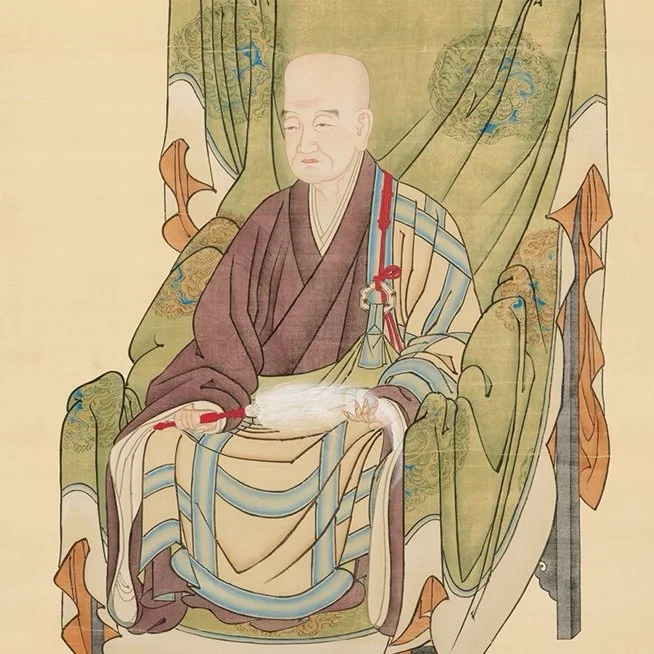
Myōan Eisai, famed for his pivotal role in introducing and popularising Zen Buddhism and tea culture in Japan.
Image credit: Eisa Tea Co.
Centuries later, as the age of war hardened into the pageantry of rule, Sen no Rikyū surveyed the shimmer and chose restraint. He had moved within the orbit of power—first under Oda Nobunaga, then Toyotomi Hideyoshi—where tea had become currency, displayed in gold rooms and measured by the rarity of Chinese bowls. His answer was not denunciation but reduction. He lowered the teahouse ceiling so that even the mighty must incline their heads. He narrowed the entrance to a humble crawl, asking swords and status to remain outside. He turned from porcelain brilliance to the rough Korean bowl, from lacquered sheen to clay that bore the memory of the kiln. From his practice emerged wabi-cha: not austerity for its own sake, but a discipline of attention; not the rejection of beauty, but its distillation. In a room scarcely larger than four and a half tatami mats, tea shed its brocade and found its meaning again. Water murmured in the iron kettle. Powder met whisk. Steam lifted and disappeared. Each gesture, pared to its essence, gathered gravity. What remained was not spectacle but presence. Tea, unadorned, resumed—in the grain of clay, in the pause between movements, in time allowed to lengthen and deepen.
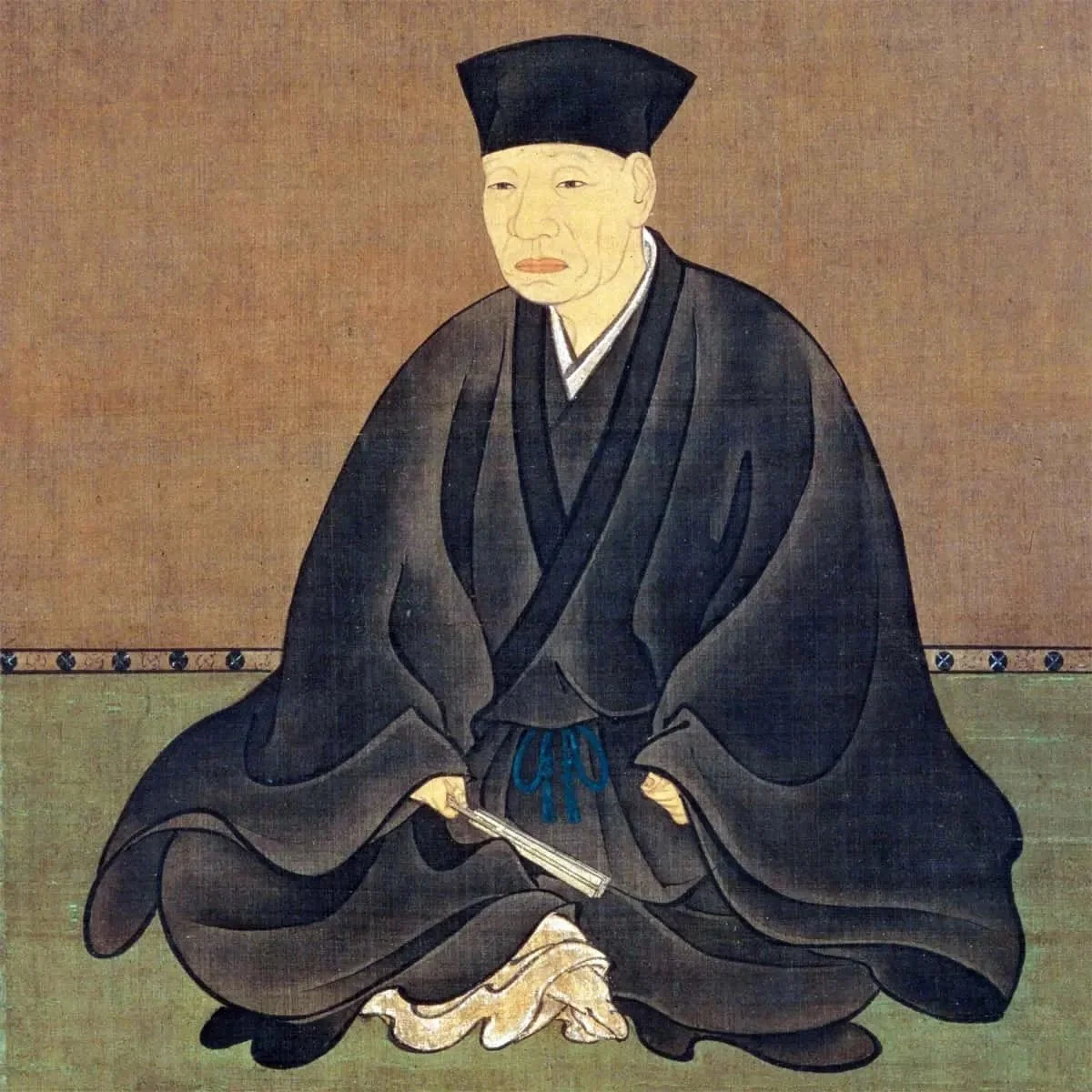
Sen no Rikyū defined the Japanese tea ceremony through radical simplicity and wabi-sabi aesthetics.
Image credit: Osaka.com.
What Rikyū refined within a few tatami mats, Uji sustains on a far wider canvas. The philosophy contracts the gesture; the landscape expands it. South of Kyoto, the hills fold into terraces of camellia sinensis, their order almost monastic. In spring the bushes are draped with woven screens, tempering the light to a muted green dusk. Shade alters the leaf’s chemistry: chlorophyll thickens, sweetness rises, bitterness recedes. The fields take on a saturated brilliance, as if colour itself has been steeped and concentrated.
From this husbandry comes Uji matcha, long held as the measure of excellence. The youngest leaves are plucked, briefly steamed to halt oxidation, dried, and then turned slowly between granite stones until they become powder fine enough to cling to air. Whisked into hot water, it yields a suspension at once vegetal and luminous—a green so dense it seems almost architectural.
Along the approach to Byōdō-in, tea completes its circle. Byōdō-in Omotesandō gathers centuries into its shopfronts: family-run chaya where bowls are set down with practised quiet. The matcha rests in black lacquer, its surface holding a soft sheen. Beside it, wagashi arrive in seasonal forms—plum blossom, iris, maple leaf—fleeting emblems shaped from bean paste and sugar. Field becomes powder, powder becomes bowl, and the bowl returns, once more, to stillness.
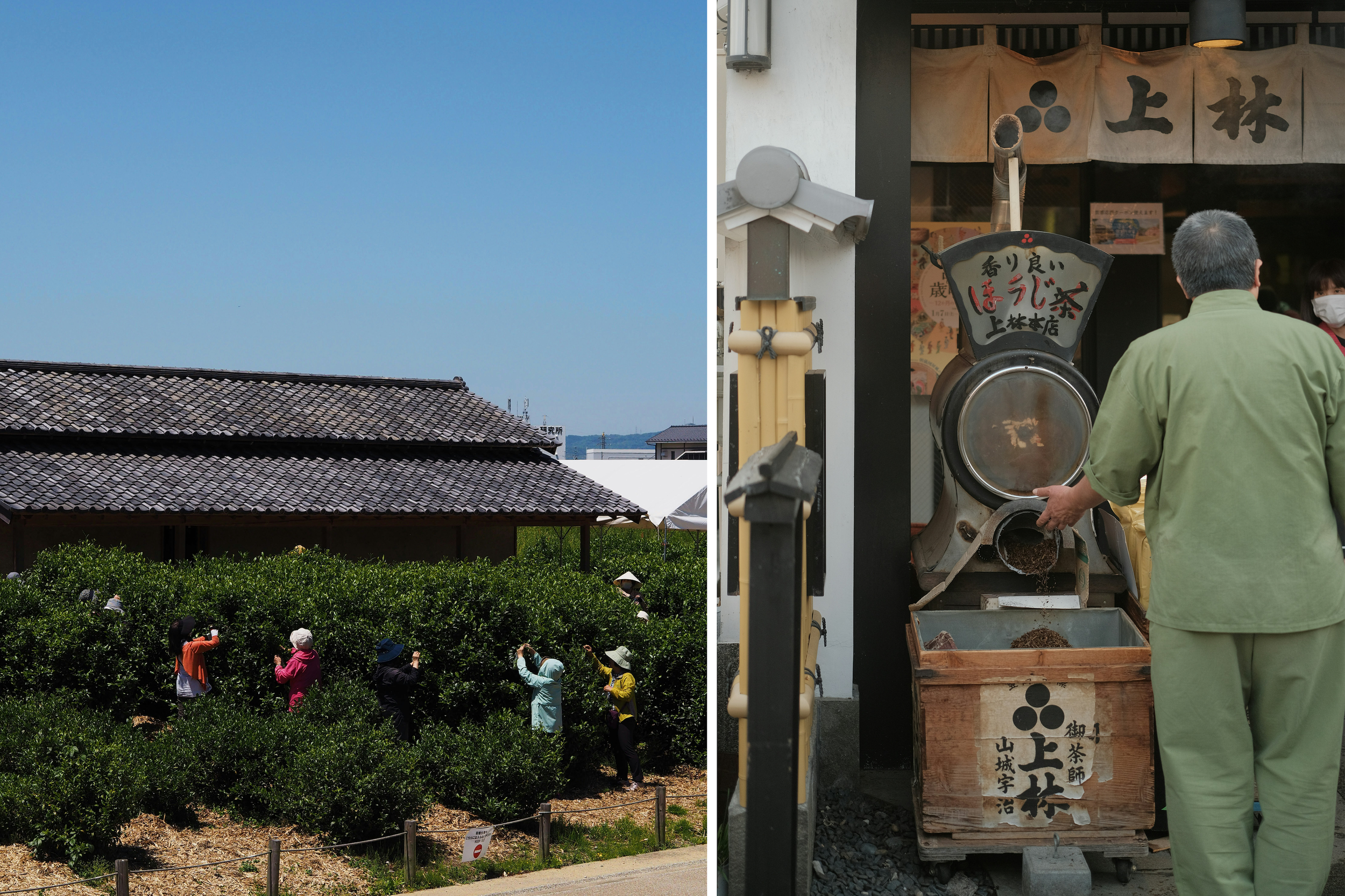
Tea plantation in Uji, and a man with a wooden box of hōjicha. Image credits: Chloé Lefleur and Perry Merrity II, Unsplash.
Yet Kyoto is not preserved in amber. The city that guards ceremony also permits reinvention.
At Ippodo, trading for more than three centuries, cedar counters glow with the sheen of long handling. The staff move with unhurried assurance, guiding visitors through gyokuro, sencha, and hojicha as though conducting a tasting rather than a lesson. Gyokuro, shaded like the leaves of Uji, is brewed at a temperature so low it feels counterintuitive; the liquor arrives thick, almost brothy, pooling on the tongue with a sustained, marine sweetness—umami drawn out to its fullest register.
Across the river, in a renovated machiya townhouse, Saryo Suisen pares the ritual back to line and light. There is no tokonoma, no tatami geometry—only whitewashed walls and glass teapots catching a muted glow. Tea is handled with near-clinical precision, each infusion measured, each pour exact. If Rikyū sought essence through shadow and clay, this is essence rendered in glass and air.
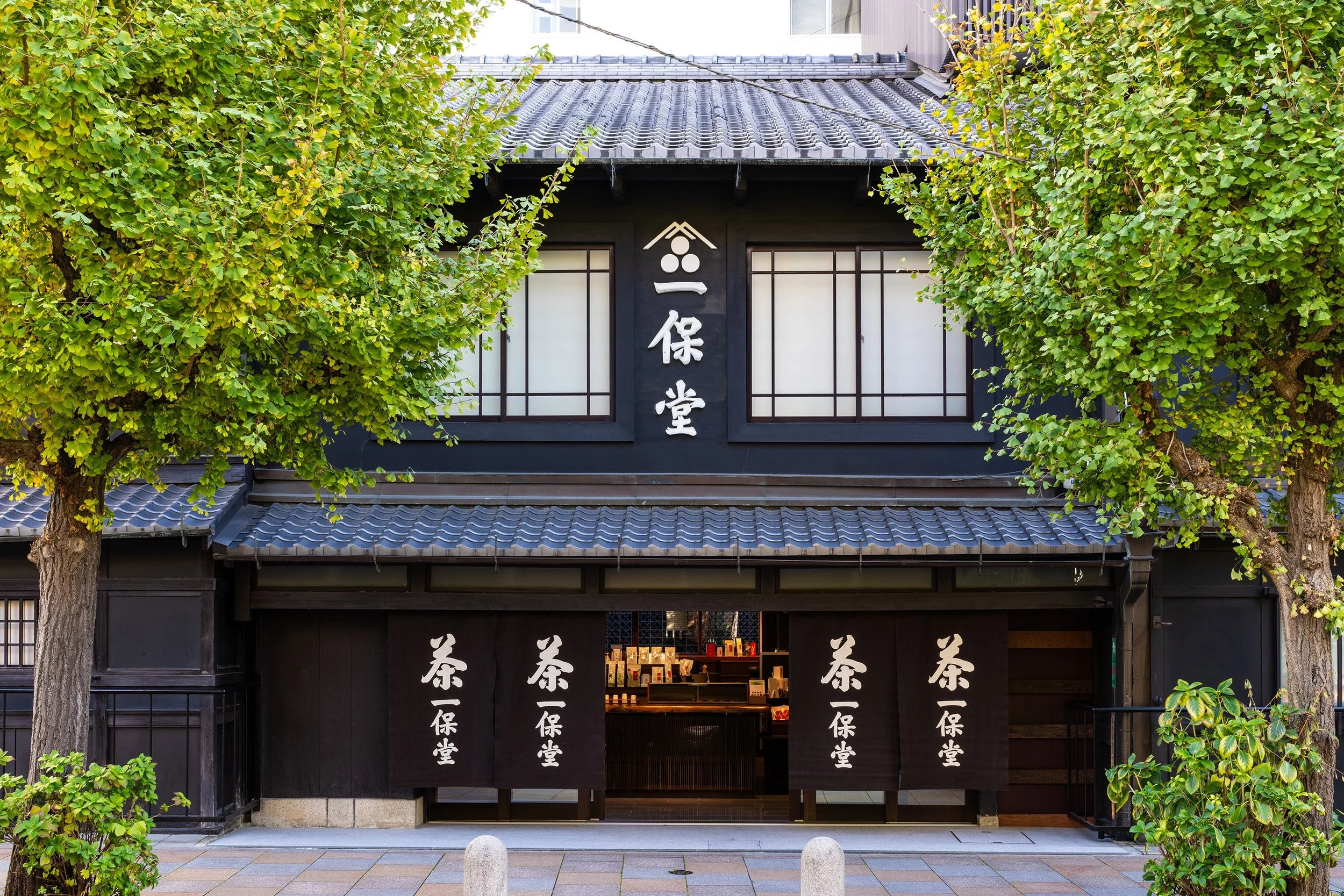
Ippodo, Kyoto. Image credit: Ippodo.
In 1860, in the tea-growing heartlands of Kyoto, Riemon Tsuji founded what would become TSUJIRI. He was guided by a principle he called YUWA—to continue innovating while sustaining tradition. It was not an abstract motto but a working creed. Tsuji refined the cultivation of gyokuro, the most prized grade of Japanese green tea, developing shading techniques that coaxed out its sweetness and depth, methods that endure to this day. He also designed a tea chest that preserved freshness during transport, allowing Kyoto’s delicate leaves to reach distant cities at a time when such journeys risked dulling their character. In recognition of his contributions to Japan’s tea industry, a statue was later erected in his honour in Kyoto.
More than a century later, that same pioneering spirit travelled beyond Japan. In 2010, TSUJIRI CHAHO—chaho meaning tea shop—opened its first overseas outpost, becoming one of the earliest traditional Japanese tea houses to expand internationally. It carried the flavours of Kyoto and Yame into new cities, yet its purpose stayed constant: to serve fresh, carefully prepared tea and let tradition evolve rather than stand still.
Long before refrigeration and airtight packaging, freshness depended on ingenuity. In Uji, Tsuji faced a problem: the finest shaded leaves lost their brilliance to heat, humidity and distance. His answer was the Chabitsu—a wooden cabinet designed to stabilise temperature and moisture. With it, fresh Uji tea could travel far from its birthplace, arriving fragrant and intact, and Japanese tea culture could journey with it.
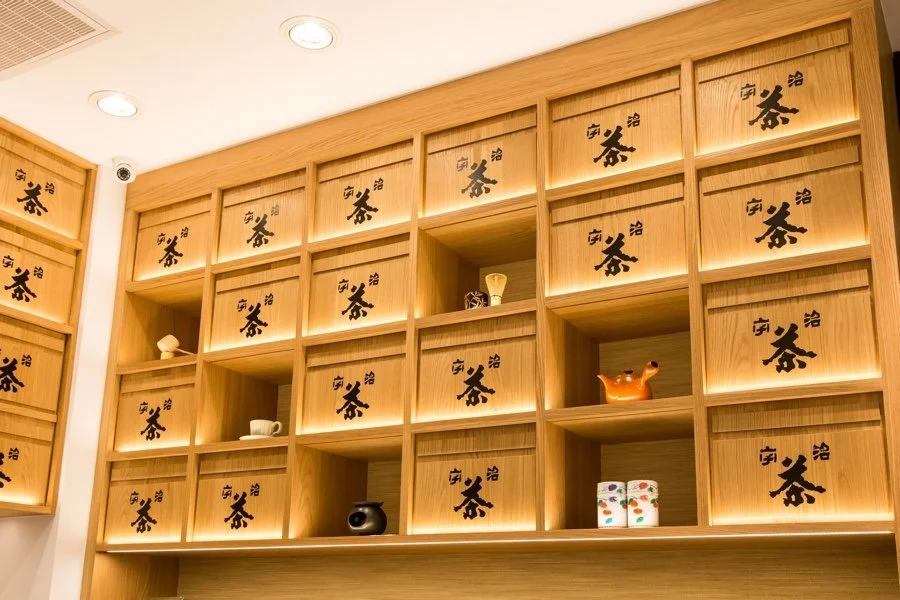
Tea Box (Chabitsu). Image credit: TSUJIRI.
To drink tea in Kyoto is to understand the city’s essence: its patience, its refinement, its refusal to rush. You do not find it in a frappe, thick with syrup and foam. You find it in the hush of a tearoom at Camellia, in the silence of MAIKOYA at dawn, in the luminous green of Uji fields at springtime. You hold the bowl in both hands, feel its warmth seep into your palms, raise it to your lips, and drink. In that sip, you taste not just tea, but a thousand years of Kyoto—distilled into a single, fleeting moment.
Kyoto’s contradictions only deepen its devotion. Teenagers may sip bubble tea in Nishiki Market, but at home, their grandparents pour bancha into chipped porcelain cups, the kind that outlast generations. Salarymen buy canned green tea from vending machines on their commute, but on weekends, some kneel in small tatami rooms at workshops, rediscovering the art of the whisk. The city may play with trends, but it always returns to the bowl.
Japanese terminology
Bancha
A later-harvest Japanese green tea; everyday, robust, slightly more astringent.
Camellia sinensis
The botanical name of the tea plant.
Chabitsu
Traditional wooden tea chest designed to preserve freshness.
Chaho
Japanese for “tea shop.”
Chaya
Traditional Japanese teahouse.
Gyokuro
Premium shaded Japanese green tea known for sweetness and umami.
Hojicha
Roasted Japanese green tea with a warm, toasty aroma.
Machiya
Traditional wooden townhouse found in Kyoto.
Matcha
Finely ground powdered green tea used in tea ceremony.
Sencha
Common Japanese green tea brewed from whole leaves.
Tatami
Traditional woven straw floor mats used in Japanese interiors.
Tokonoma
Recessed alcove in a Japanese room for art or seasonal display.
Umami
The savoury “fifth taste,” associated with depth and brothy richness.
Wagashi
Traditional Japanese sweets served with tea.
Wabi-cha
The austere, rustic style of Japanese tea practice centred on humility and simplicity.
Wabi-sabi
The broader Japanese aesthetic philosophy that finds beauty in imperfection.