

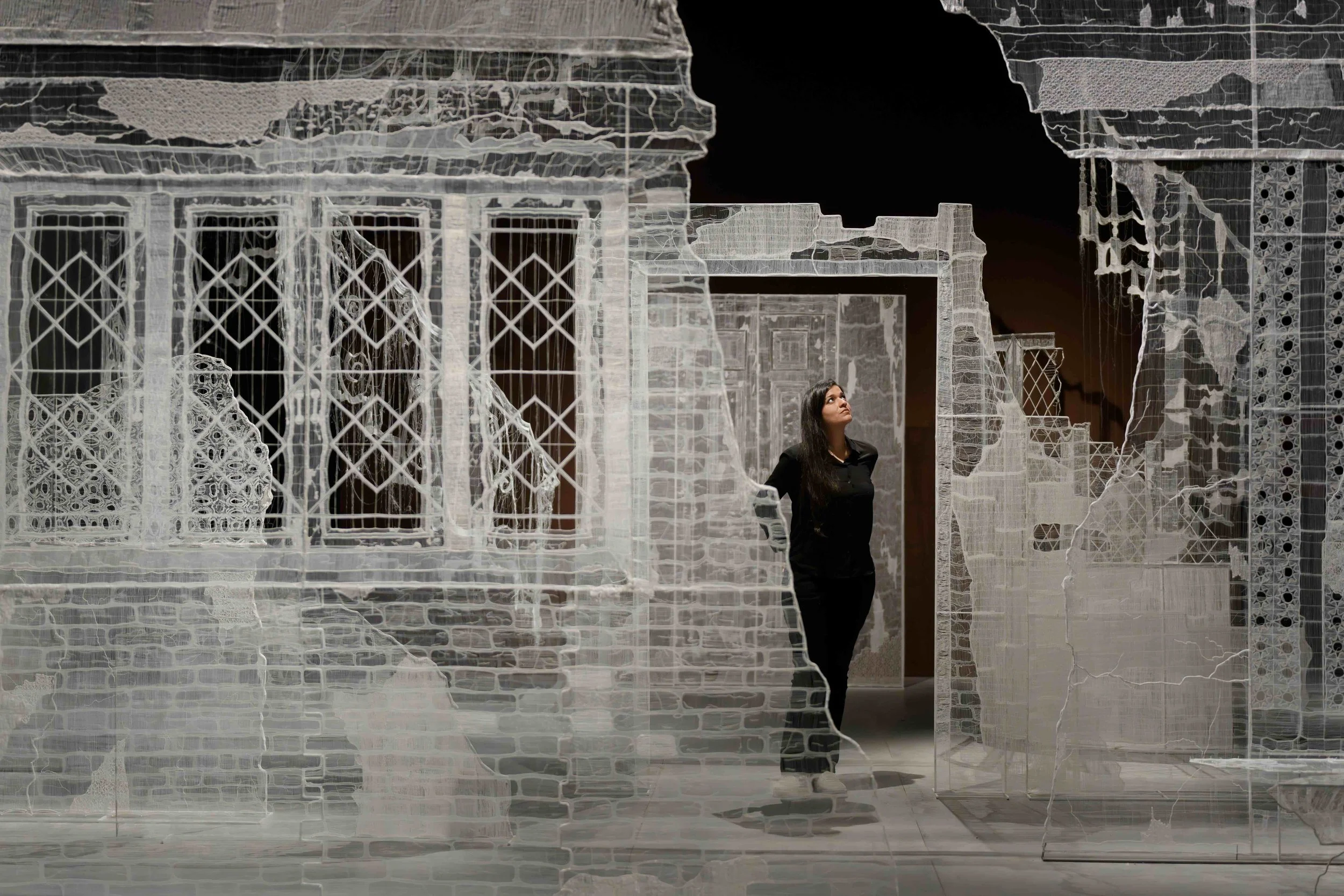
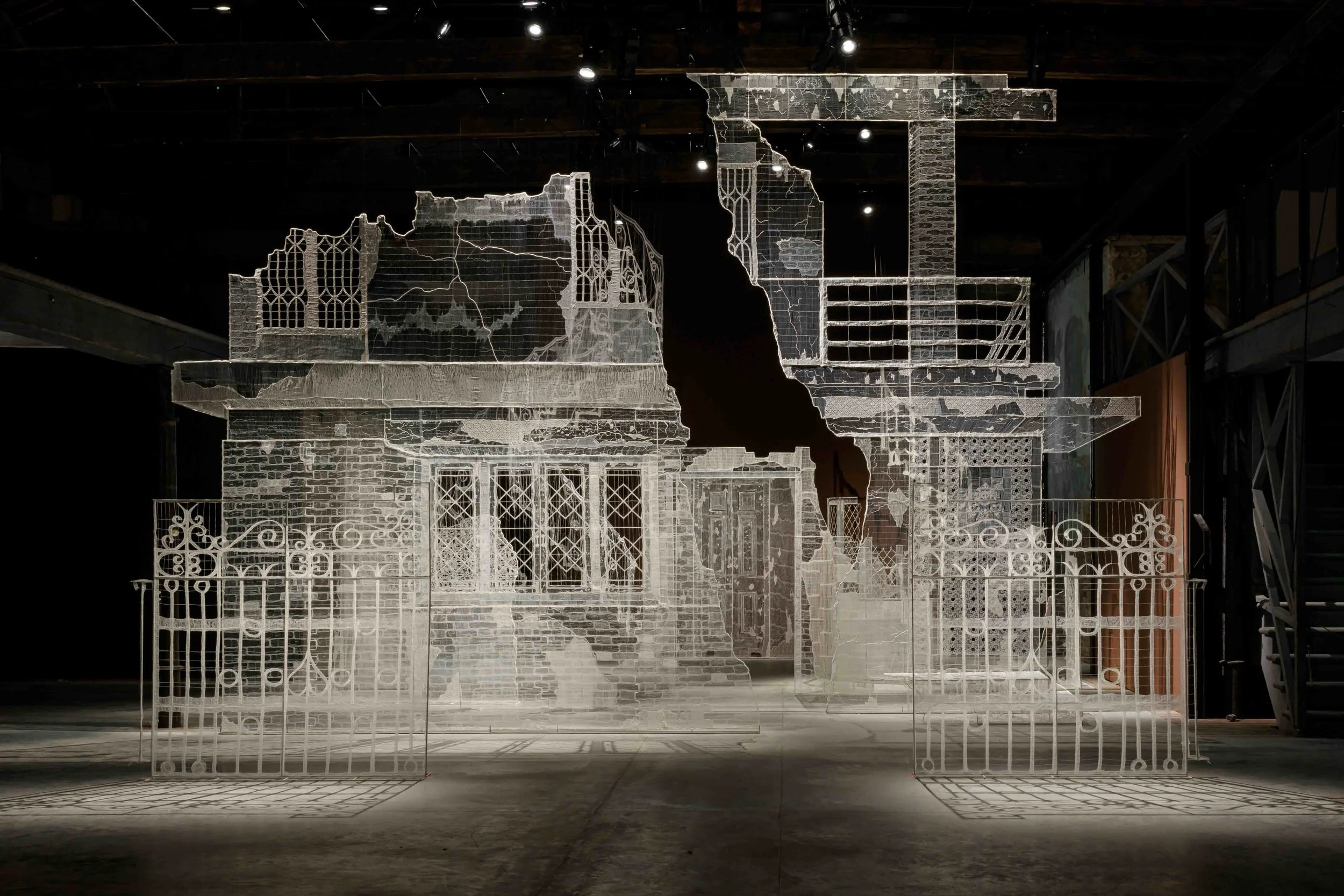
Sumakshi Singh, Permanent Address, India Pavilion at La Biennale di Venezia, 2026. Image courtesy: photographer Andrea Avezzú.
“The world has never felt entirely solid to me,” reveals Sumakshi Singh. It is an unusual admission from an artist whose practice repeatedly returns to the language of architecture. Buildings are generally meant to reassure: they set themselves against the weather, against entropy, against the erosion of time. Stone aspires to permanence; monuments are erected in the hope that memory might acquire material form and survive those who made it. Yet Singh has long been drawn to the point at which such certainties begin to loosen—when walls cease to shelter and become repositories of absence, carrying within them the lives that have passed through them.
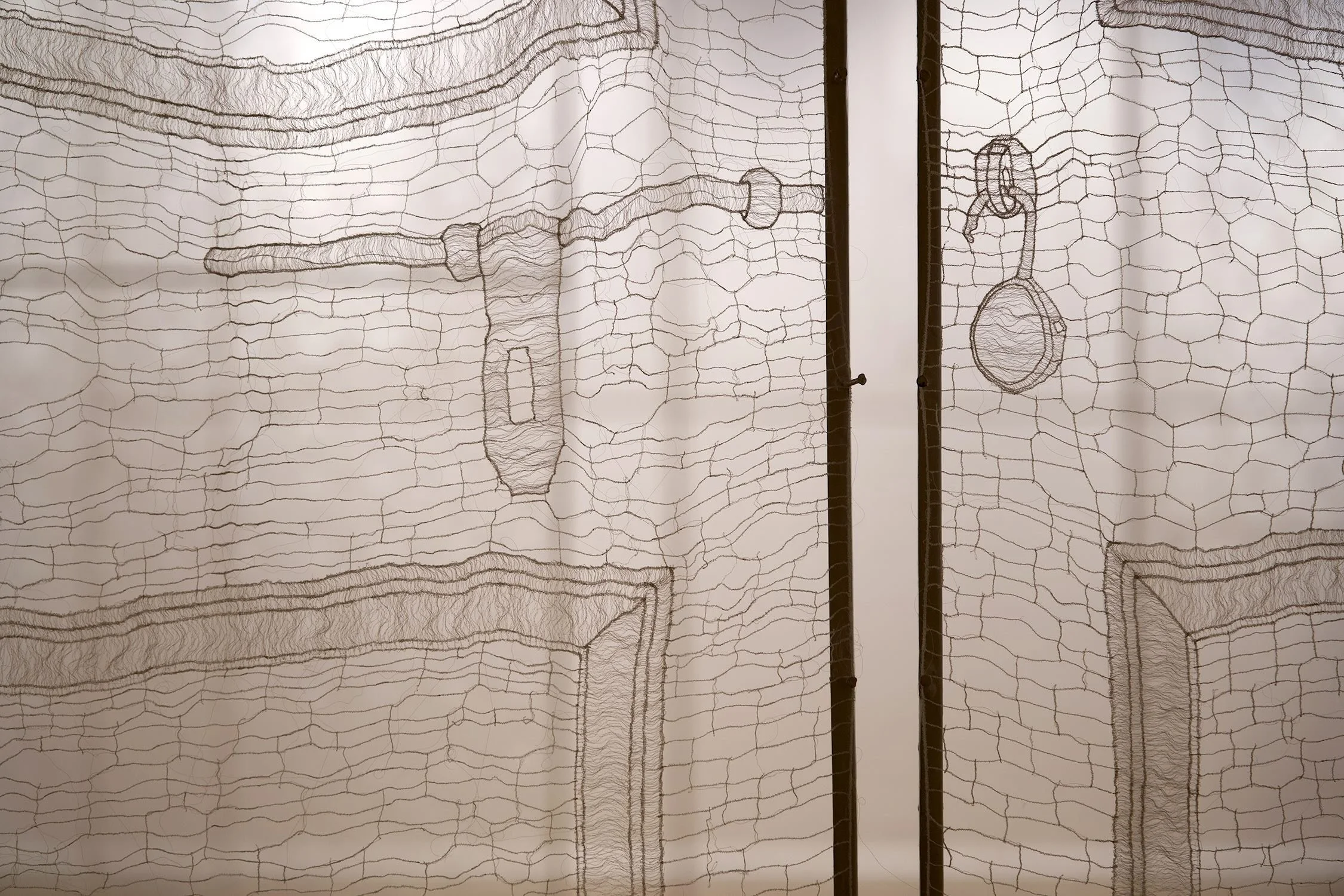
Sumakshi Singh, detail of “Garden Doors”, 33 Link Road at Kiran Nadar Museum of Art (KNMA), Delhi, 2020. Image courtesy: KNMA.
In the work showcased at the Indian Pavilion at the 2026 Venice Biennale, Permanent Address, Singh reconstructs her demolished family house with white, almost translucent thread. Its structure is in pieces, yet despite the fragmentation, it is characterised by intricate details, reflecting the time and care needed for its creation. Through slow, repetitive acts of stitching, the artist reimagines architecture as something represented not by permanence, but by fragility embedded in memory and time. In pieces such as Permanent Address, the walls become vessels for stories, traces of relationships, and evidence of the quiet labour that allows a home to exist in the first place, shifting attention from what buildings are made of to what they hold.
Stone aspires to permanence; monuments are erected in the hope that memory might acquire material form and survive those who made it. Yet Singh has long been drawn to the point at which such certainties begin to loosen—when walls cease to shelter and become repositories of absence, carrying within them the lives that have passed through them.
Between Presence and Absence
“I have always been interested in thresholds,” she says, “the spaces between what appears stable and what is constantly slipping away.” Across installation, sculpture, painting, animation and drawing, Singh’s practice inhabits these unstable territories: between presence and absence, material and immaterial, remembering and forgetting. Her earlier works questioned distinctions that ordinarily appear fixed—art and non-art, figure and ground, physical form and illusion—asking viewers to remain, however briefly, within what she describes as “a more open field of perception, before habit and conditioning begin to separate experience into categories.” Throughout her practice, attention becomes a method of inquiry, revealing how meaning alters according to context, perspective and memory. She notices how easily what appears immutable can shift, dissolve or reveal itself to be something else and remains drawn to moments when certainty begins to soften.
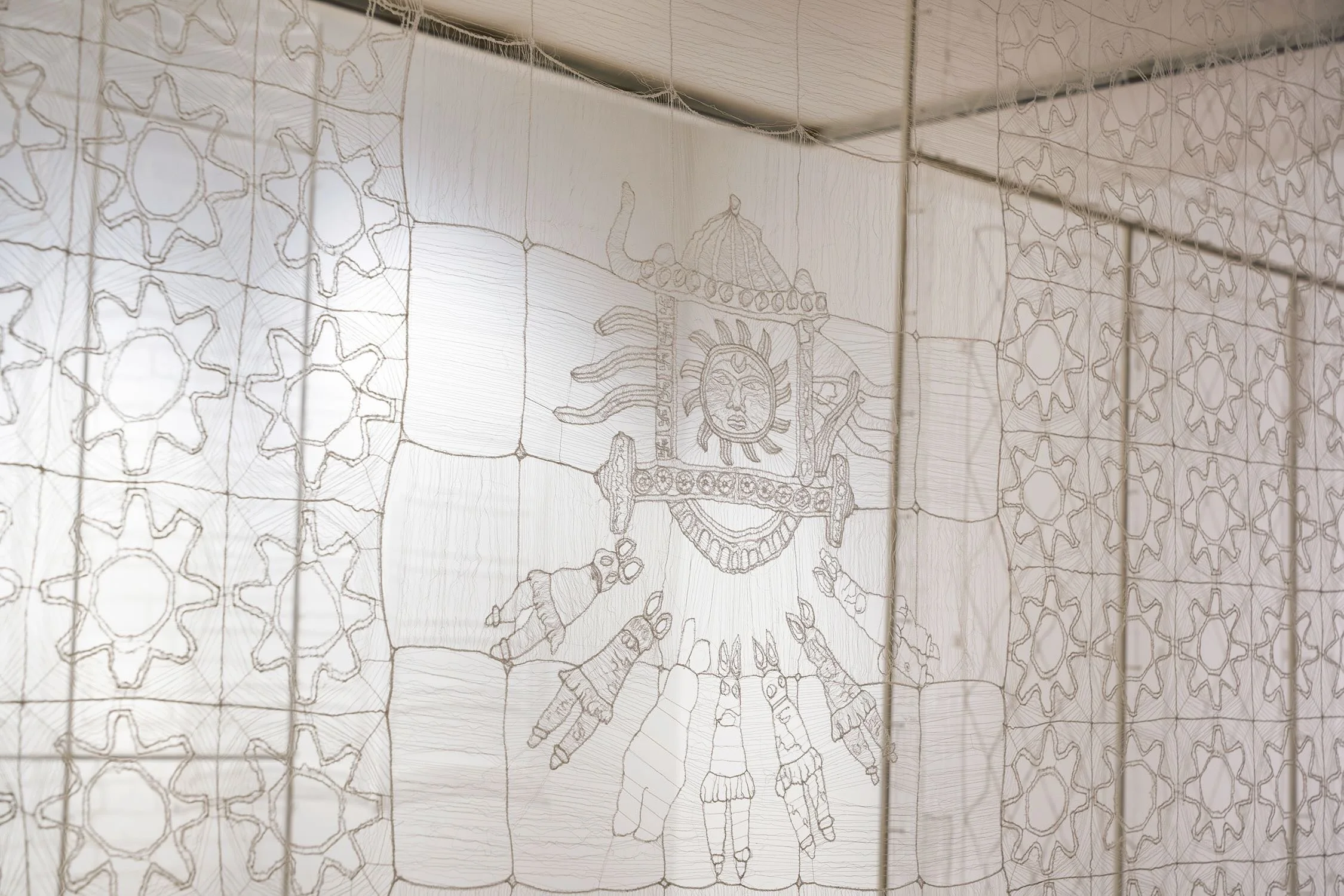
Sumakshi Singh, detail of “Mural Wall”, 33 Link Road at Kiran Nadar Museum of Art (KNMA), Delhi, 2020. Image courtesy: KNMA.
The same sensibility governs the temporal life of Singh’s work. For Singh, slowness is an act of resistance—a way of restoring duration to experience. Months of repetitive labour are embedded within the installations, and they seem to ask for a corresponding stillness from those who encounter them. One does not simply look at these works and move on. They reveal themselves incrementally, allowing the eye to wander, adjust and return, until what first appeared insubstantial begins to assume a different kind of presence.
“We live in a culture of immediacy,” the artist asserts, “that often encourages us to arrive at quick interpretations, consume something, and move on to the next thing. But many things of value only reveal themselves over time. If we remain with them long enough, other layers begin to emerge—metaphor, atmosphere, rhythm, emotional resonance.”
More recently, her attention has turned towards memory itself and the curious persistence of things thought to be lost. Singh is interested in how memory shifts, places disappear, and identities change over time, and in what survives these transformations—not as fixed or complete forms, but as traces, echoes and accumulated acts of remembering. In seeking a form through which such questions might be explored, Singh gravitated towards a material that seemed to embody their very nature. Thread, with its capacity to carry the imprint of touch while remaining vulnerable to tension, fraying and disappearance, became the medium through which these meditations could be most fully realised.
One does not simply look at these works and move on. They reveal themselves incrementally, allowing the eye to wander, adjust and return, until what first appeared insubstantial begins to assume a different kind of presence.
The House Remembered
For over seven decades, 33 Link Road in Delhi was the centre of Singh’s family life. Built by her grandparents after arriving in the city as refugees in the aftermath of Partition, it witnessed successive generations gathering beneath its roof: births and deaths, weddings, sleepovers, shared meals, illnesses and recoveries. As children grew up and relatives dispersed across cities and continents, the house remained what Singh calls ‘a shared anchor’, a place that continued to bind together lives increasingly lived elsewhere.
The loss of the house altered her understanding of home itself. Home, she realised, was never simply an accumulation of bricks, stone and foundations, but something continually made and remade through acts of care, memory and belonging.
When her grandparents passed away, the house stood empty. The transformation was subtle but profound. Walls that had once seemed immovable acquired a distinctive fragility. Heavy doors and thick masonry, once reassuring in their solidity, appeared strangely vulnerable, as though they had lost the purpose for which they had been built. ‘Without the daily rhythms of life to animate them,’ Singh recalls, ‘the structure began to feel strangely exposed.’ Its scale and permanence only intensified this sensation, making absence palpable. Eventually, the house was demolished. Its disappearance clarified something that has since become central to her work.
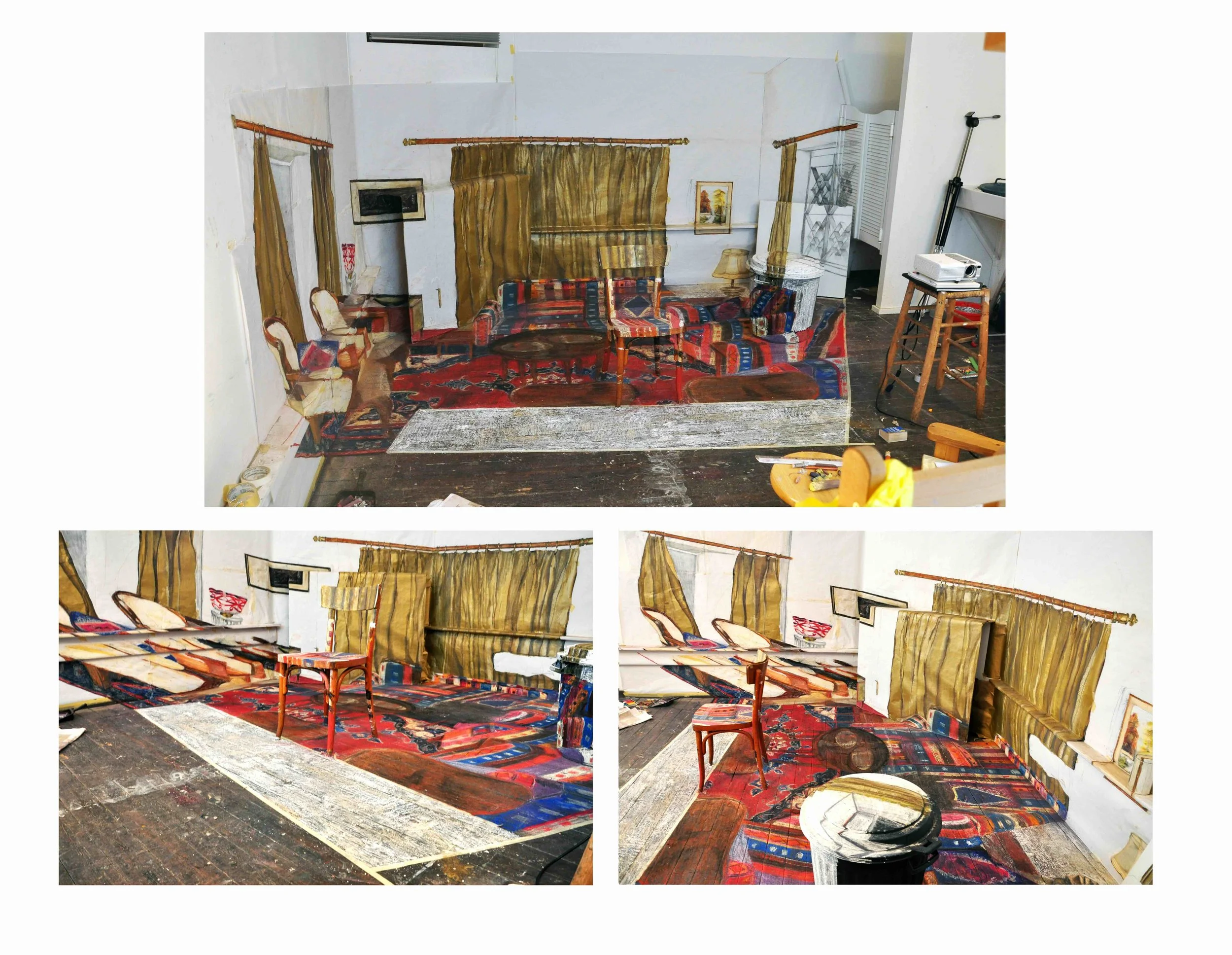
Sumakshi Singh, installation views of Mapping the Memory Mandala, Camargo Foundation, France, 2008. Courtesy of the artist.
“Absence and erasure are not the same thing,” Singh concludes. She argues that invisible, missing and fragile things continue to shape us long after they have disappeared. The loss of the house altered her understanding of home itself. Home, she realised, was never simply an accumulation of bricks, stone and foundations, but something continually made and remade through acts of care, memory and belonging. What remained with her was not the architecture’s material certainty, but its softer histories.
The Language of Thread
Afternoons spent sitting in the garden embroidering alongside her mother and grandmother resurfaced with particular intensity. The women in her family taught her to knit and stitch not through formal instruction, but through proximity: sometimes talking, sometimes in silence, sharing time as much as technique. In Punjab, where her family traces its roots, women traditionally gathered to create Phulkari embroideries that carried stories, preserving intimate moments from daily life rather than grand historical narratives. The domestic knowledge inherited through these shared acts of embroidering would later find expression in her artistic practice. “As an homage to those moments,” Singh says, “I wanted to recreate the house in thread.”
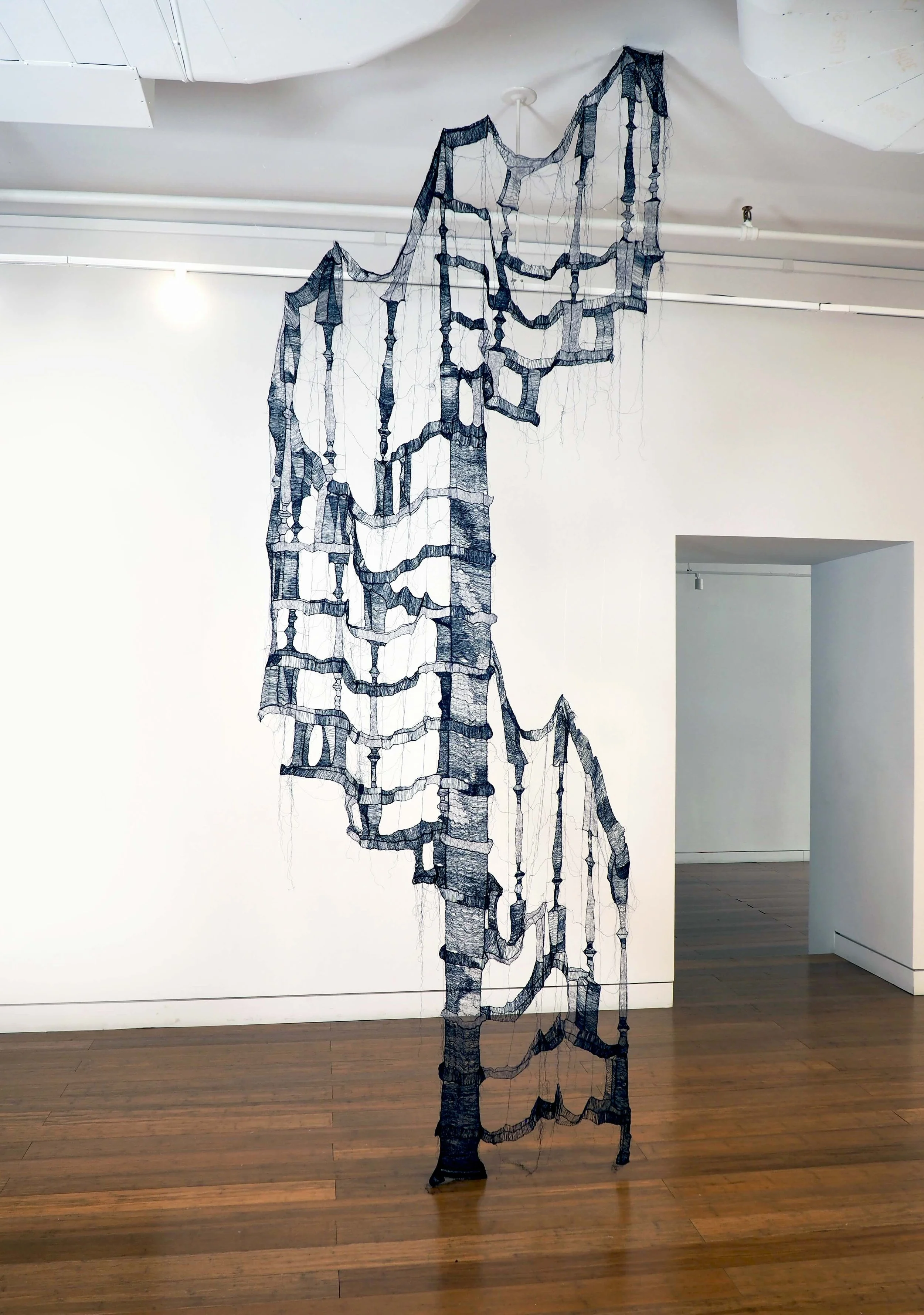
Sumakshi Singh, Spiral Staircase at Aicon Contemporary, New York, 2021. Courtesy of the artist.
The decision was not merely symbolic. In the months before demolition, Singh returned repeatedly to the house carrying a sketchbook and measuring tape, moving slowly through rooms that had once been animated by conversation and routine. She measured walls, traced window frames, touched worn surfaces and drew doorways, trying to understand how a structure built of weight and permanence might be translated into another language. The visits became less an exercise in documentation than a ritual of attention, a way of remaining with a place already poised between presence and disappearance.
Her thread drawings emerged as an extension of that prolonged encounter. “Each stitch marked both a presence and an absence,” Singh emphasises. For her, embroidering became a way of preserving what could no longer exist in physical form. Gradually, the house relinquished its solidity. Brick and mortar gave way to suspended strands of white thread; walls thinned into porous membranes; doorways lingered like half-remembered scenes. What remains are works that possess none of architecture’s customary authority. Instead, they hover in space as what Singh calls “soft, spectral cobwebs of light and memory”—less structures than apparitions, their forms becoming visible only through shifting registers of light, shadow and movement.
Sumakshi Singh, Permanent Address, India Pavilion at La Biennale di Venezia, 2026. Image courtesy: photographer Andrea Avezzú.
The works emerge through an equally ephemeral process. Singh embroiders onto a soluble fabric that is later dissolved, leaving behind delicate thread structures suspended in space. The disappearance of the supporting surface echoes many of the themes that occupy her practice: absence, impermanence and the traces that remain after something has vanished. At the same time, the process unsettles inherited hierarchies between art and craft. Embroidery, long associated with women’s domestic labour and often treated as an ornament rather than a structure, assumes a different role here. Once the supporting fabric dissolves, only the embroidery remains. What was once considered decorative becomes the architecture itself, carrying both form and narrative.
Because stitching is an embodied, familiar act, something understood through touch and repetition, thread carries an intimacy that conventional architectural materials cannot. “We wear it every day,” she points out. “We understand what it feels like against our skin. We know intuitively what it takes to make a single stitch. The act is meditative, attentive, time-consuming and very human.” Memory, she suggests, behaves in much the same way. It frays, accumulates, fades and reforms. It survives not as an intact archive but as fragments gathered through repeated acts of return. For Singh, thread became a more faithful analogue for memory than stone, concrete or steel, precisely because of its vulnerability and capacity to retain traces of touch. Because stitching is an embodied, familiar act, something understood through touch and repetition, thread carries an intimacy that conventional architectural materials cannot.
Time, Repetition and Repair
Repetition, for Singh, is not simply a method of production but a mode of inquiry. “Be it mantra or knitting,” she observes, “repetition allows you to move beyond the analytical mind into a deeper, less verbal mode of knowing.” Through slow and sustained labour, time itself begins to change character. It becomes less linear and more accumulative — “almost sedimentary and excavative”, as she describes it. Insights surface there that cannot be reached through speed or deliberate analysis alone.
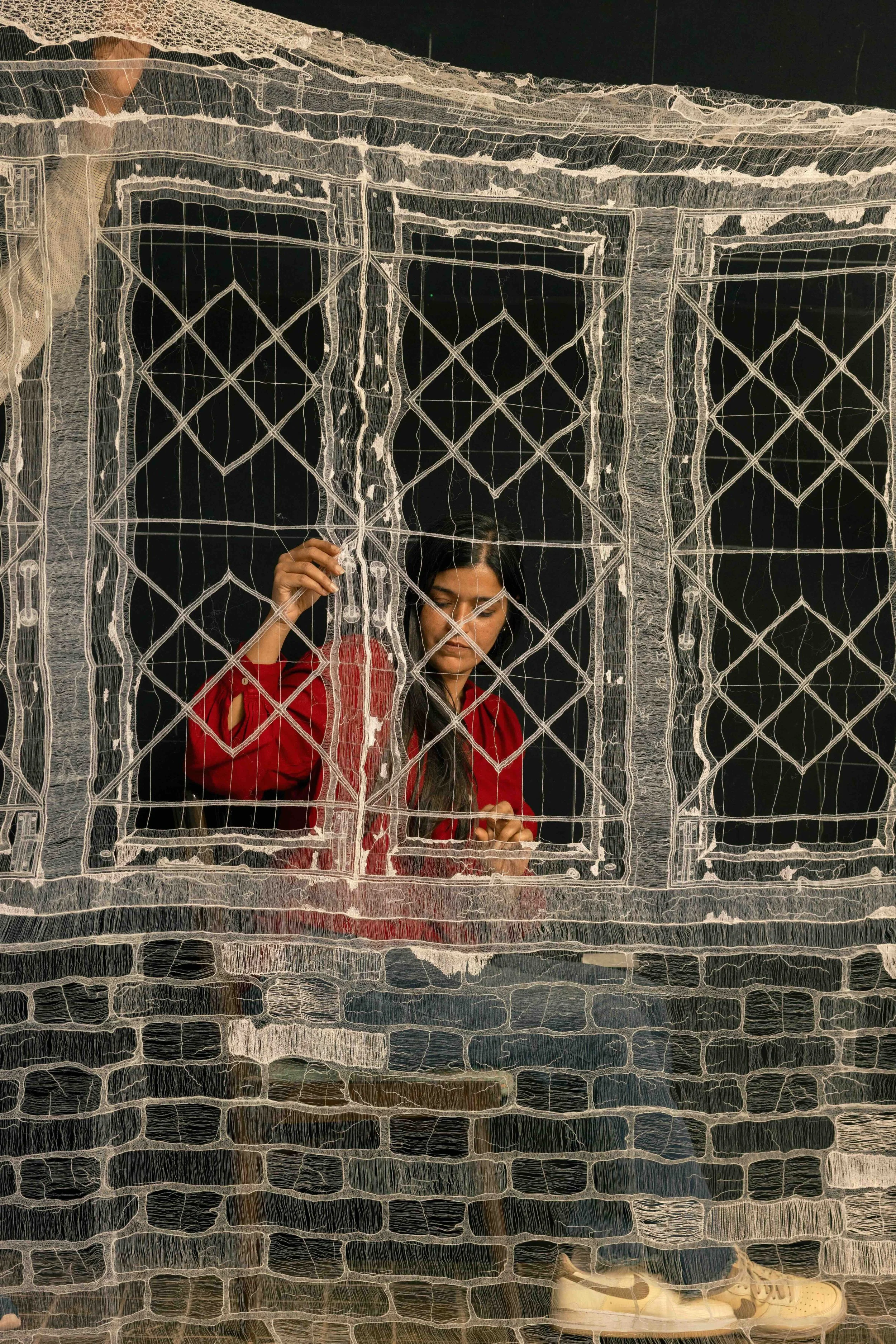
Sumakshi Singh, the making of Permanent Address. Image courtesy: photographer Lokesh Dang.
In the case of Permanent Address, that prolonged engagement also altered the nature of grief itself. Stitch by stitch, surface by surface, what began as an act of preservation slowly became an act of acceptance. Singh recalls a line often attributed to Rumi: “The wound is the place where the light enters you.” For her, moving more deeply into the experience of loss gradually gave way to gratitude.
Some houses are demolished. Others continue to shelter us, long after they have ceased to exist.
Gratitude for weathered walls whose purpose had quietly concluded. Gratitude for the generations they had sheltered. Gratitude, too, for the possibility that making something outwardly might permit an inward transformation. “In many ways,” she reflects, “the stitching makes the fracture more visible, tracing what is absent as much as what remains.”
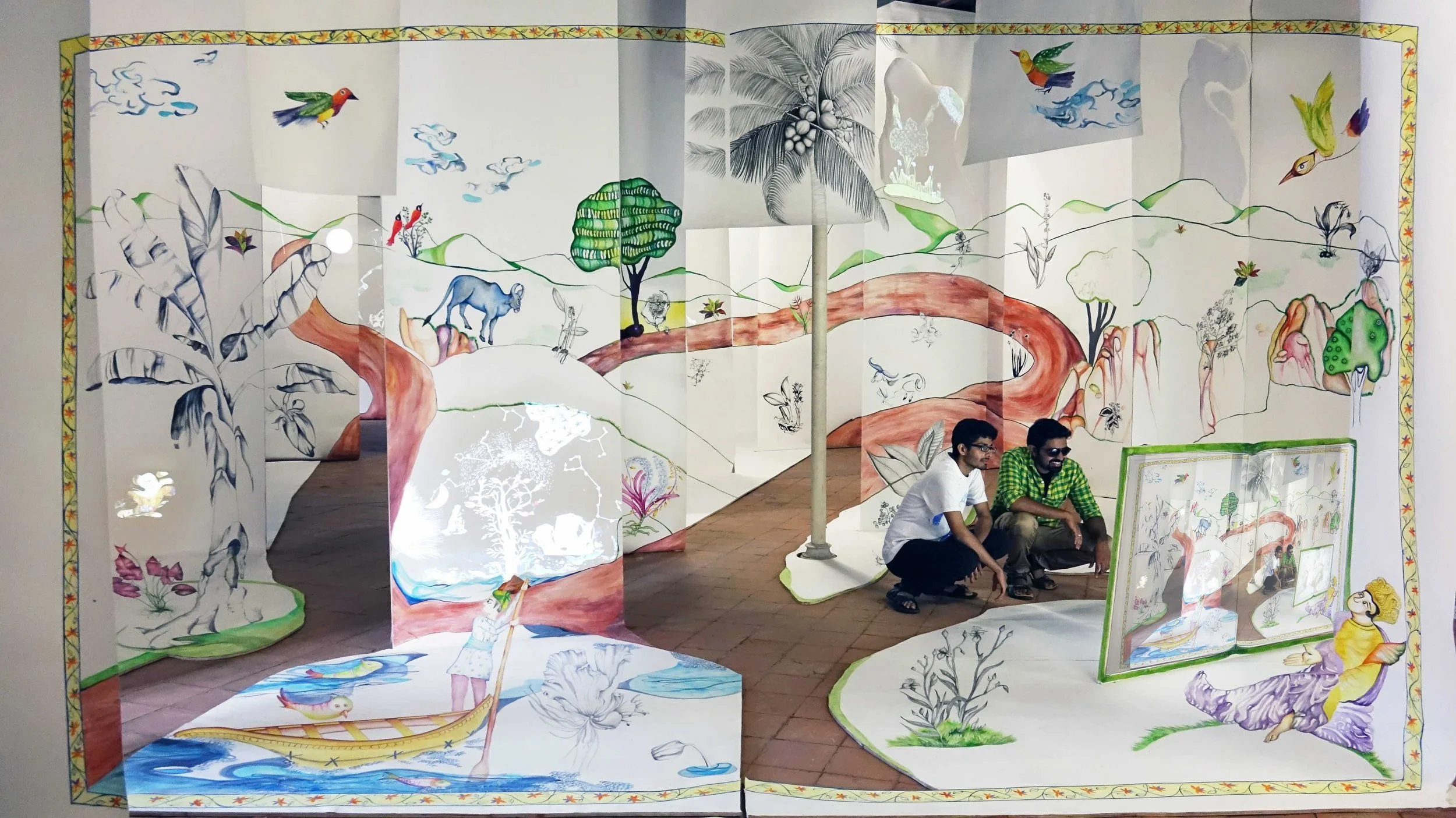
Sumakshi Singh, In, Between the Pages, Kochi-Muziris Biennale, Kochi, India, 2014. Courtesy of the artist.
Perhaps this is what Singh’s soft monuments ultimately offer. They do not seek to restore what time has taken away, nor do they pretend that memory can be made permanent. Instead, they dwell within the fragile space between disappearance and endurance, reminding us that what outlives us is seldom the solidity of walls, but the gestures that once animated them: hands moving patiently through thread, voices exchanged in companionable silence, afternoons so ordinary that they seem destined to be forgotten until loss reveals how deeply they have been woven into us. Some houses are demolished. Others continue to shelter us, long after they have ceased to exist.