

In Hong Kong, a city shaped as much by translation as by architecture, language seldom settles into a fixed form. It moves between scripts, accents, and meanings, carried across streets, galleries, and conversations with a distinct fluidity. This condition of living between voices rather than within a single one underpins a season of exhibitions that approach the notions of identity, memory, and perception from markedly different angles, yet remain connected through a shared attentiveness to how meaning is constructed and continuously redefined. Across galleries and museums, artists and curators turn to sound, image, material, and environment as mutable systems through which experience is mediated.
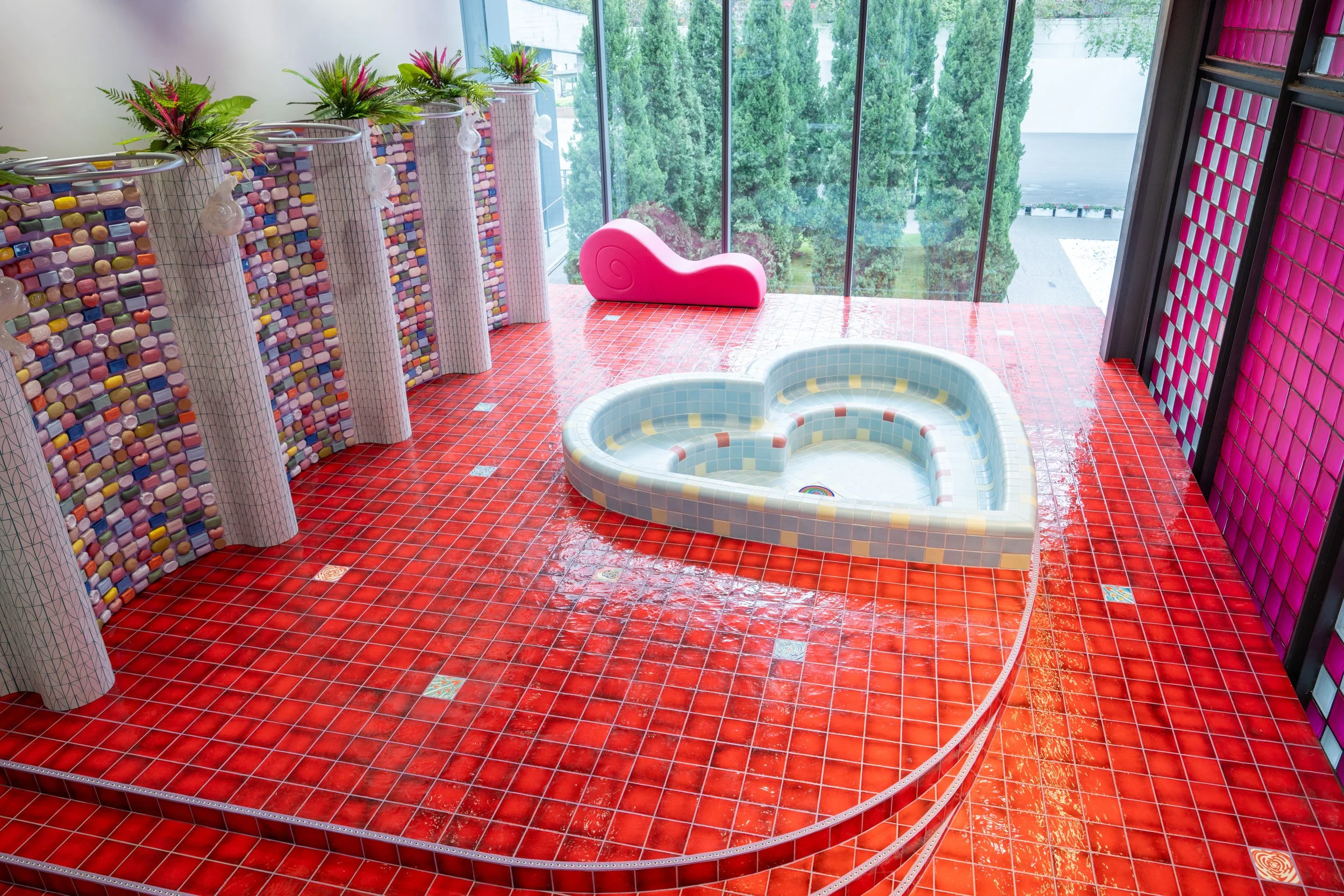
LEVO LOVE by Chan Wai Lap, at Oi!. Courtesy of Oi!
Whether through the slippages of language, the intimacy of listening, the traces of memory embedded in photographs, or the weight of materials shaped over time, each exhibition proposes a more elastic understanding of culture — one that accommodates contradiction, embraces uncertainty, and allows multiple histories to coexist. What emerges is less a survey of exhibitions than a textured portrait of a city negotiating its own complexities, where art becomes a means of navigating the shifting space between what is seen, what is heard, and what is understood.
‘胡 ( هو / who) are you?’ at Rossi & Rossi
In Hong Kong, where languages overlap in shopfronts, subway announcements, and the brief delay between translation and meaning, Slavs and Tatars present 胡 (هو / who) are you?, their first solo exhibition in the city. The title challenges the idea of introduction itself, turning identity into something provisional, spoken across three scripts at once and never entirely fixed.
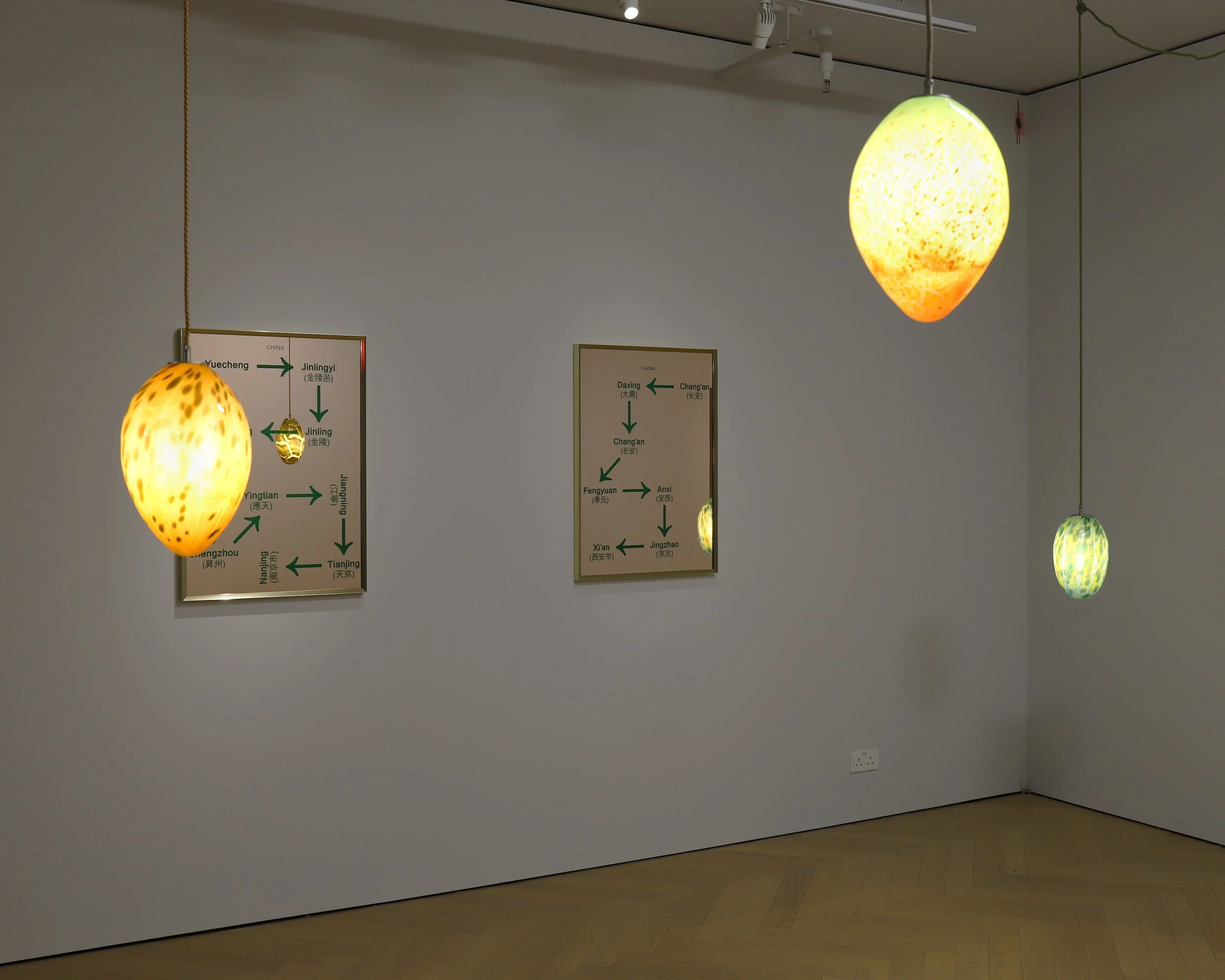
Slavs & Tatars, ‘胡 ( هو who) are you’, exhibition view at Rossi & Rossi Gallery. Courtesy of the gallery.
Founded in 2006 by Payam Sharifi and Kasia Korczak, Slavs and Tatars began as a reading group, a point of departure that continues to shape their practice. Working across exhibitions, books, lecture-performances, and communal spaces, the collective approaches knowledge as shared, contested, and continually reassembled. Their often-cited territory, “east of the former Berlin Wall and west of the Great Wall of China”, functions less as geography than as a method: a way of thinking through contradiction, where scholarship collides with folklore, mysticism and popular culture, often with humour close at hand. That resistance to fixed meaning is embedded in the exhibition’s title. 胡 (hu), هو (hu), and “who” sit beside one another not as direct translations but as echoes that fail to align completely. Language becomes less a bridge than a site of friction. The artists frequently return to the historical use of 胡 in Chinese to describe non-Han people, foregrounding how naming has long operated through classification and exclusion. Here, asking “who” is never neutral; it carries the weight of identities imposed from elsewhere.
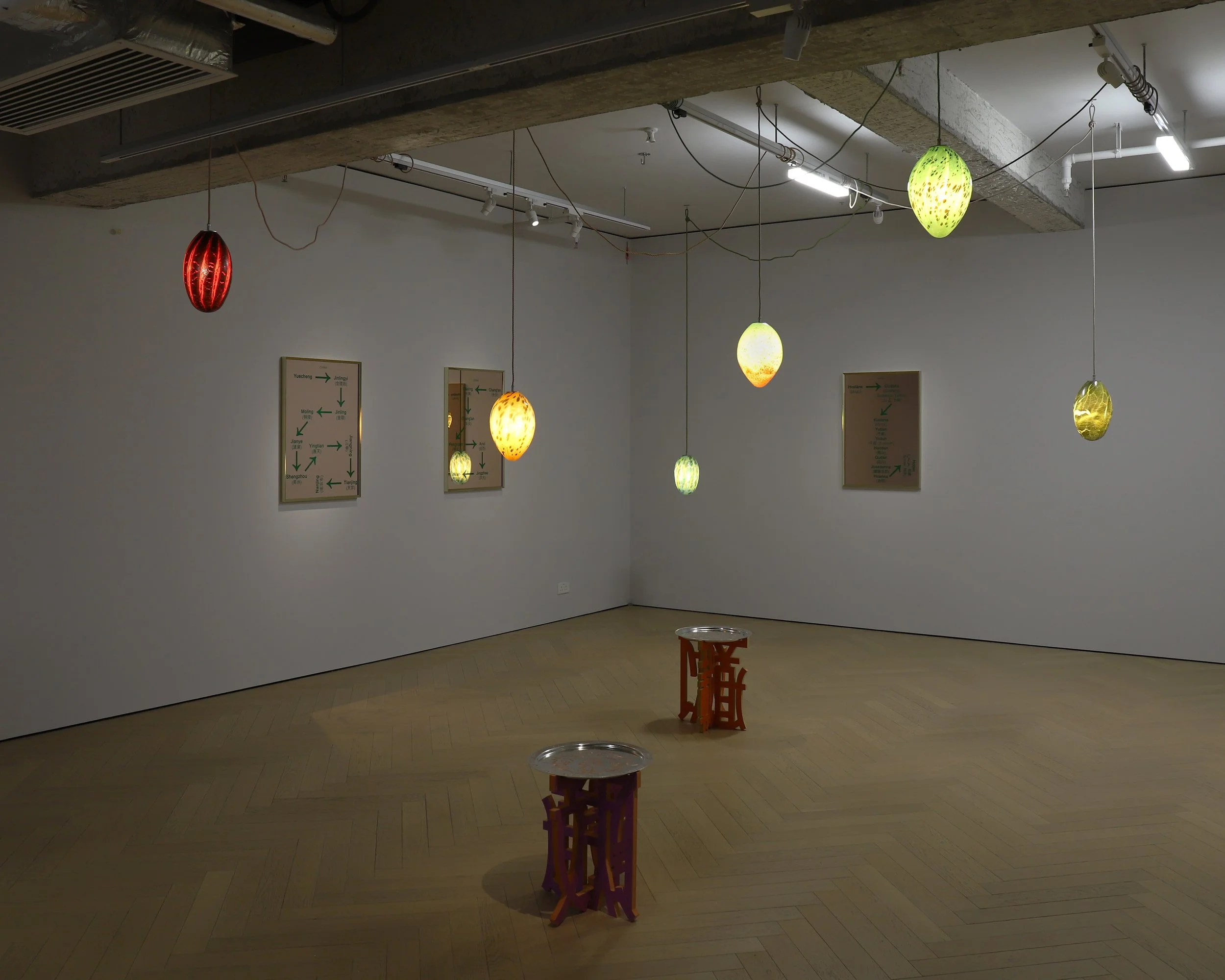
Slavs & Tatars, ‘胡 ( هو who) are you’, exhibition view at Rossi & Rossi Gallery. Courtesy of the gallery.
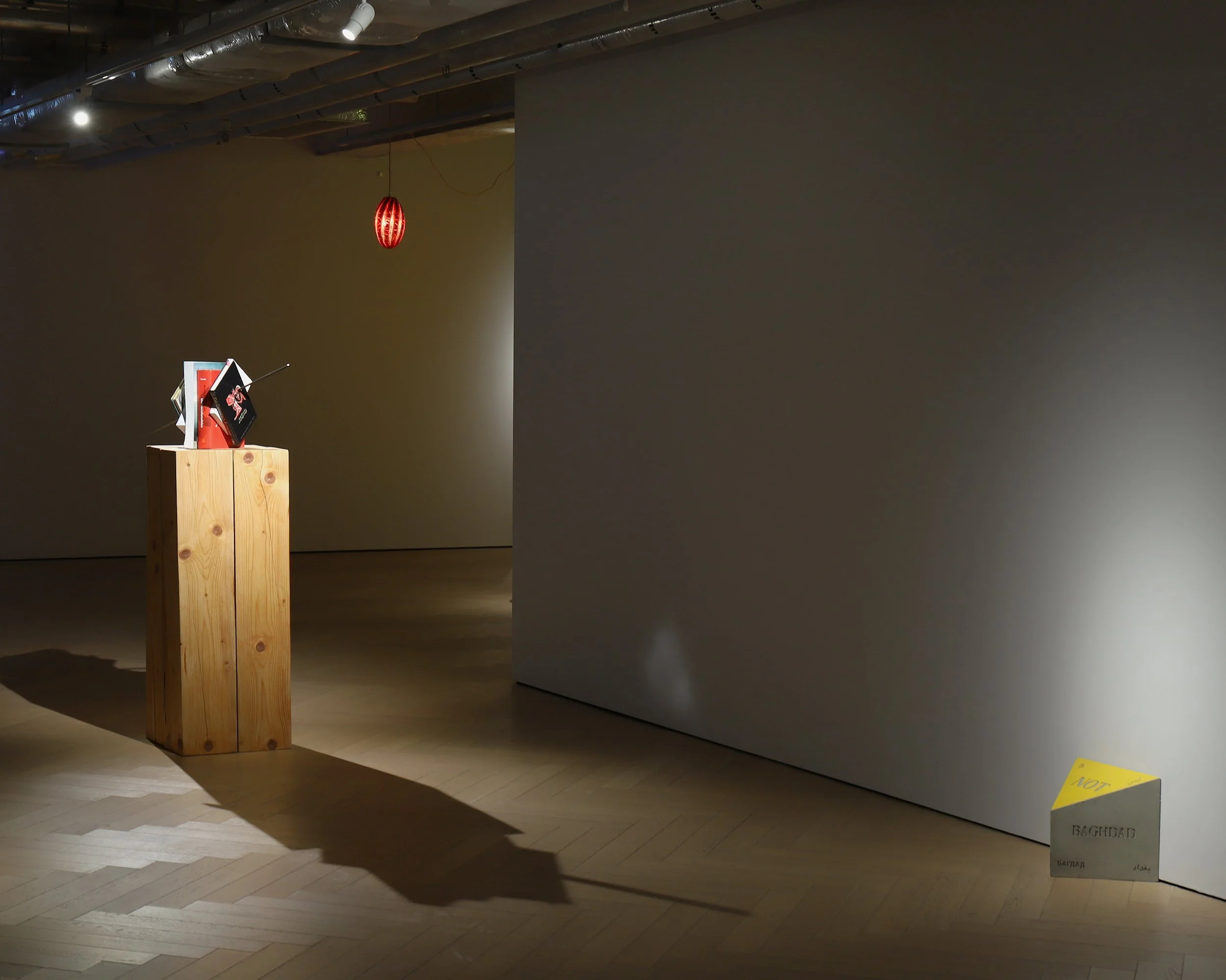
Slavs & Tatars, ‘胡 ( هو who) are you’, exhibition view at Rossi & Rossi Gallery. Courtesy of the gallery.
The Love Me, Love Me Not series turns to cities shaped by shifting empires and alphabets, suggesting that geography itself is always being rewritten. Concrete road-sign sculptures such as Not Bukhara Not Berlin (2011) and Not Baghdad Not Bahamas (2011) disrupt the certainty of place, pairing locations that resist easy association. Elsewhere, vacuum-formed works including Samovar (2024) and This Not That (2024) revisit Marcel Broodthaers’s Musée d’Art Moderne, Département des Aigles, replacing the imperial eagle with the Simurgh from Turkic-Persianate mythology. Where the eagle signifies authority, the Simurgh gestures towards multiplicity and transformation.
Publishing remains central to the collective’s practice. Across more than fifteen books exploring alphabets, satire, Central Asian syncretism and the politics of language, reading emerges as a communal act rather than a solitary one. Works such as Down Low Gitter (2018) transform seating into shared intellectual space, while Kitab Kebab (Fatima et Marie) (2020), with books skewered like meat, collapses the distance between thought and consumption.
Throughout the exhibition, humour operates not as decoration but as a method, sustaining contradiction rather than resolving it. In Hong Kong, where translation is embedded within daily life, 胡 (هو / who) are you? leaves its question deliberately open, continuing to ask itself in different forms.
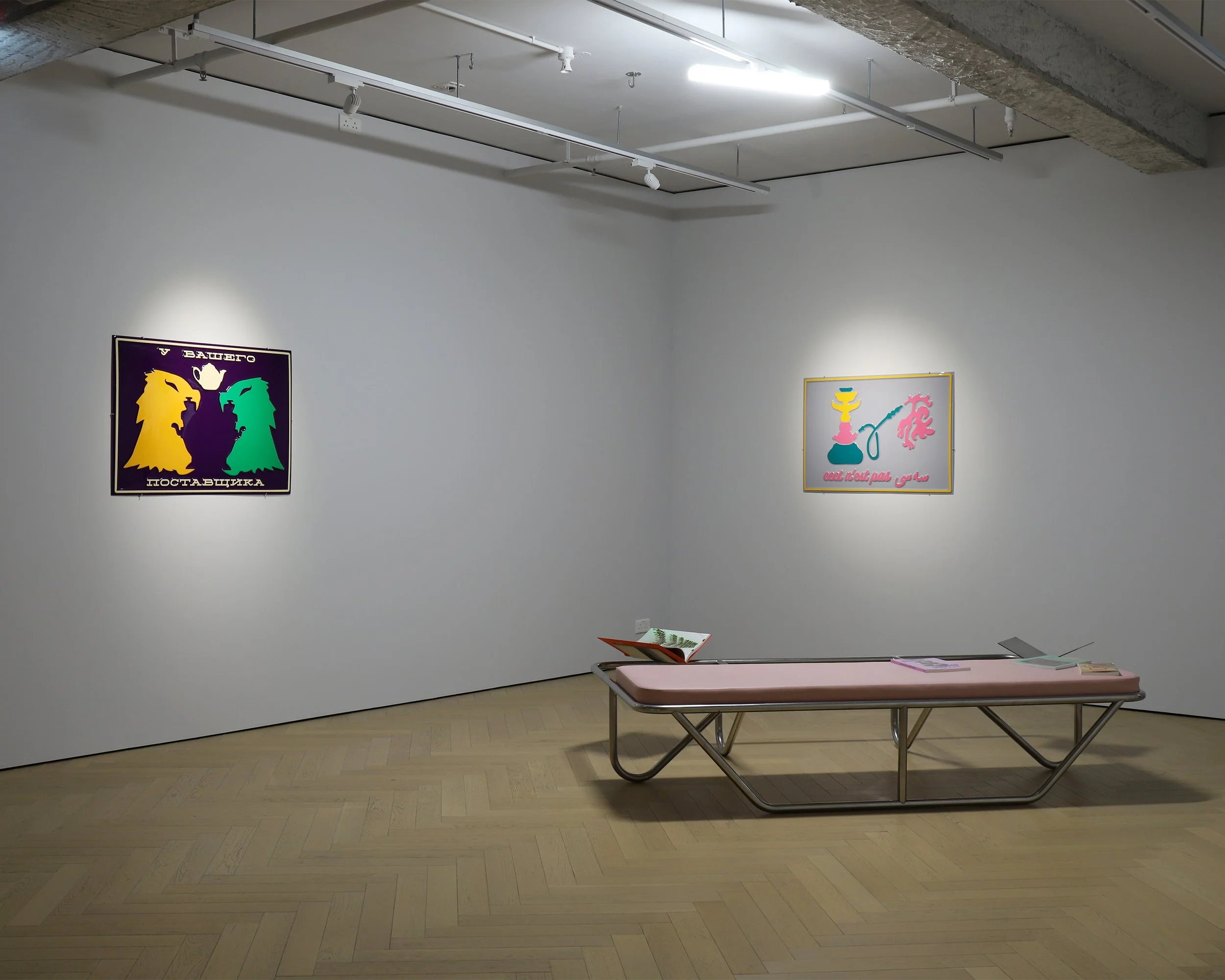
Slavs & Tatars, ‘胡 ( هو who) are you’, exhibition view at Rossi & Rossi Gallery. Courtesy of the gallery.
‘Dial-A-Poem Hong Kong’ at M+
Dial-A-Poem was first conceived in 1969 by the American poet John Giorno, who sought to dissolve the distance between poetry and everyday life. Believing that “much poetry is intended to be heard, not merely read”, he invited writers, artists and musicians to contribute recordings accessible simply by dialling a telephone number. What began as an experimental hotline later evolved into gallery installations in which visitors listened to randomly selected spoken works through sculptural telephones.
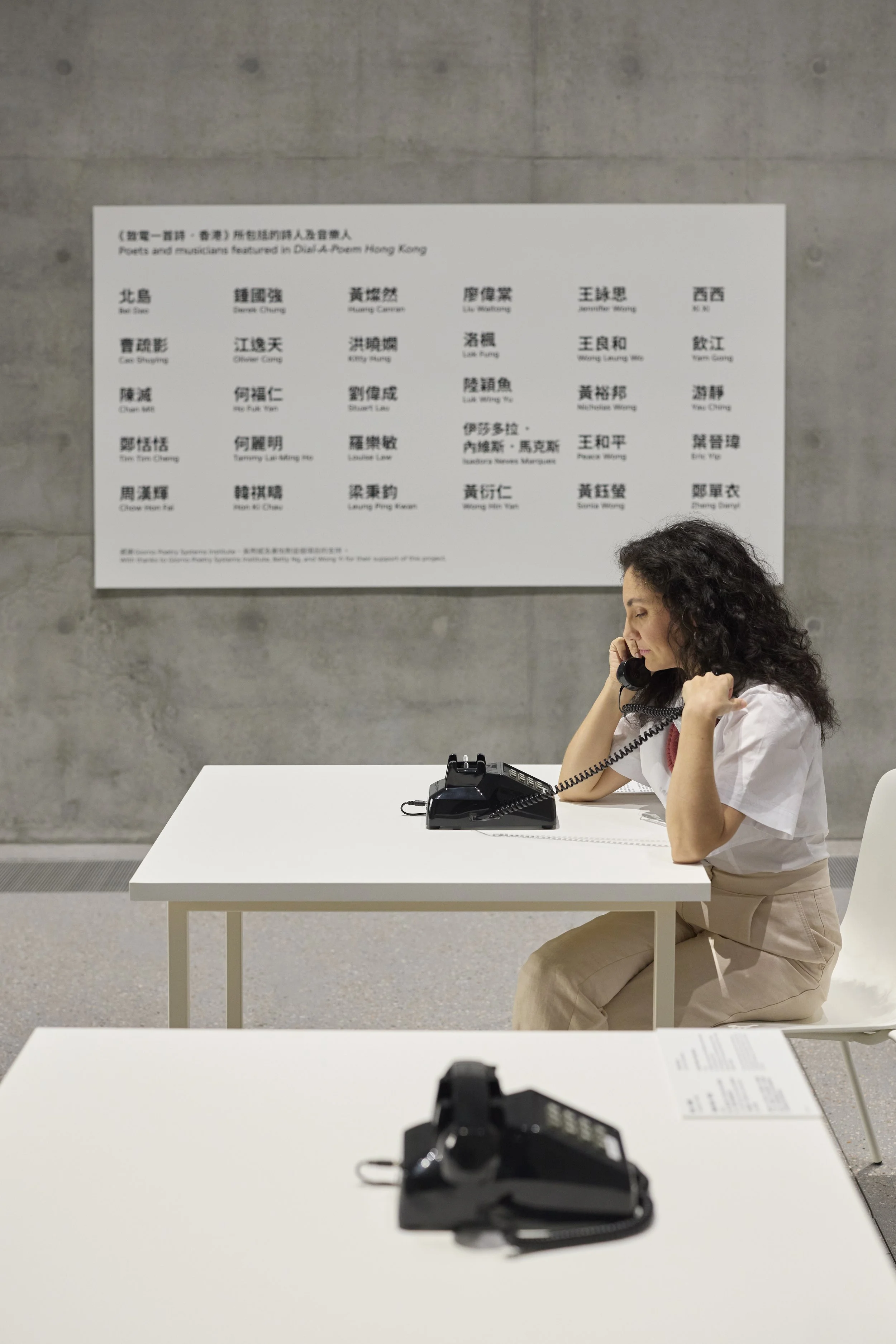
“Dial A Poem” at M+ Museum, Hong Kong, installation view. Courtesy of the museum.
Since then, the project has travelled internationally, taking on new local inflexions in cities across France, Mexico and Brazil. Its latest iteration, Dial-A-Poem at M+ in Hong Kong, continues this lineage through newly commissioned recordings in Cantonese, Mandarin, and English featuring thirty poets and artists, including Bei Dao, Jennifer Wong, Yau Ching, and Eric Yip.
Within the museum’s Focus Gallery, visitors encounter the work through old-fashioned telephone receivers, or by calling +852 3009-9386 from outside the museum. Each call plays a different recording selected at random, shifting unpredictably between voices, languages and rhythms. Installed as an immersive listening environment, the project presents poetry not as fixed text but as a disembodied voice carried through the apparatus. It’s deliberately uncurated sequencing privileges accident, interruption, and proximity over interpretation, allowing fragments of language to surface and disappear in real time. Meaning emerges not only through comprehension, but through cadence, tone, and texture, where language is encountered first as sound.
In this sense, Dial-A-Poem extends Giorno’s original proposition that poetry need not remain confined to books, institutions or specialist audiences, but can circulate through ordinary life as unexpectedly and as intimately as a telephone call.
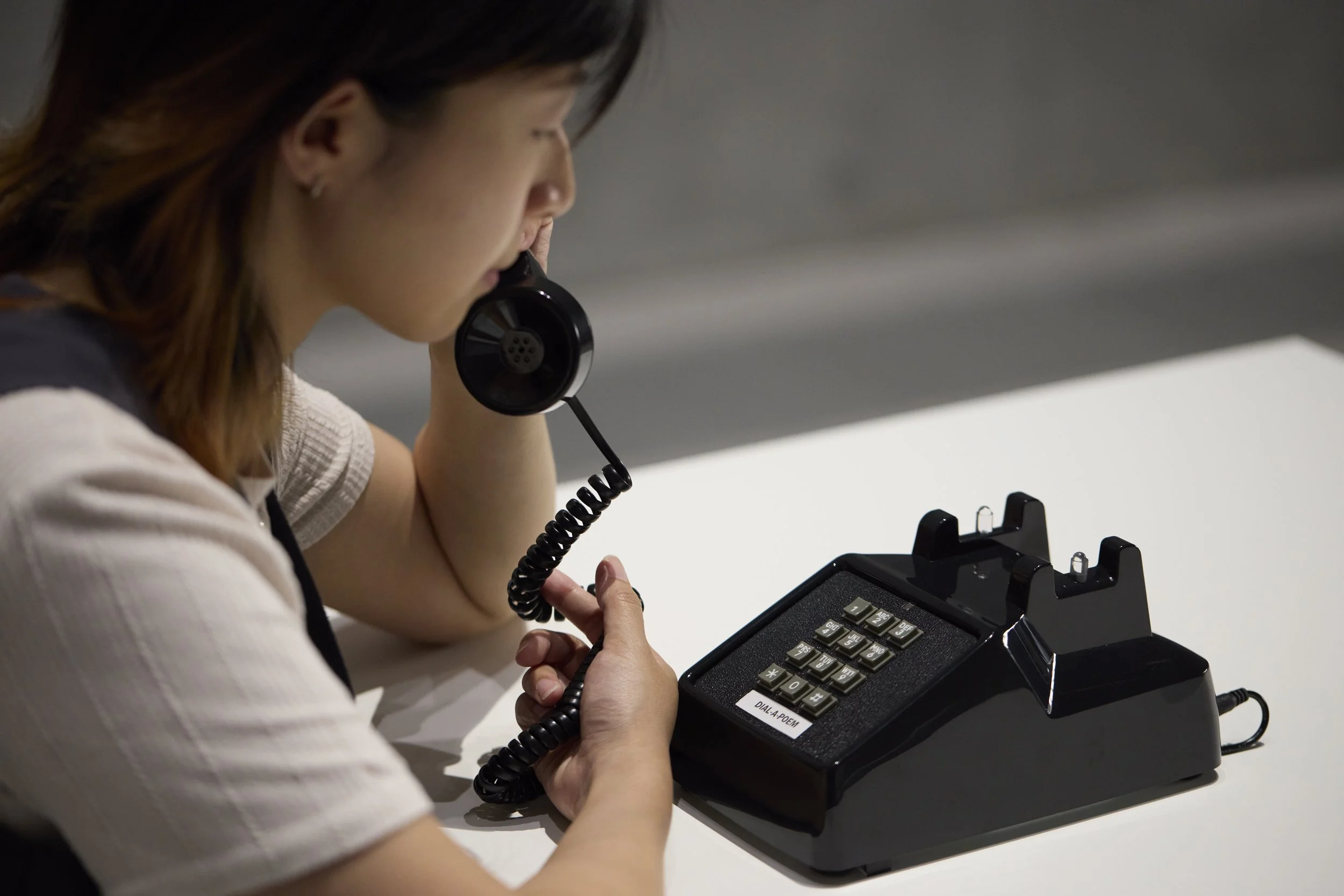
“Dial A Poem” at M+ Museum, Hong Kong, installation view. Courtesy of the museum.
‘Distance’ at Blue Lotus Gallery
Blue Lotus Gallery presents Distance, the first Hong Kong exhibition by Koji Onaka, introducing local audiences to one of Japan’s most influential photographic voices. Bringing together three key series, Distance, Tin Roof & Chimney, and Memories of Younger Days in Shinjuku, the exhibition surveys a practice that has unfolded over more than four decades. Across streets, coastlines, interiors, and urban margins, Onaka’s photographs transform ordinary encounters into meditations on memory, separation, and human connection.
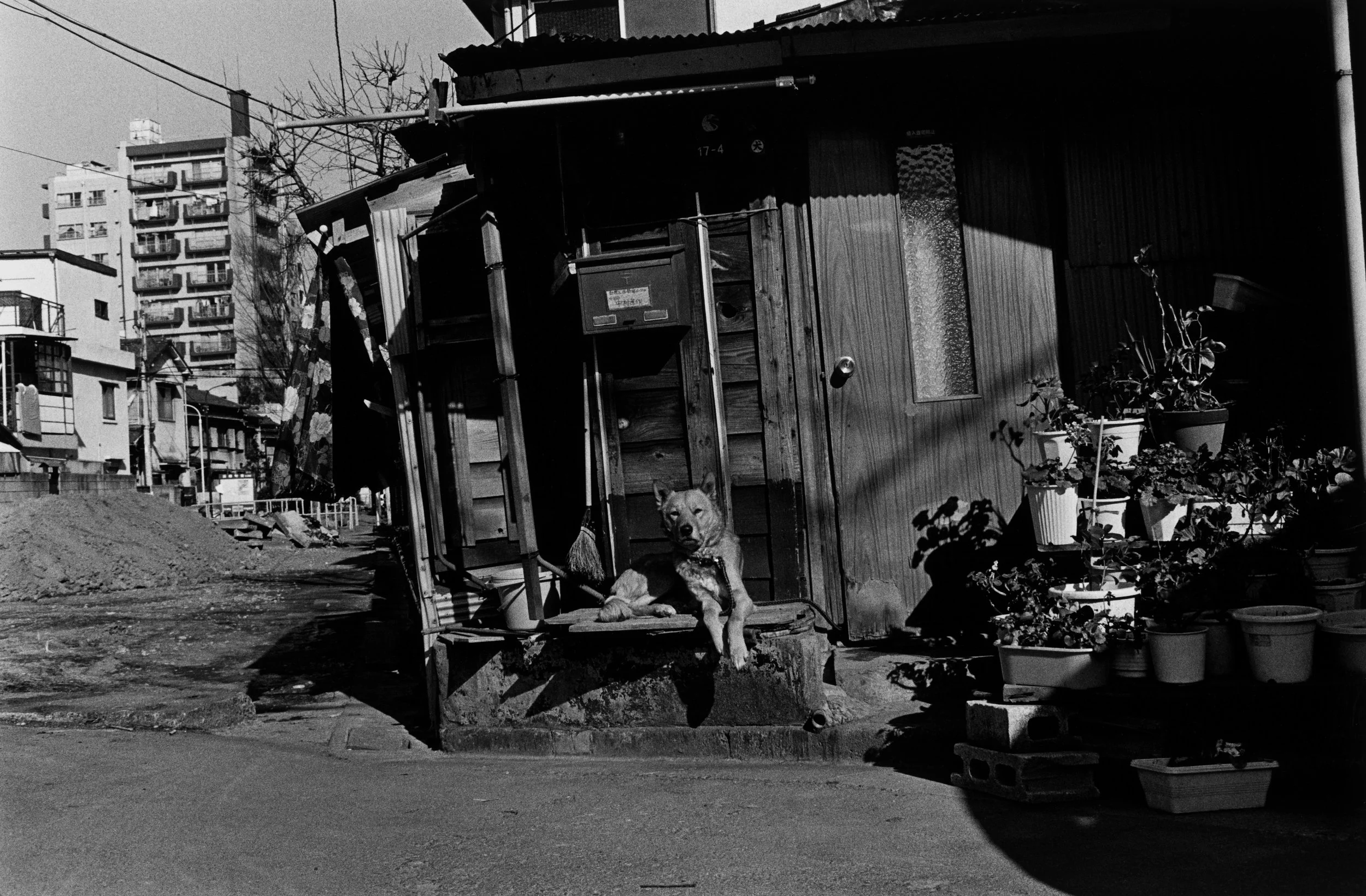
Koji Onaka, Shinjuku 1988, Silver Gelatin Print, courtesy of Blue Lotus Gallery.
Born in Fukuoka in 1960, Onaka studied photography in Tokyo before joining the Image Shop CAMP workshop led by Daido Moriyama. Where many contemporaries embraced confrontation and fragmentation, Onaka cultivated a poetics of observation shaped by warmth, spontaneity and subtle humour. His images often appear casual at first glance, yet reveal emotional precision and formal restraint. Central to this sensibility is the process itself. Onaka continues to hand-print his photographs, giving each work a tactile intimacy and tonal softness that reward slow looking.
The exhibition’s title series, Distance, forms one of the earliest coherent bodies of work in his career. Produced during the 1980s and serialised in Asahi Camera over the course of a year, the black-and-white photographs move through peripheral landscapes across Japan, including harbours, industrial edges, roadside spaces, and quiet outskirts rarely granted symbolic attention. Onaka approaches these environments with understated sensitivity, allowing their stillness to register emotionally without drifting into sentimentality. The photographs preserve places that feel both ordinary and are already receding from view.
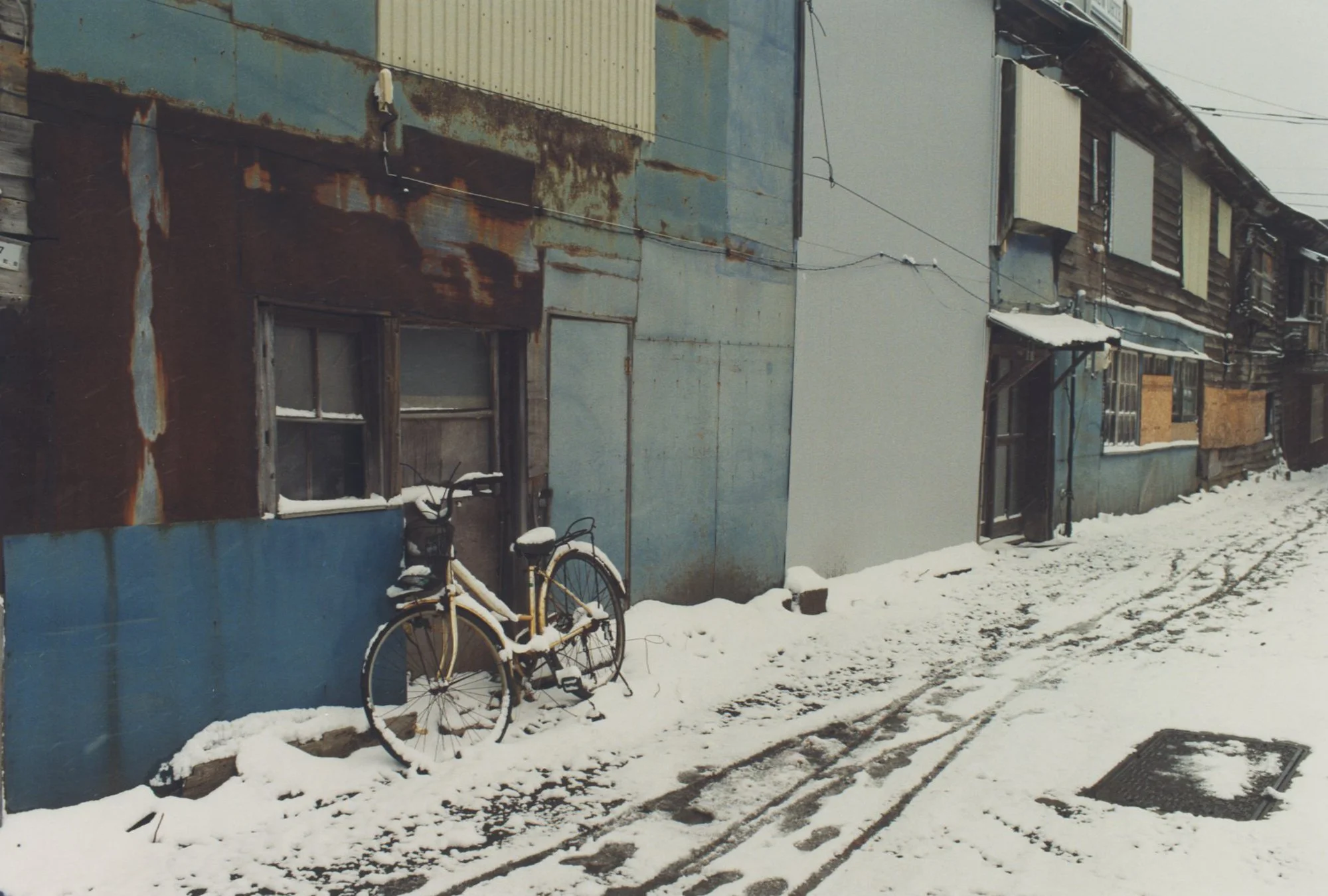
Koji Onaka, Hokkaido Hakodate 2021, handmade darkroom print, courtesy of Blue Lotus Gallery.
If Distance establishes the foundations of his photographic language, Tin Roof & Chimney traces its later evolution through colour. Produced between 2021 and 2024 across Japan, from Hokkaido to Kagoshima, the series turns towards rural towns and ageing architecture. Using a muted, atmospheric palette, Onaka photographs tin roofs, smokestacks, and weathered facades with curiosity rather than nostalgia. Memory here is not framed as loss, but as something embedded within the surfaces of the built environment.
Completing the exhibition is Memories of Younger Days in Shinjuku, a deeply personal series made between 1982 and 1994 while Onaka lived and worked in Tokyo’s Shinjuku district. Photographing the streets around him, as well as the artists and photographers gathered in the Golden Gai area, Onaka captures both the restless energy of the city and the intimacy of its creative communities. Seen today, the images offer a portrait not only of a place, but of the bohemian culture that shaped a generation of Japanese photography.
Across these bodies of work, Onaka remains attentive to how people inhabit space and how space absorbs traces of living. His photographs linger at thresholds between town and country, presence and absence, solitude and encounter. Spanning more than forty years, Distance reveals a practice grounded in restraint, tenderness, and the belief that memory often resides within the most ordinary places.
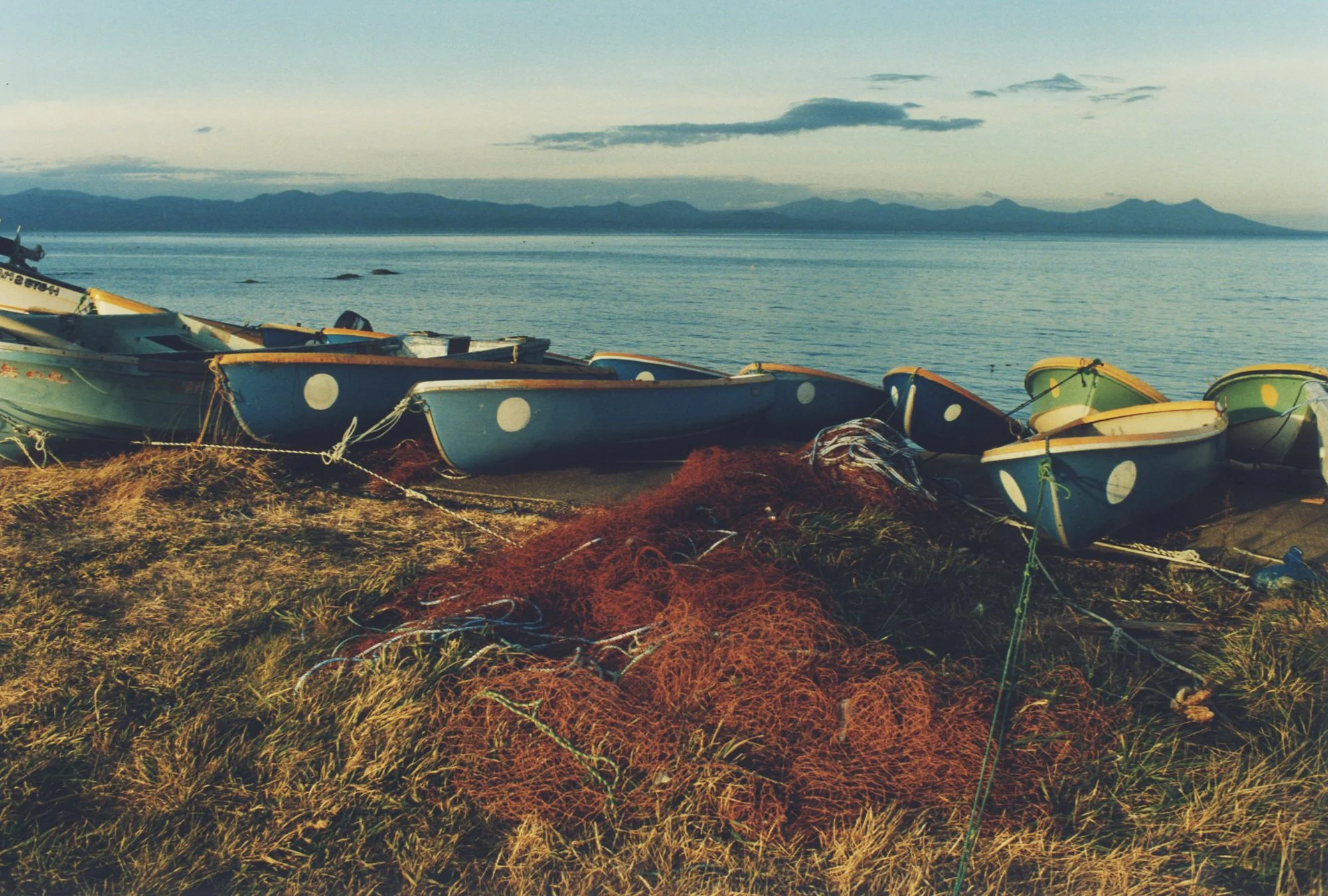
Koji Onaka, Aomori Natsudomari, 2021, handmade darkroom print, courtesy of Blue Lotus Gallery.
‘Jeremy’s Bathhouse’ at Oi!
Chan Wai Lap transforms Oi! into a playful yet psychologically astute environment with Jeremy’s Bathhouse, an immersive installation that reimagines bathing as a participatory social encounter. Continuing his long-running Swimming series, the exhibition extends Lap’s interest in the shifting dynamics between public and private space, self and other, exposure and retreat. Here, the familiar architecture of pools and changing rooms is reconfigured through a warmer emotional register, inviting visitors into a space where intimacy, distance, and coexistence are continually negotiated.
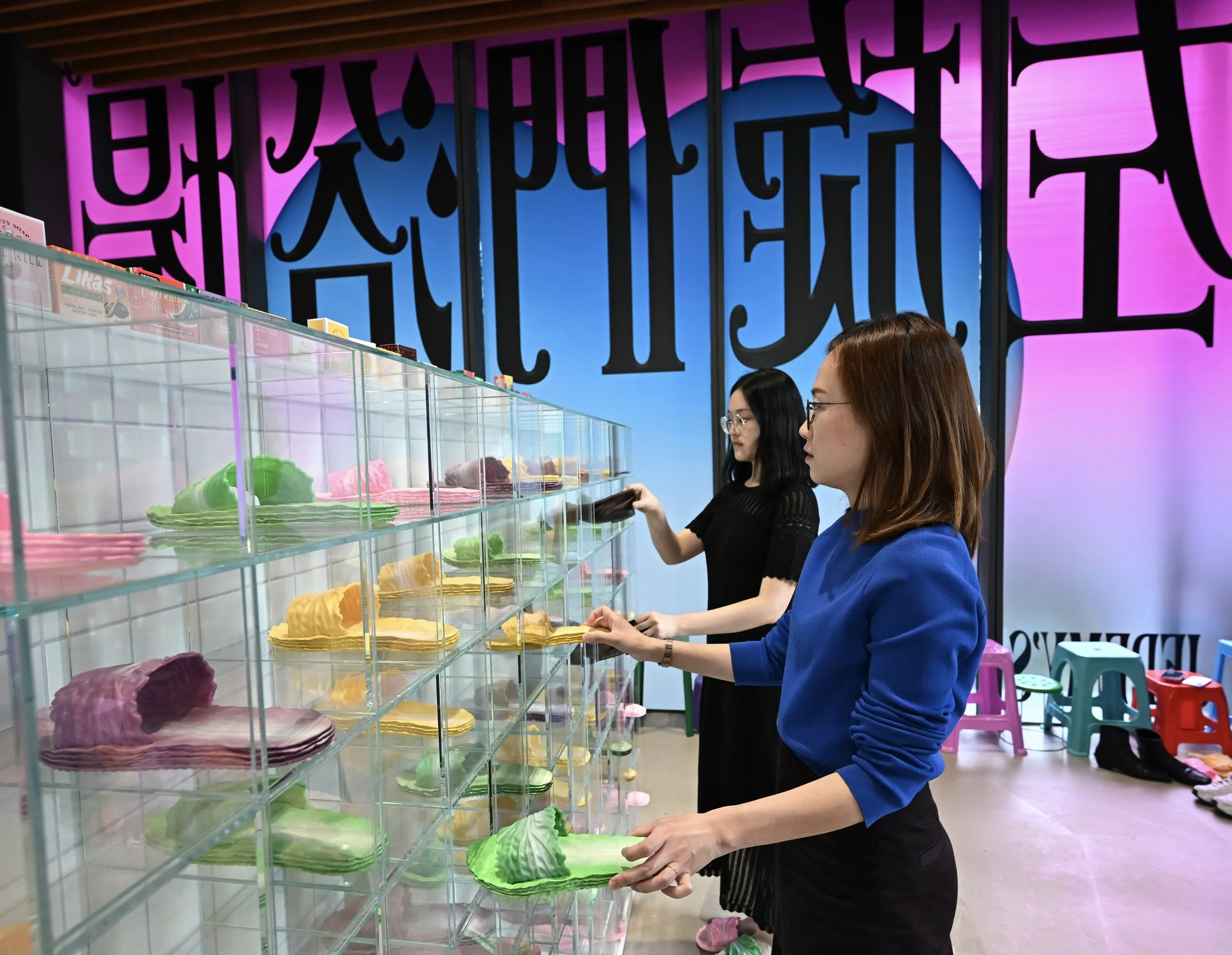
Courtesy of Oi! gallery.
The title draws on the widely reported story of Jeremy, a rare left-spiral garden snail whose reversed shell made finding a mate unusually difficult. Lap adopts this biological anomaly as a metaphor for contemporary urban life, where individuality can become both a defining trait and an obstacle. In his reading, the left-spiral snail becomes a symbol of variation, adaptation, and the challenge of living alongside difference. Amid the city’s density, one may remain surrounded by others while still engaged in a private search for connection.
At first glance, the installation appears functional. Tiled surfaces, partitions, slippers, and shower-like fixtures evoke the atmosphere of a bathhouse or a changing room. Yet this familiarity gradually slips into theatricality. Lap uses the translucent glass-brick architecture of Oi! as an active element within the installation, balancing ceramic solidity with light, reflection, and transparency. The space shifts fluidly between observation and participation.
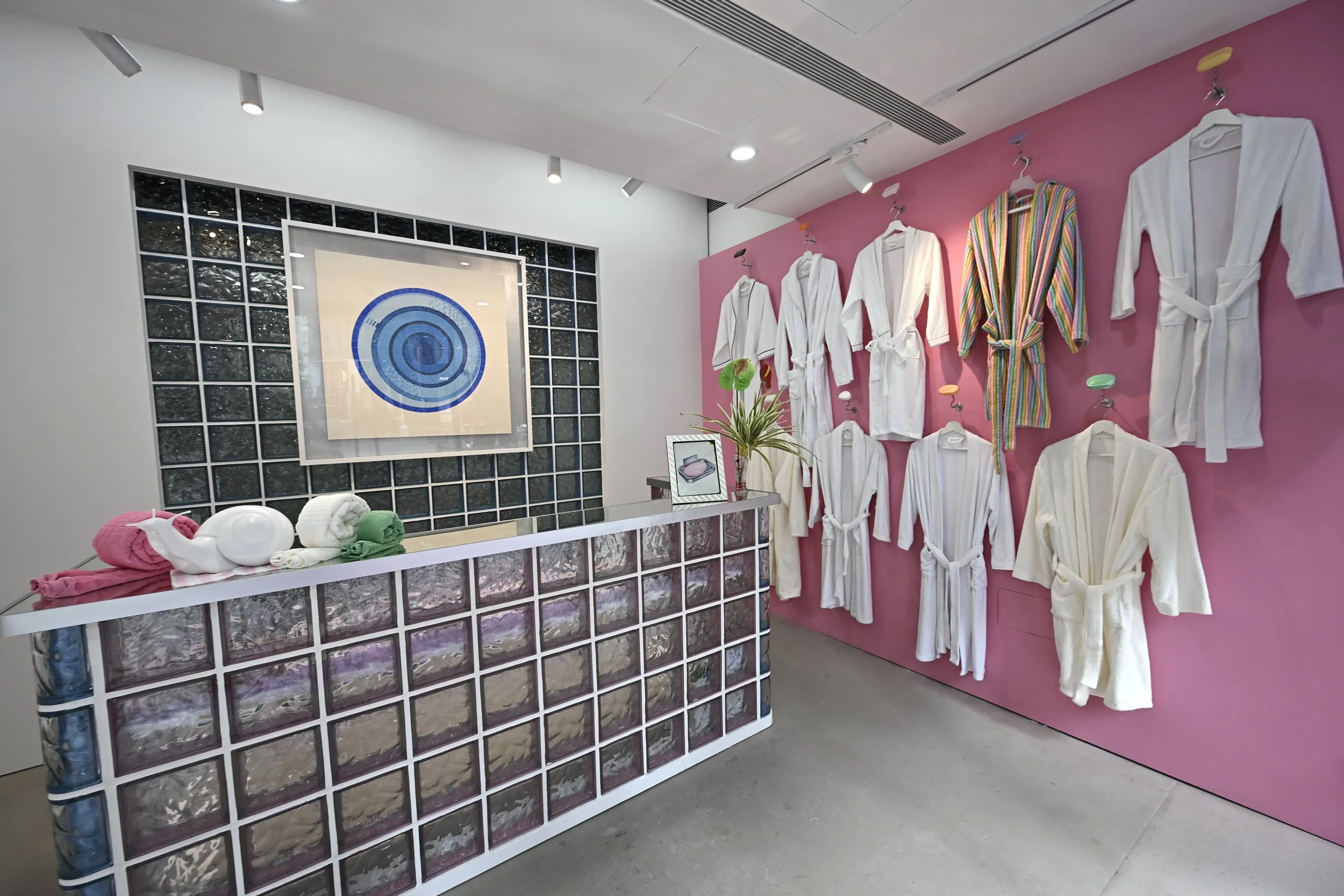
Chan Wai Lap, Dreaming of Swimming Pools, view of the installation at Oi!. Courtesy of Oi!
At its centre is LEVO LOVE (2026), a heart-shaped plunge pool constructed from more than 1,200 handcrafted ceramic tiles. To produce the work, Lap travelled to Jingdezhen, the historic centre of Chinese porcelain production, where he studied ceramic firing techniques and created custom tiles and motifs for the exhibition. The pool’s playful form evokes romance while retaining sculptural precision, inviting visitors to physically enter the work and experience it through the body itself.
Elsewhere, Chromatic Soap (2026) reflects on the intimate relationship between soap and skin through a material associated with touch, erosion, and care. Lap sourced soaps from grocery shops across multiple cities before recreating them as thousands of ceramic forms in varying colours and shapes. Installed in clusters along the walls, the works suggest individuality within collective life, turning repetition into a subtle study of difference and coexistence.
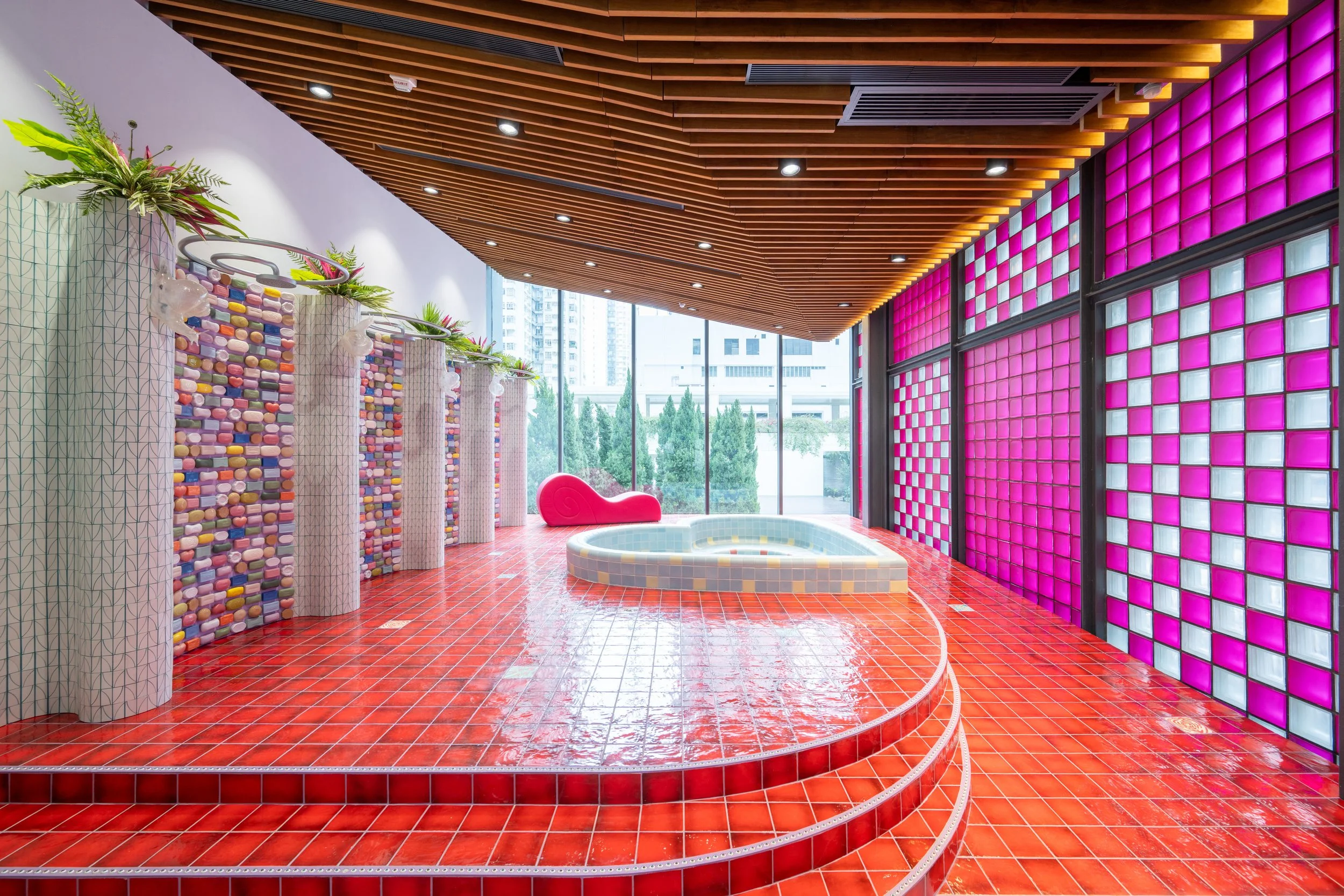
Chan Wai Lap, LEVO LOVE, view of the installation at Oi!. Courtesy of Oi!
A discreet misting system periodically releases scented haze throughout the gallery, softening outlines and dissolving spatial certainty. Visibility shifts, surfaces glisten and the distinction between staged environment and lived experience begins to blur. This atmospheric instability reinforces Lap’s interest in how bodies navigate communal space and proximity.
Humorous yet reflective, Jeremy’s Bathhouse suggests that contemporary intimacy often unfolds through fleeting encounters rather than permanence. By transforming a private setting into an open social arena, Lap proposes that vulnerability and coexistence need not be opposites. Like the unlikely snail that inspired it, the exhibition suggests that difference may complicate belonging, but can also create new forms of relation.
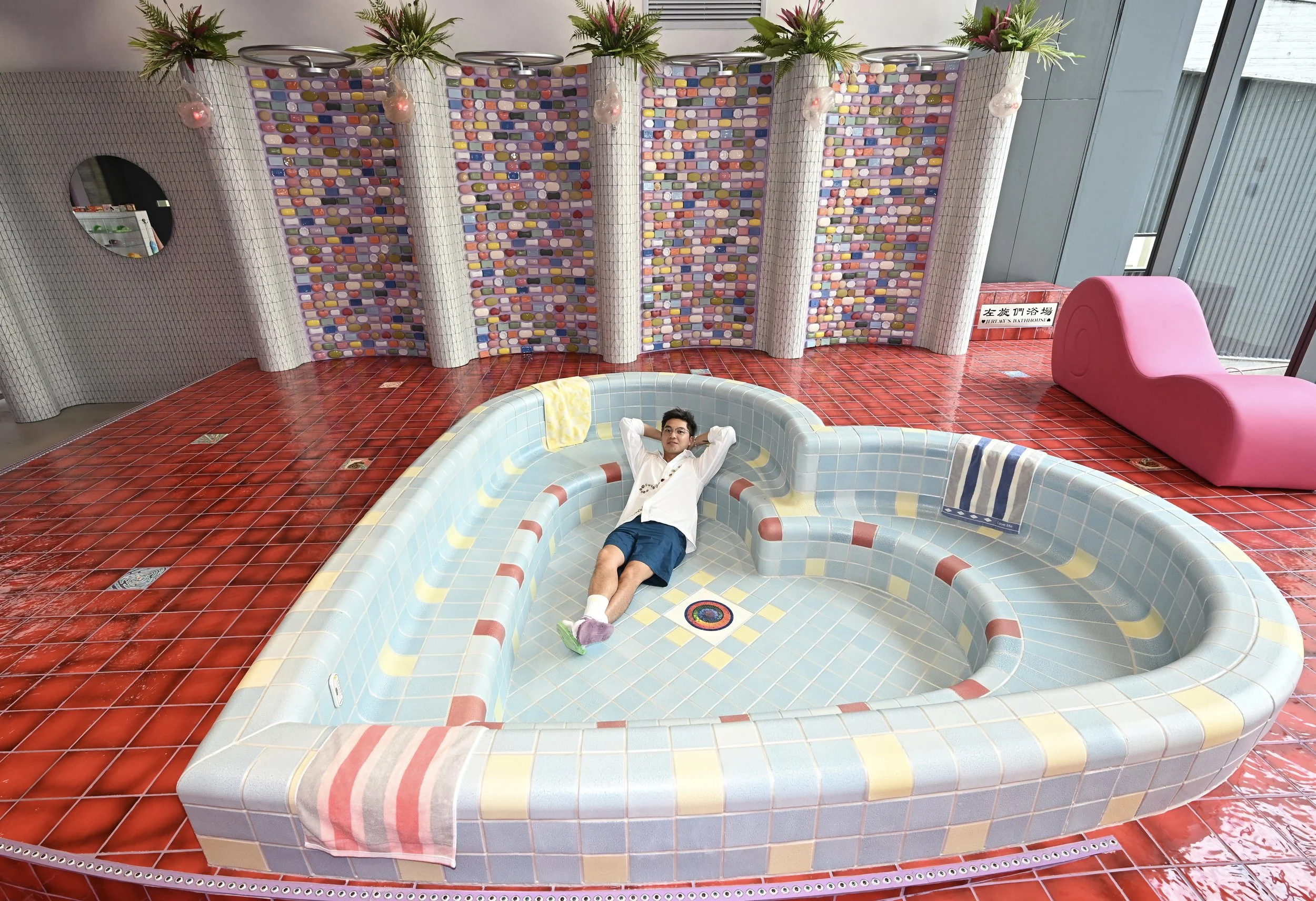
Artist Chan Wai Lap, site-specific installation LEVO LOVE. Courtesy of Oi! gallery.
‘Lee Bul: From 1998 to Now’ at M+
Since the 1990s, Lee Bul has developed a practice that resists easy categorisation, moving across sculpture, performance, installation, and drawing while probing the unstable boundary between the human body and its technological extensions. Her work repeatedly returns to tensions between desire and control, idealism and collapse, imagining futures that fracture under the weight of their own ambitions.
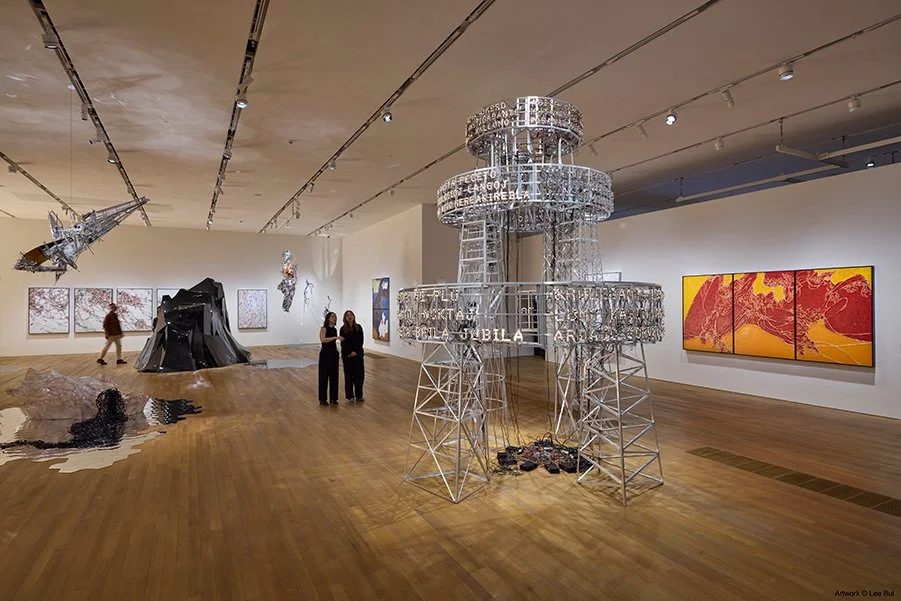
Installation views of Lee Bul’s works at M+. Courtesy M+ Museum.
She emerged in late-1980s Seoul during a period of profound political and social change, and this history remains an important undercurrent throughout her work. Raised as the daughter of political dissidents, she developed a sustained sensitivity to systems of power, vulnerability and ideological promise. Her early performances confronted the female body, beauty and abjection with directness, while later works expanded these concerns into reflections on architecture, modernity, and civilisation itself.
It is within this terrain that Lee Bul: From 1998 to Now arrives at M+. Co-organised with Leeum Museum of Art, where it first drew significant public attention, the exhibition functions less as a conventional retrospective than as a long view across four decades of inquiry. Bringing together more than 200 works from the artist’s studio alongside institutional and private loans from across Asia and beyond, the Hong Kong presentation expands on the Seoul iteration with forty-nine additional early works from the late 1990s and early 2000s, as well as recent works produced in 2024. Across these works, Bul transforms philosophical and political inquiry into objects of striking formal intensity that remain both materially seductive and conceptually unsettling.
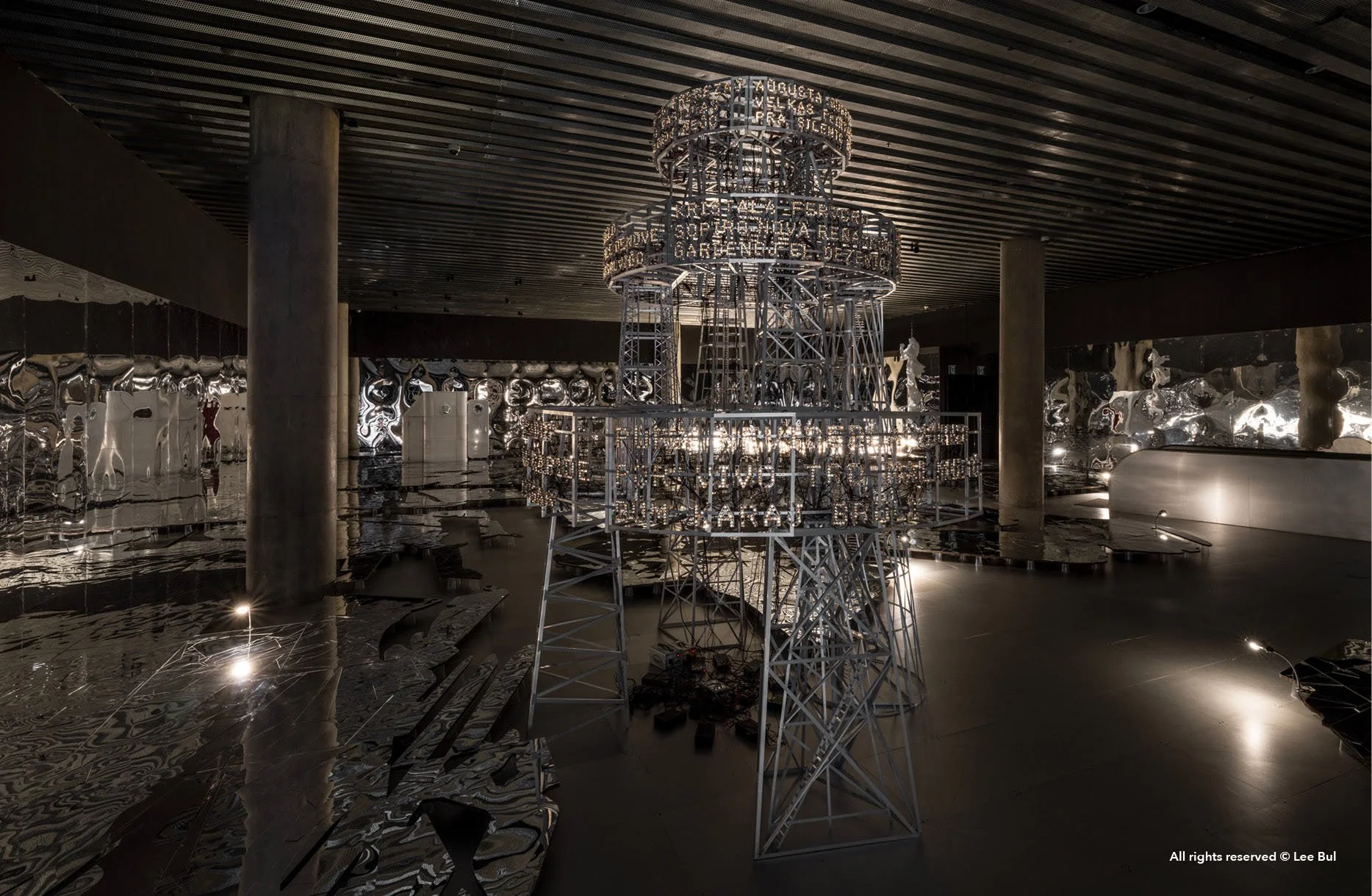
Installation views of Lee Bul’s works at M+. Courtesy Lee Bul.
The exhibition unfolds across three sections. The opening chapter centres on works from the Mon grand récit series (2005–ongoing), where fragmented, gleaming structures evoke both the ambitions and ruins of modernism. These sculptural environments reflect on failed utopias and the grand narratives that once promised perfected futures. They are shown alongside works from the Perdu and Untitled (Willing to Be Vulnerable – Velvet) series, in which softness, ornament and fracture complicate the harder surfaces of technological progress. Together, the works suggest that history’s ideals remain inseparable from instability and loss.
The second section returns to the Cyborg and Anagram series that established Bul’s international reputation in the late 1990s and early 2000s. Here, bodies appear fragmented, hybridised, and reconfigured, drawing equally from classical sculpture, science fiction, and feminist critique. Idealised forms are disrupted by prosthetic fantasies and biomechanical mutations that challenge inherited ideas of beauty, gender, and wholeness. Long before such concerns entered mainstream discourse, Bul was already examining how technology reshapes identity and turns the body into a site of aspiration, anxiety, and control.
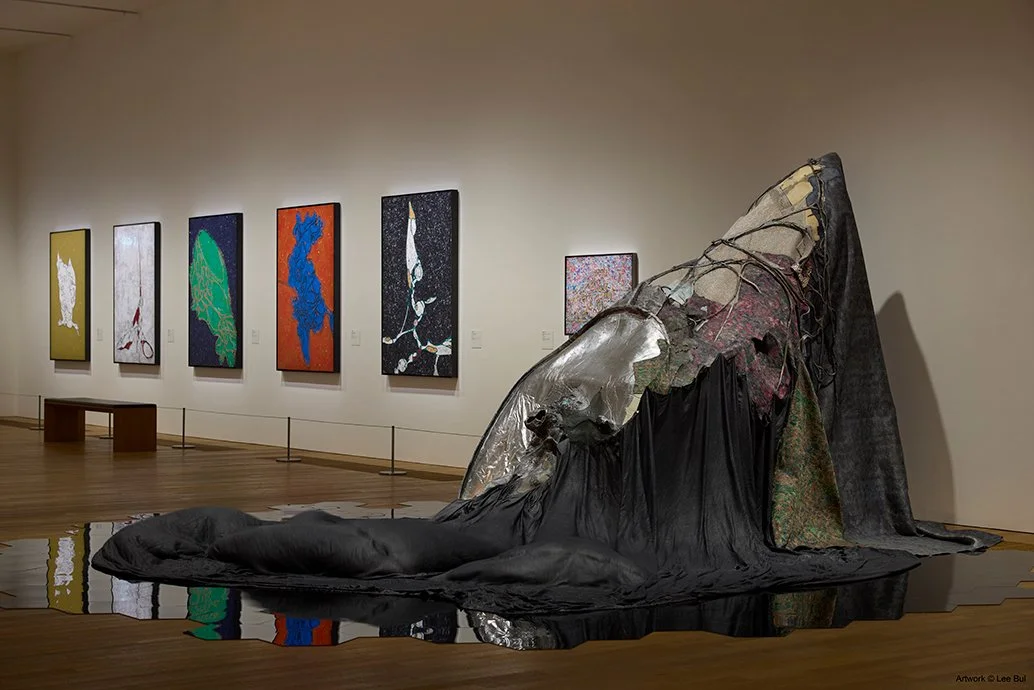
Installation views of Lee Bul’s works at M+. Courtesy M+ Museum.
A final section, conceived in the manner of an artist’s studio, shifts attention towards process and experimentation. Around one hundred drawings, sketches, and scaled maquettes reveal the speculative thinking and formal precision underpinning Bul’s often monumental installations. Rather than functioning as secondary material, these studies demonstrate how intuition, philosophical inquiry, and material experimentation converge within her practice. The exhibition ultimately positions Bul not only as a major Korean artist, but as one of the defining figures of contemporary art internationally. Following its Hong Kong presentation, the exhibition will travel to the Museum of Contemporary Art Antwerp and the National Gallery of Canada through late 2027.
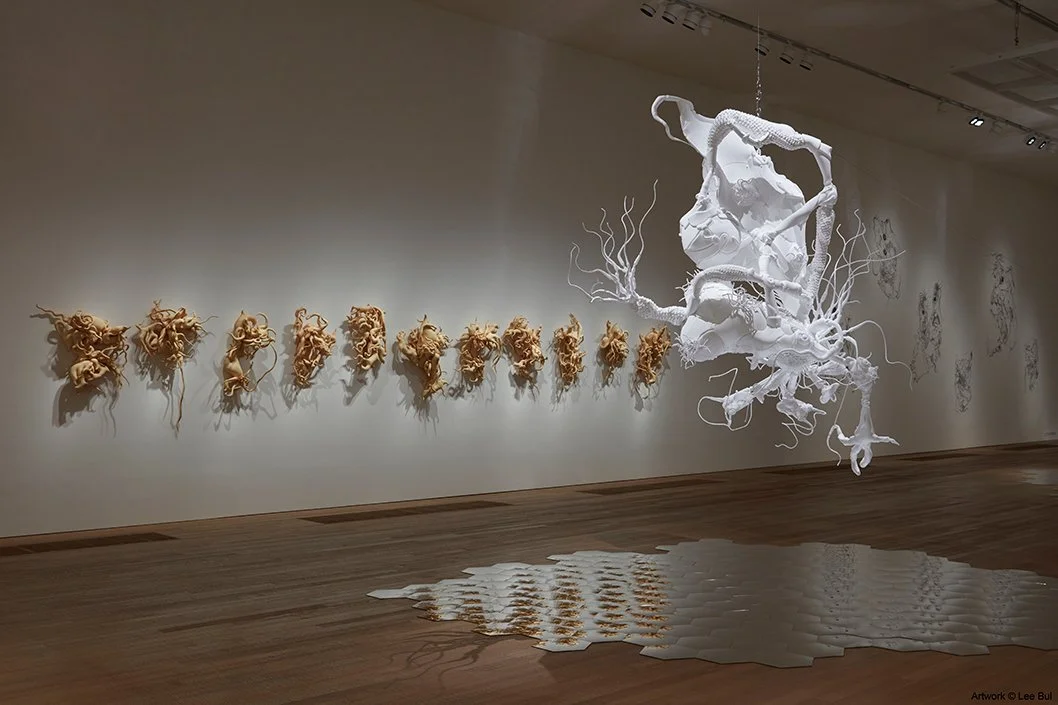
Installation views of Lee Bul’s works at M+. Courtesy M+ Museum.
‘Remembrance’ at 10 Chancery Lane Gallery
10 Chancery Lane Gallery presents Remembrance, an exhibition tracing the life and work of Dinh Q. Lê, one of Southeast Asia’s most influential contemporary artists. Curated by David Elliott, the exhibition revisits a practice shaped by displacement, memory, and the instability of historical narratives. Through photography, installation and his distinctive photo-weaving techniques, Lê approached history as something fragmented and continually reconstructed.
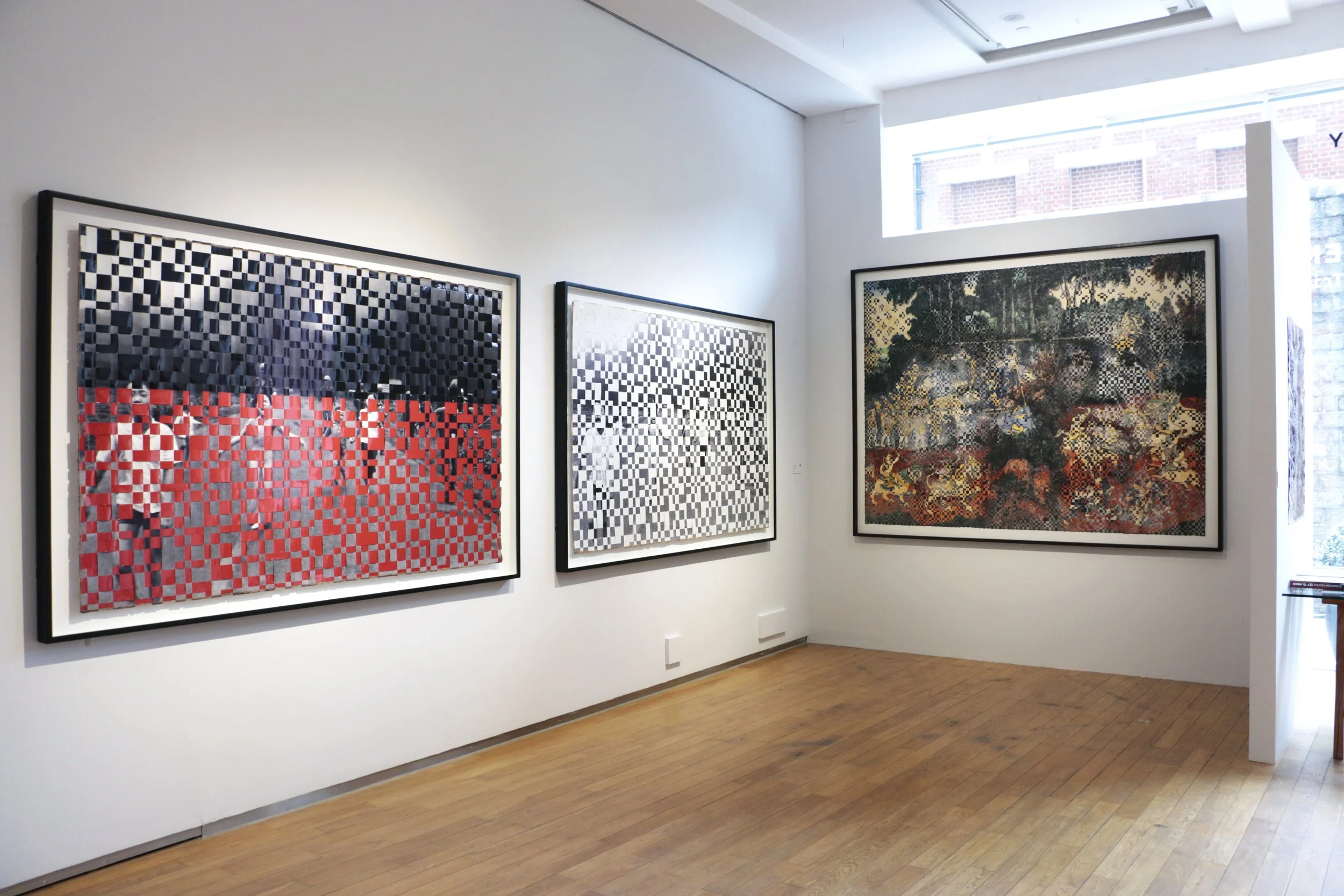
Remembrance. A Tribute to the Work of Dinh Q. Lê, 10 Chancery Lane Gallery. Courtesy of the gallery.
Born in Hà Tiên, South Vietnam, Lê fled the country with his family in 1978 before resettling in the United States. Growing up between Vietnam and America informed his enduring interest in exile, identity, and the politics of representation. After studying fine arts and photography in California and New York, he began critically examining the American retelling of the Vietnam War, particularly through cinema. His signature photo-weaving method, inspired by the woven grass mats made by his aunt in Vietnam, disrupted the apparent authority of photography by interlacing images into layered and often conflicting narratives.
Many works in Remembrance reflect this approach. From Vietnam to Hollywood (2004) juxtaposes film stills, news imagery and vernacular photographs to expose how the Vietnam War was mythologised through Western popular culture. Works such as Cambodia: Splendour and Darkness (1998) and Hill of Poisonous Tree (2008) confront histories of violence and trauma through archival imagery and fragments of Angkor Wat.
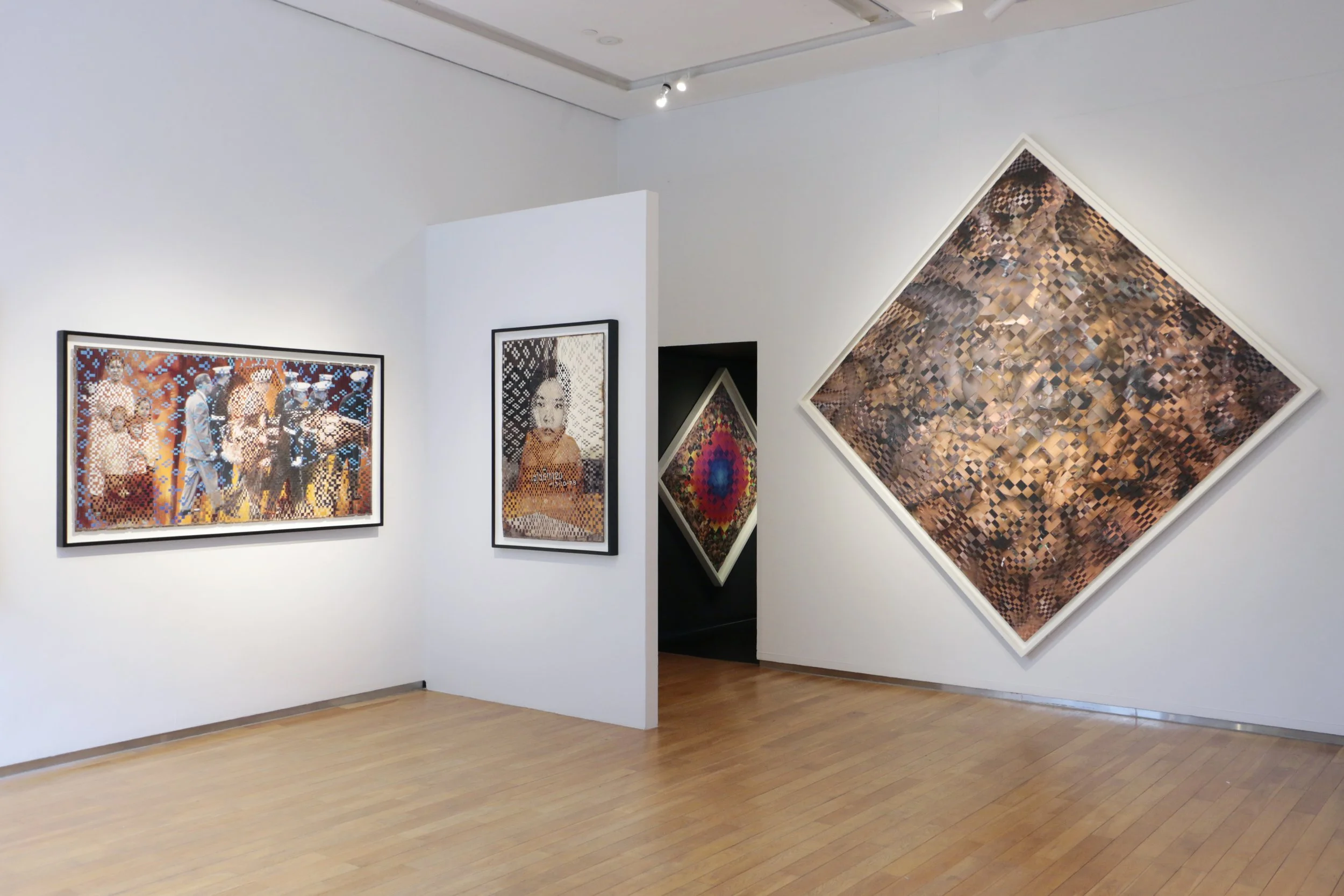
Remembrance. A Tribute to the Work of Dinh Q. Lê, 10 Chancery Lane Gallery. Courtesy of the gallery.
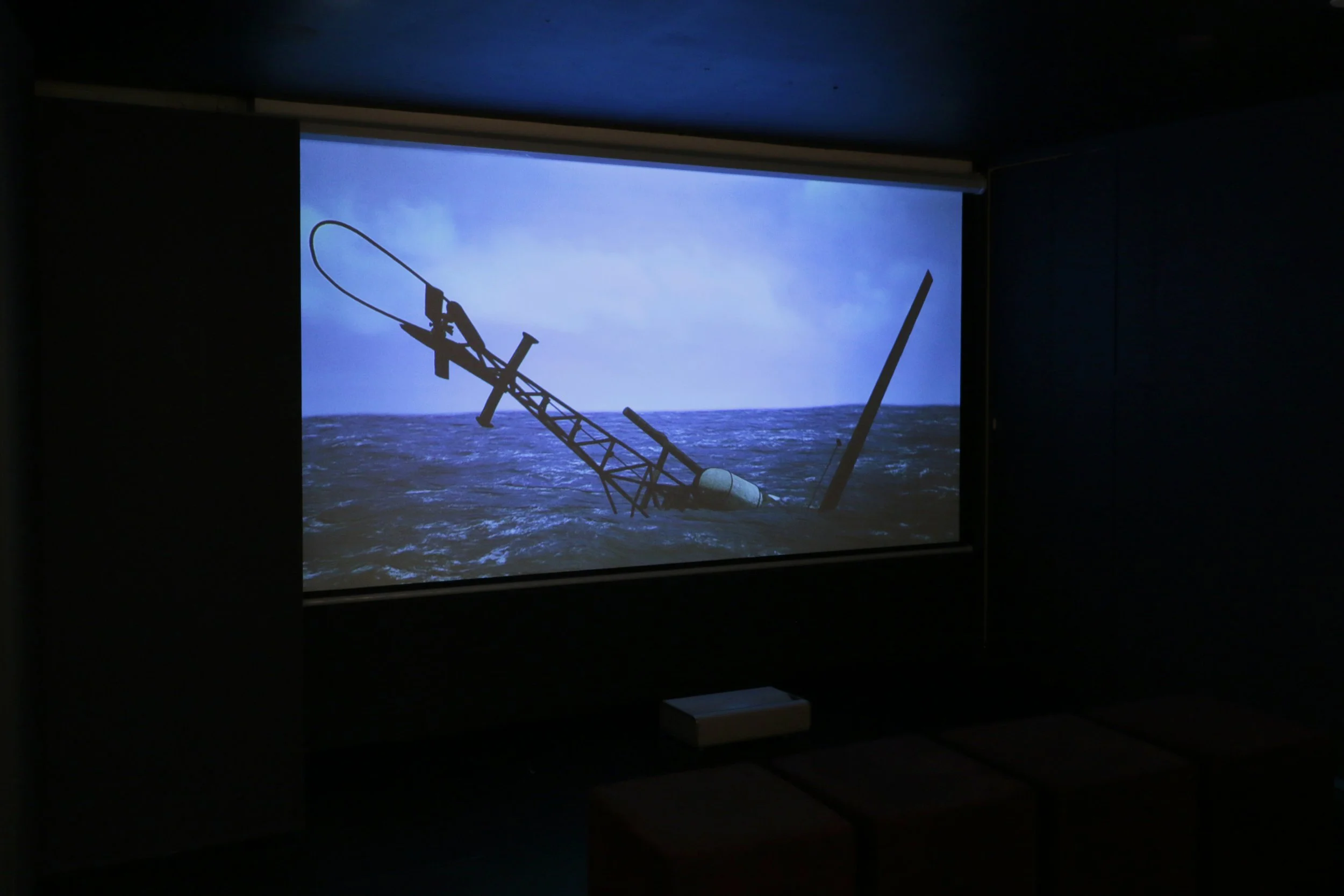
Remembrance. A Tribute to the Work of Dinh Q. Lê, 10 Chancery Lane Gallery. Courtesy of the gallery.
Later projects, including South China Sea Pishkun (2009), Tropicana Fantasy (2015), and Glitter’s Paradise (2015), shift towards the contradictions of contemporary Vietnam, exploring tourism, censorship, commerce, and ideological spectacle. Across these works, Lê remained attentive to the gap between official narratives and lived experience. Remembrance functions as both a tribute and a reflection, returning to the unresolved histories and fractured memories that shaped Lê’s practice. His work continues to resonate through its insistence that images are never neutral, but active sites where memory, ideology, and lived experience collide.
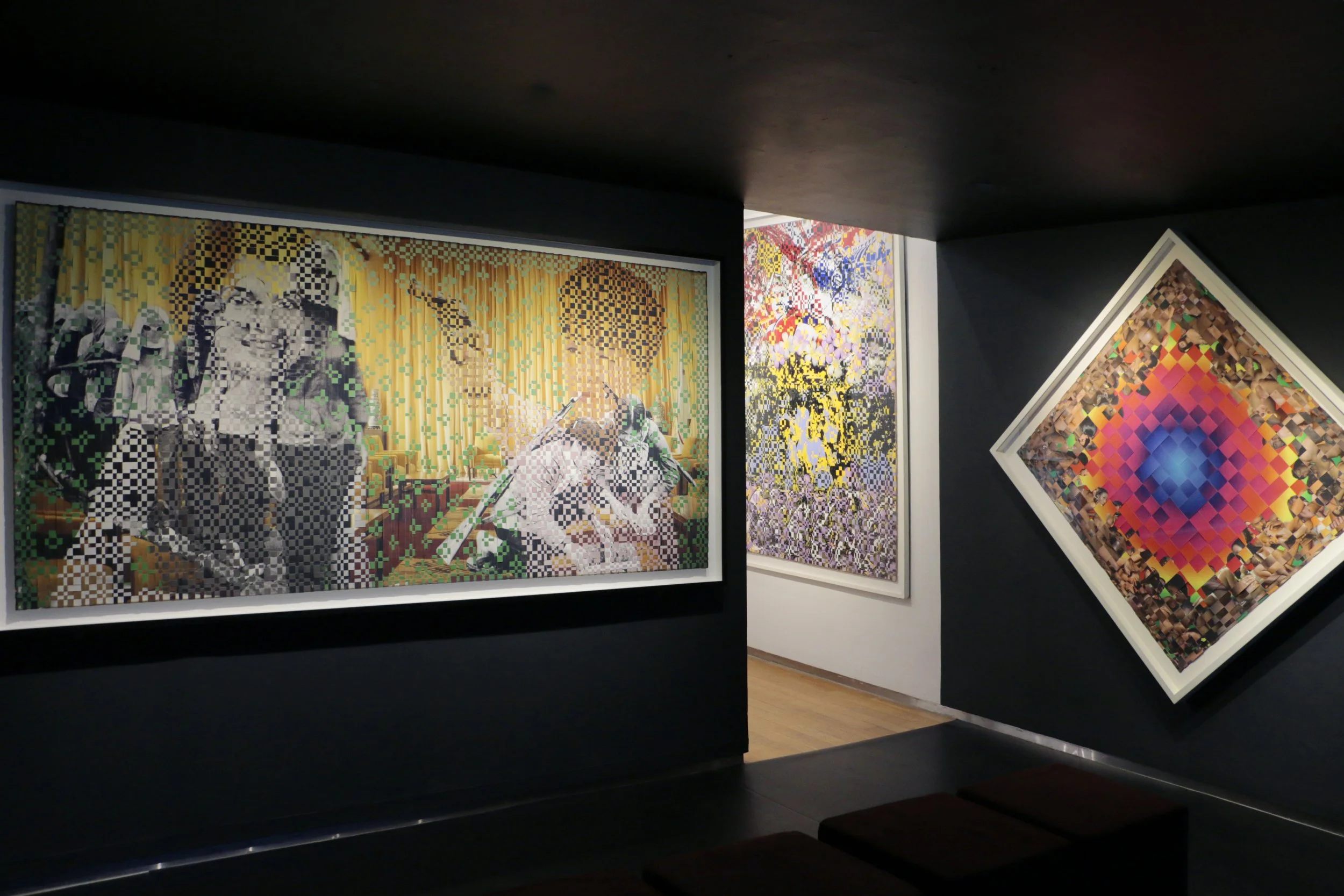
Remembrance. A Tribute to the Work of Dinh Q. Lê, 10 Chancery Lane Gallery. Courtesy of the gallery.
‘Where Roots Grow’ at Art of Nature Contemporary
Wu Guanzhen, born in Nanping, Fujian, in 1984, belongs to a younger generation of artists reworking lacquer beyond the boundaries of craft, ornament, and inherited tradition. His practice is grounded in homesickness, understood not as nostalgia but as a layered condition shaped by distance, belonging, and an ongoing relationship to place.
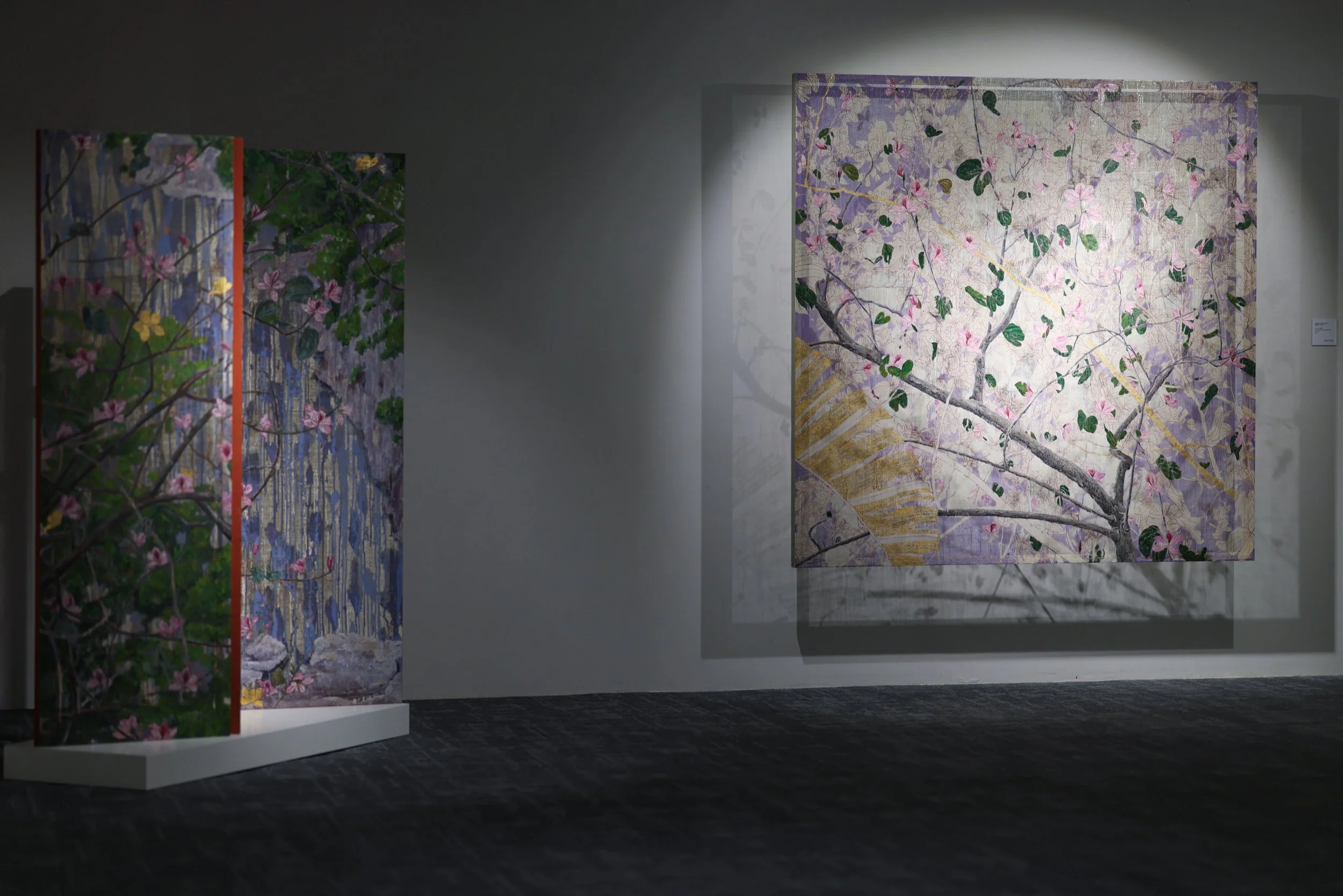
Wu Guanzhen, Where Roots Grow, exhibition view at Art of Nature Contemporary Gallery. Courtesy of the gallery.
Working with ramie fibre and natural lacquer, Guanzhen produces immersive wall-based works and installations where atmosphere is as significant as image. The material qualities of lacquer are central to his approach: its slow curing process, organic density, and unpredictable surface resist the smoothness of synthetic finishes and the formal rigidity often associated with historical lacquer traditions. By using the lighter, translucent qualities of ramie, he allows opacity and transparency to coexist, shifting lacquer away from decorative function towards something more elemental, where surface, time, and transformation become visible. The works suggest materials as repositories of experience, holding traces of making within their surfaces.
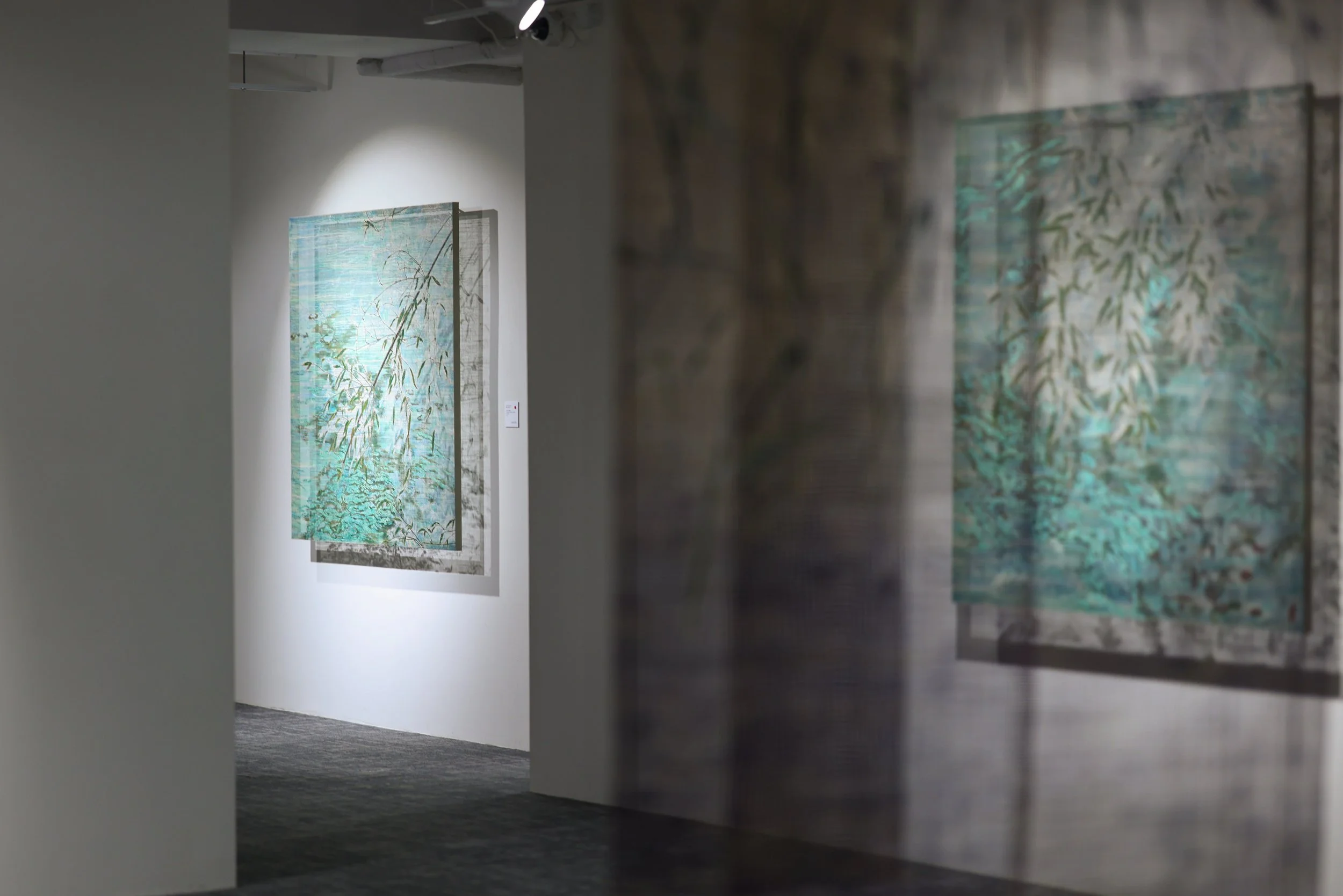
Wu Guanzhen, Where Roots Grow, exhibition view at Art of Nature Contemporary Gallery. Courtesy of the gallery.
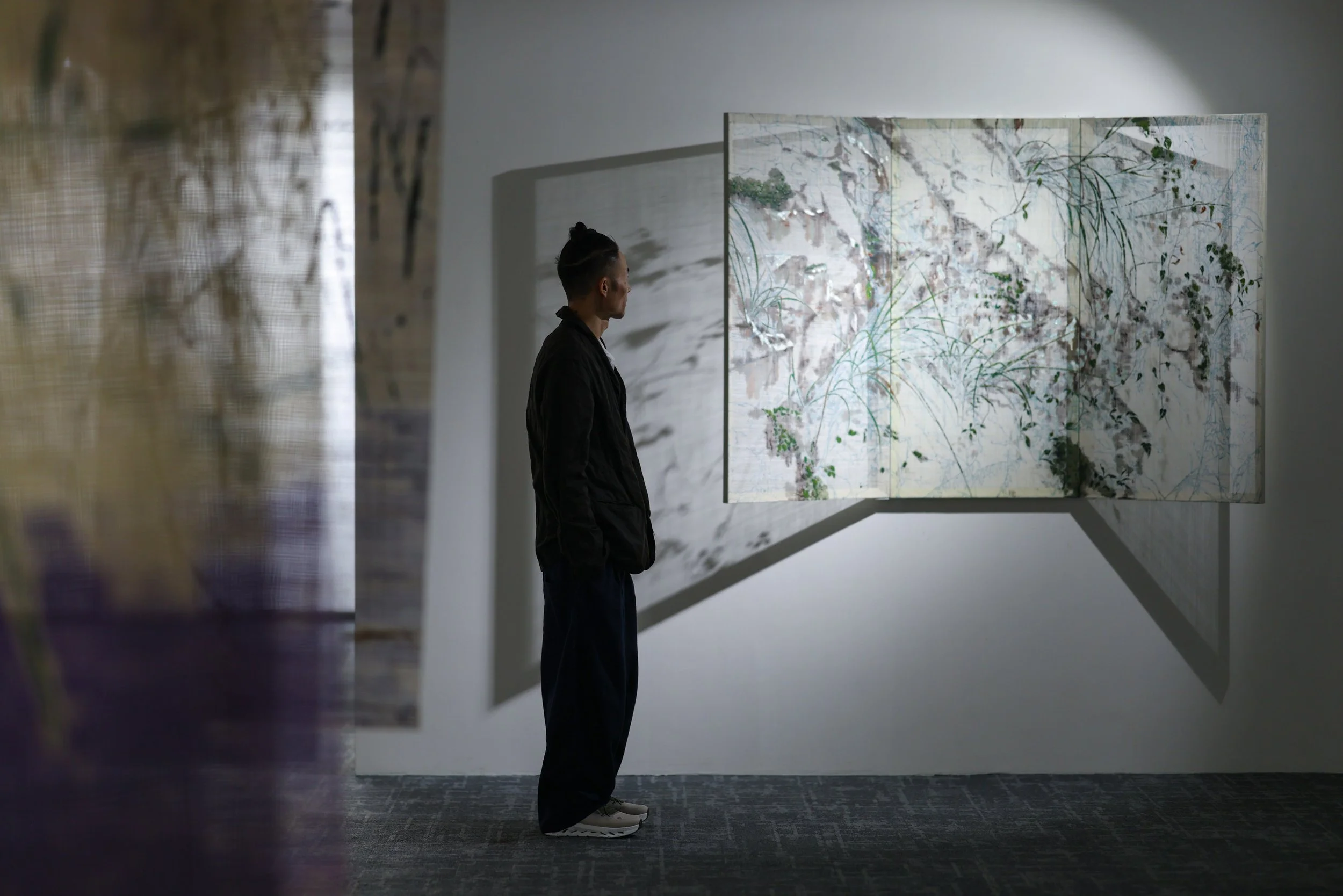
Wu Guanzhen, Where Roots Grow, exhibition view at Art of Nature Contemporary Gallery. Courtesy of the gallery.
His visual language draws on Eastern landscape imagery while avoiding literal symbolism. Mountains, streams, shifting light, and weather appear as perceptual structures rather than motifs. The landscapes of Fujian inform not only what he depicts but also how he works, where creation becomes a bodily return to the environment, movement, and atmosphere. In Where Roots Grow, this sensibility is particularly evident, with time understood as gradual accumulation within matter. Lacquer’s slowness becomes structural, building layer by layer, while ramie and hemp introduce softness and permeability, allowing light to pass through and soften form. Across his practice, Guanzhen proposes a more intimate relationship between material and life. By releasing lacquer from ceremonial and decorative expectations, he reframes it as a contemporary language of memory, environment and care, shaped by patience and the quiet persistence of roots.
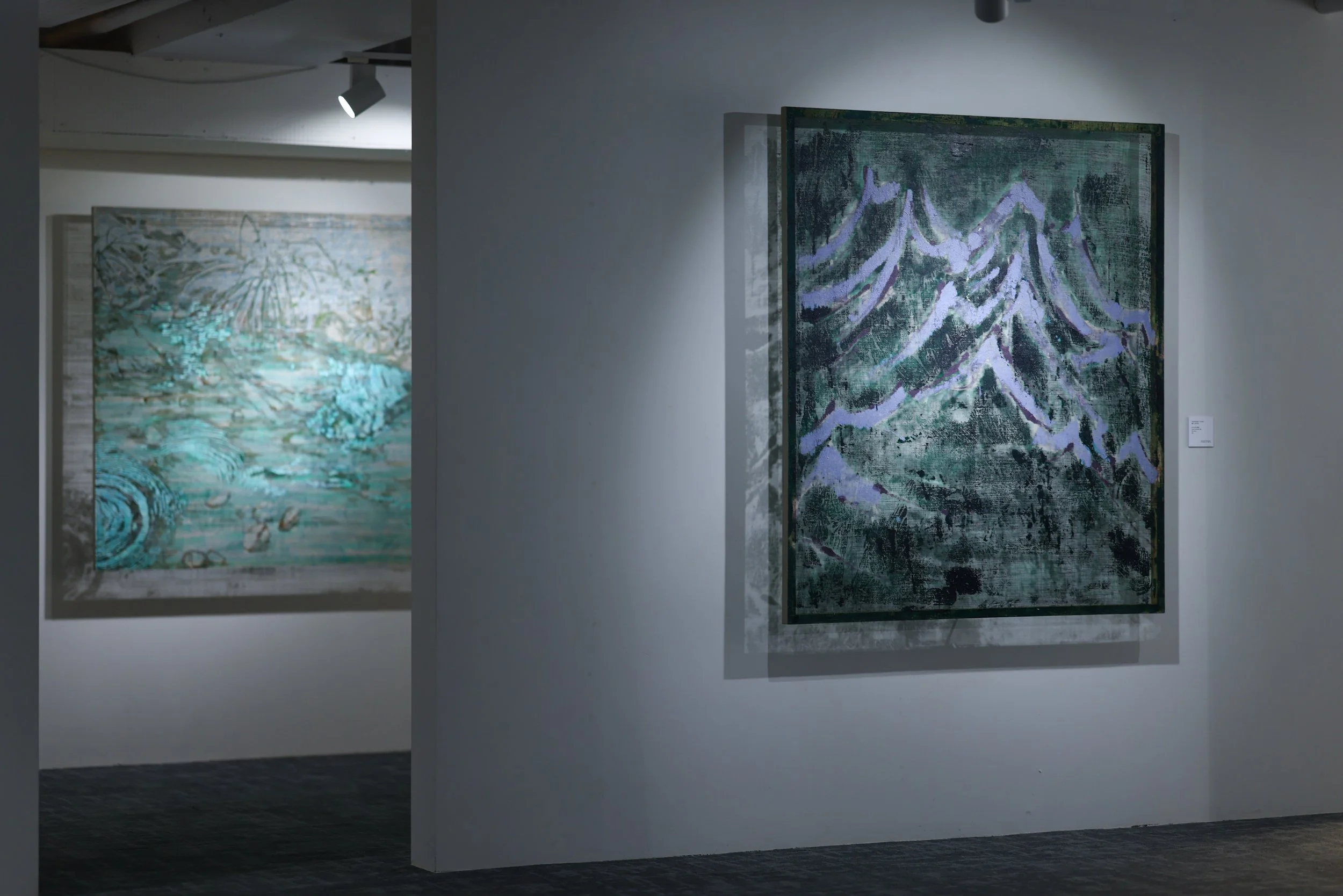
Wu Guanzhen, Where Roots Grow, exhibition view at Art of Nature Contemporary Gallery. Courtesy of the gallery.
Unstable Fields of Meaning
Across these exhibitions, Hong Kong emerges as a place shaped by constant negotiation and change. Through language that shifts across scripts, sound shaped by chance, images drawn from fractured histories, and materials marked by time and touch, the works share an interest in instability — in how perception, memory, and identity are always partial, contested, and still unfolding. Together, they resist fixed meanings, instead presenting understanding as something continuously formed through experience and relation.