
Salvaging Memory with Issam Kourbaj
To look at Issam Kourbaj’s work is to meet the artist’s gaze—pained yet unflinching, intimate, and human. It asks us not to look away. His work does not aestheticise catastrophe, nor does it offer narrative closure. Instead, it inhabits catastrophe as a lived condition—unresolved, extended, and embedded in material culture. Violence is not illustrated but endured: a temporal atmosphere borne by objects, spaces, and bodies. What remains is not an image of destruction, but the weight of endurance, and the ache of having lived through something that does not end.
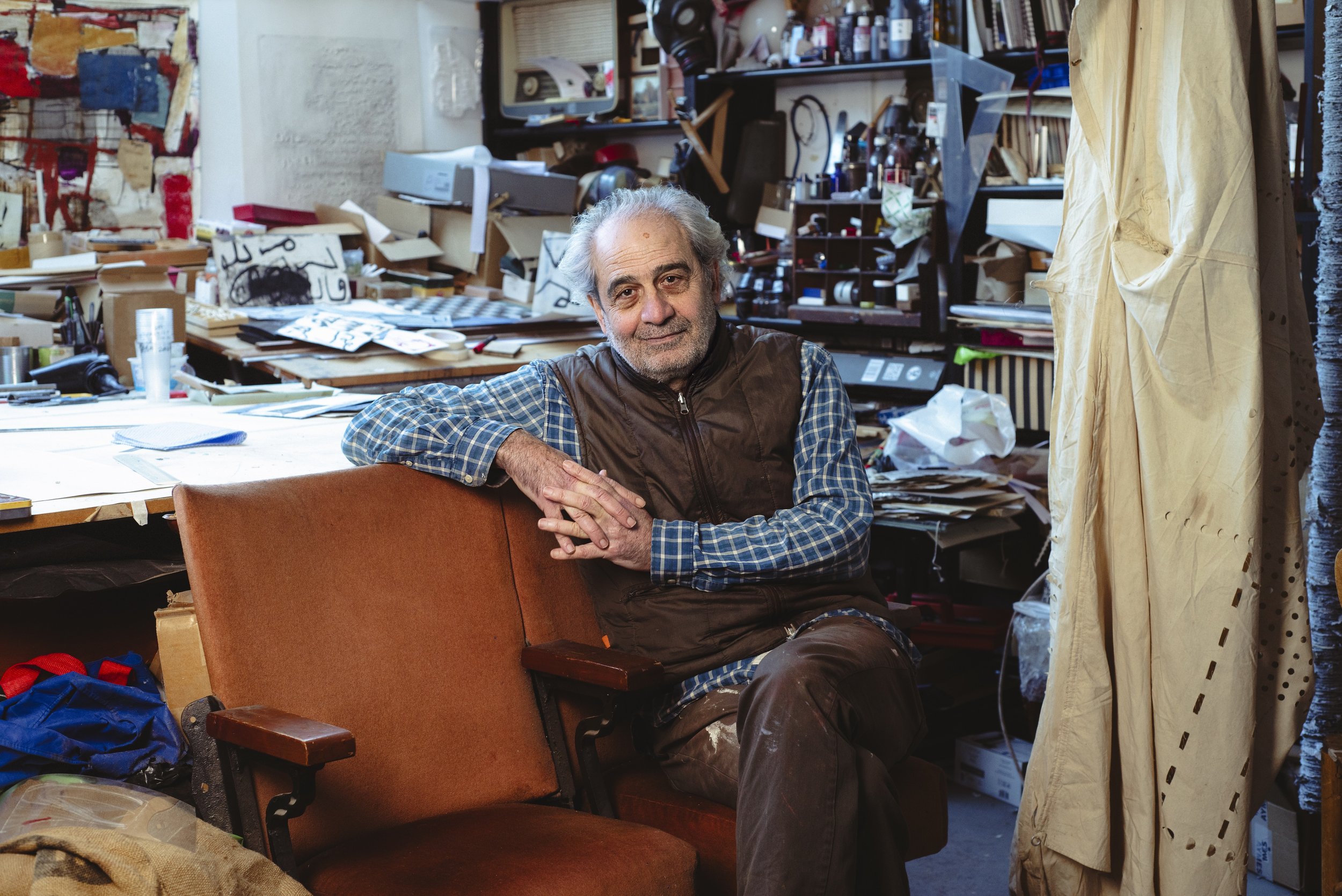
In Kourbaj’s installations, loss is not dramatised; it is allowed to accrue with dignity. Materials recur, gestures repeat, and time is permitted to slow down. Meaning emerges subtly, through sustained encounter rather than immediate recognition. Kourbaj’s works demands not empathy as reaction, but attention as responsibility—a willingness to remain with what does not resolve.
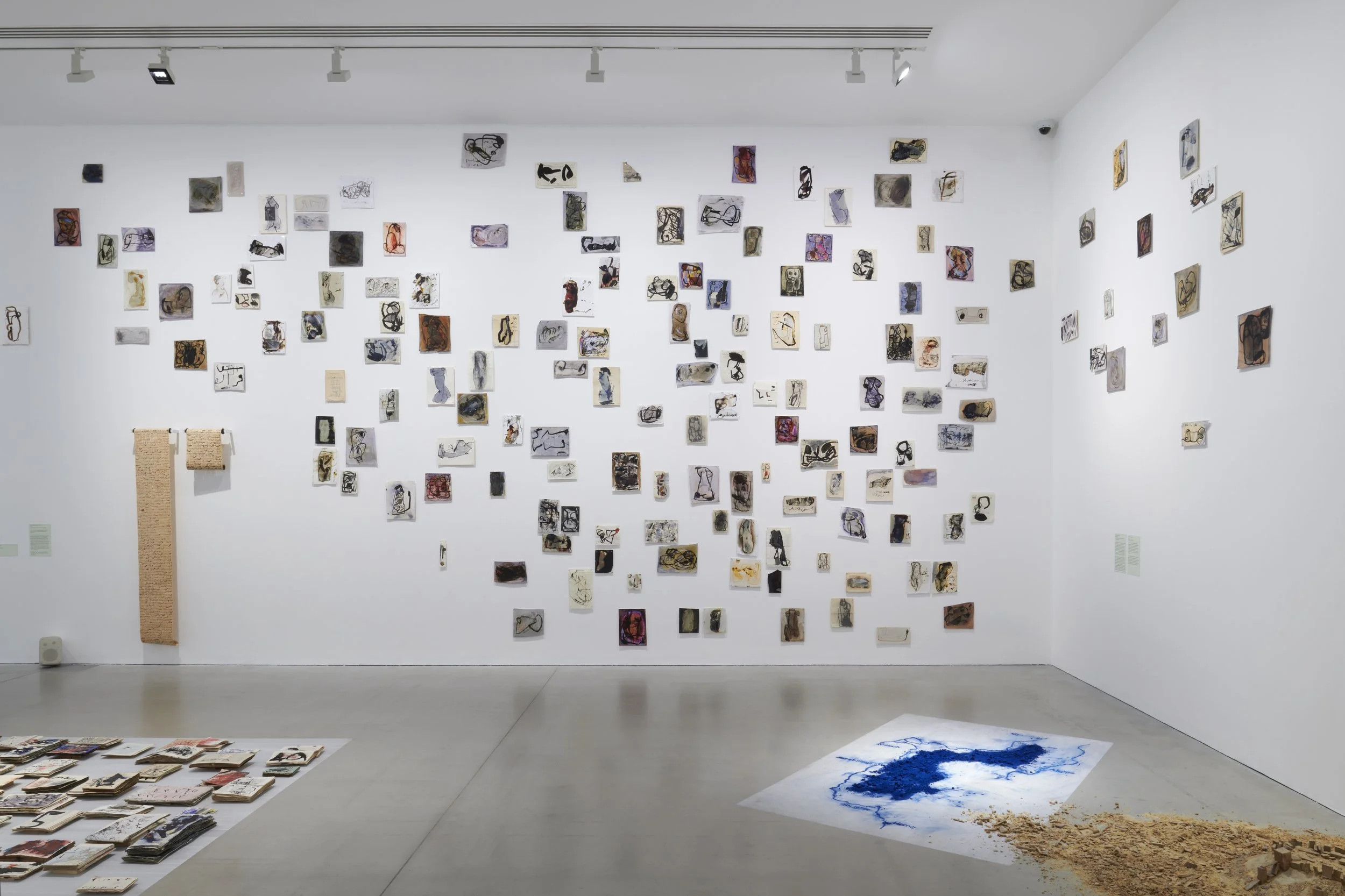
His installations may be understood as the construction of provisional architectures—structures that acknowledge impermanence as their defining condition. These are not buildings in any conventional sense, but spatial propositions composed of salvaged materials and ethical intent.
Insert caption
Born in 1963 in Sweida, in southern Syria’s Druze region, Kourbaj was shaped within a culture defined by historical scarcity and material ingenuity. Coming from the layered history of a region shaped by cycles of settlement, conquest, fragmentation, and displacement, Kourbaj’s practice articulates how memory survives when territorial continuity collapses. His work is less concerned with narrating events than with examining the conditions under which memory, ethics, and accountability persist after rupture. Catastrophe, here, is not an episode but a condition—extended, unresolved, and sedimented within material culture.
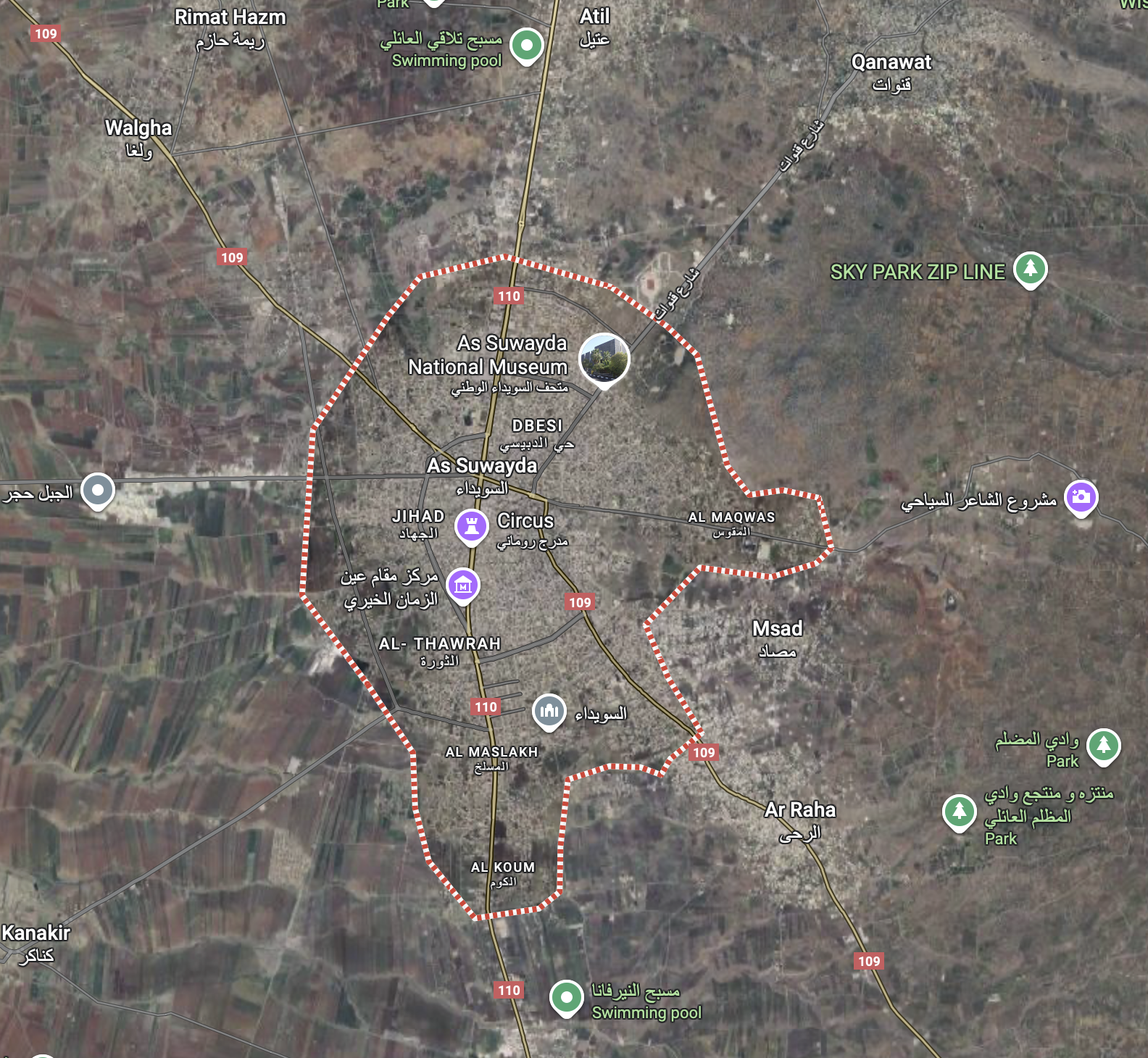
A screenshot taken from Google Maps of Sweida, Syria
Floors become sites of waiting, suspension, or passage; walls act as repositories of absence; everyday objects assume the role of witnesses. Architecture is stripped of authority and permanence. It relinquishes control and becomes instead a framework for holding vulnerability. Space is never neutral. It is shaped by displacement, charged with memory, and continually renegotiated through movement and loss. Kourbaj treats space as lived terrain rather than abstract volume—an environment shaped by human precarity rather than designed control.
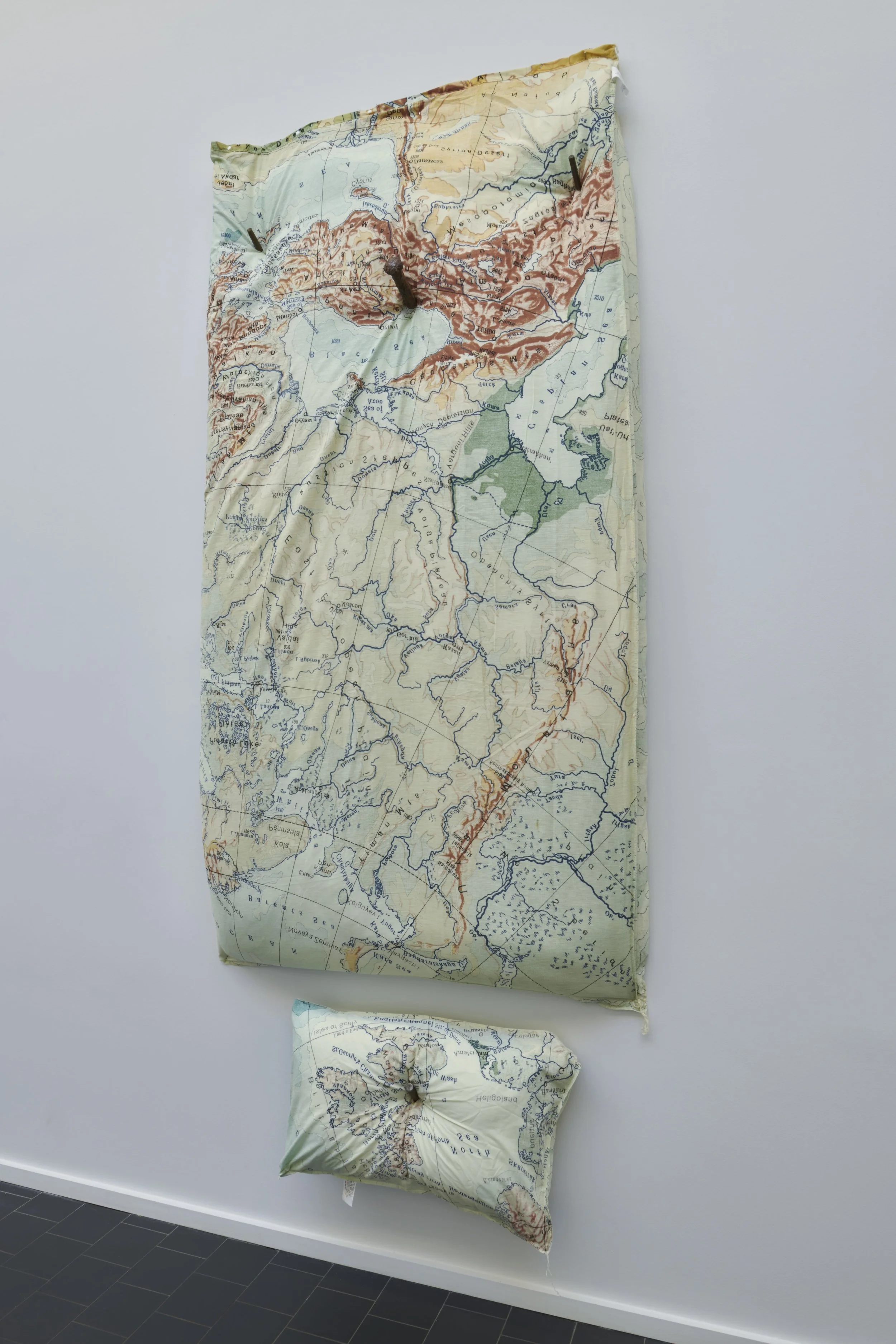
Insert caption
Reusing material was not a choice, but a necessity woven into daily life. Unexploded ordnance left behind by the French mandate was dismantled and reforged into domestic utensils; clothing was repurposed; materials circulated rather than discarded. Family histories—of quilts stitched from worn garments, of lives lost while converting weapons into tools—constituted an early ethical framework in which salvage was inseparable from survival.
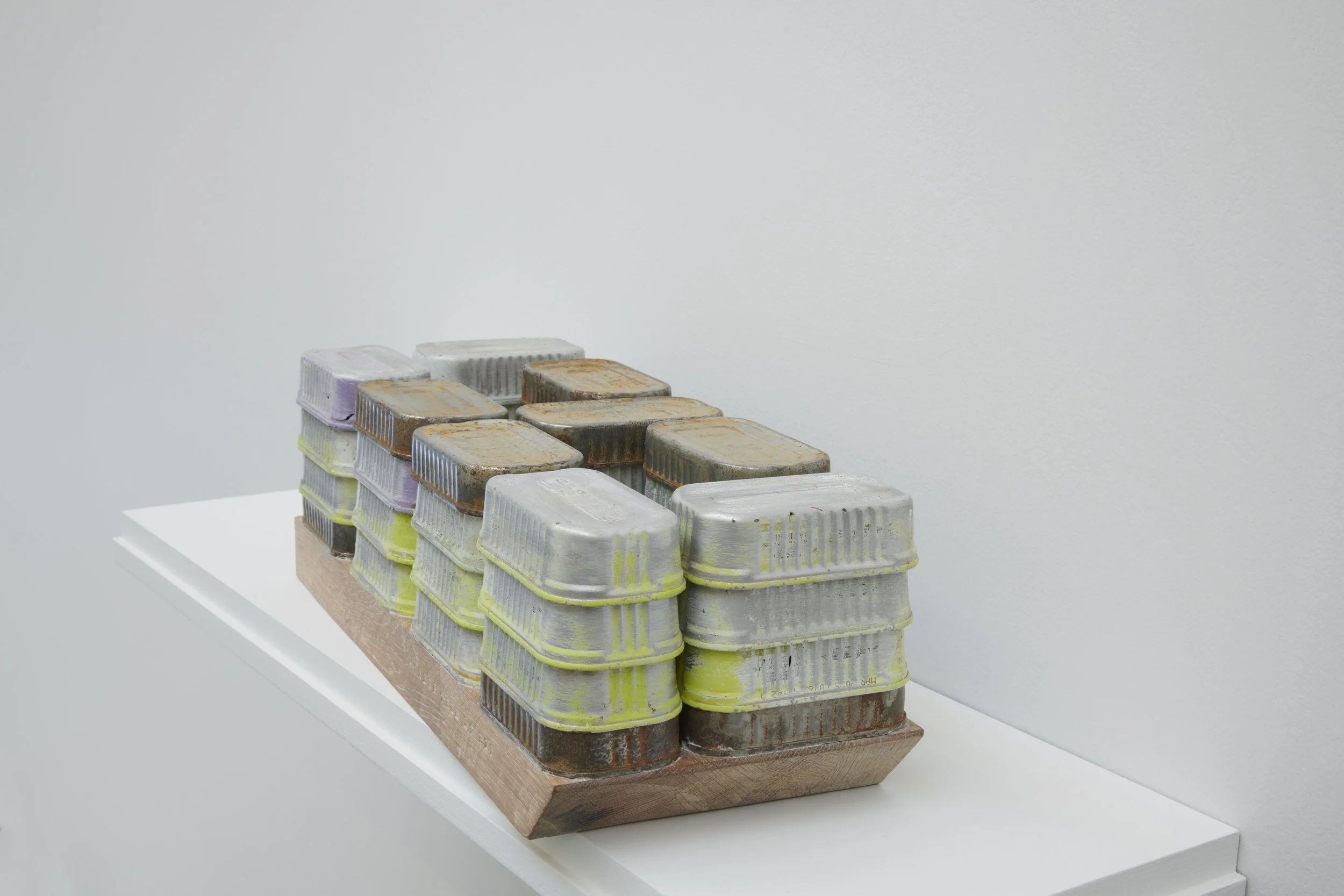
Let Them at Bay, insert caption and size
Since relocating to Cambridge in 1990, Kourbaj has worked within another historically sedimented environment. His studio, situated above a former furniture shop, contains remnants of previous commercial lives: abandoned ledgers, account books, and inventories. These items recur throughout his work, stripped of economic function and recontextualised as records of absence. What once measured value now indexes loss. Exchanges with poets, archaeologists, astronomers, dancers, and engineers extend his inquiry into how knowledge is transmitted, interrupted, and reassembled across disciplinary boundaries.
Language occupies a complex and cautious position within this trajectory. Arriving in England with limited English, Kourbaj acquired language through the act of teaching drawing. He recalls learning to write the Arabic letter ‘ayn’—meaning both “letter” and “eye”—under his mother’s guidance. The anecdote functions as personal memory and as epistemological foundation: seeing precedes naming; drawing precedes language. This prioritisation of visual cognition informs his resistance to declarative statements and explanatory texts within the work.
The outbreak of the Syrian uprising in 2011 introduced a prolonged period of silence in Kourbaj’s studio. Distance, safety, and institutional belonging produced a paralysis rooted in ethical hesitation. For several years, Syria remained absent from his practice. This absence reflects an understanding that immediacy can violate as much as it reveals, and that certain histories require temporal distance before they can be approached without appropriation.
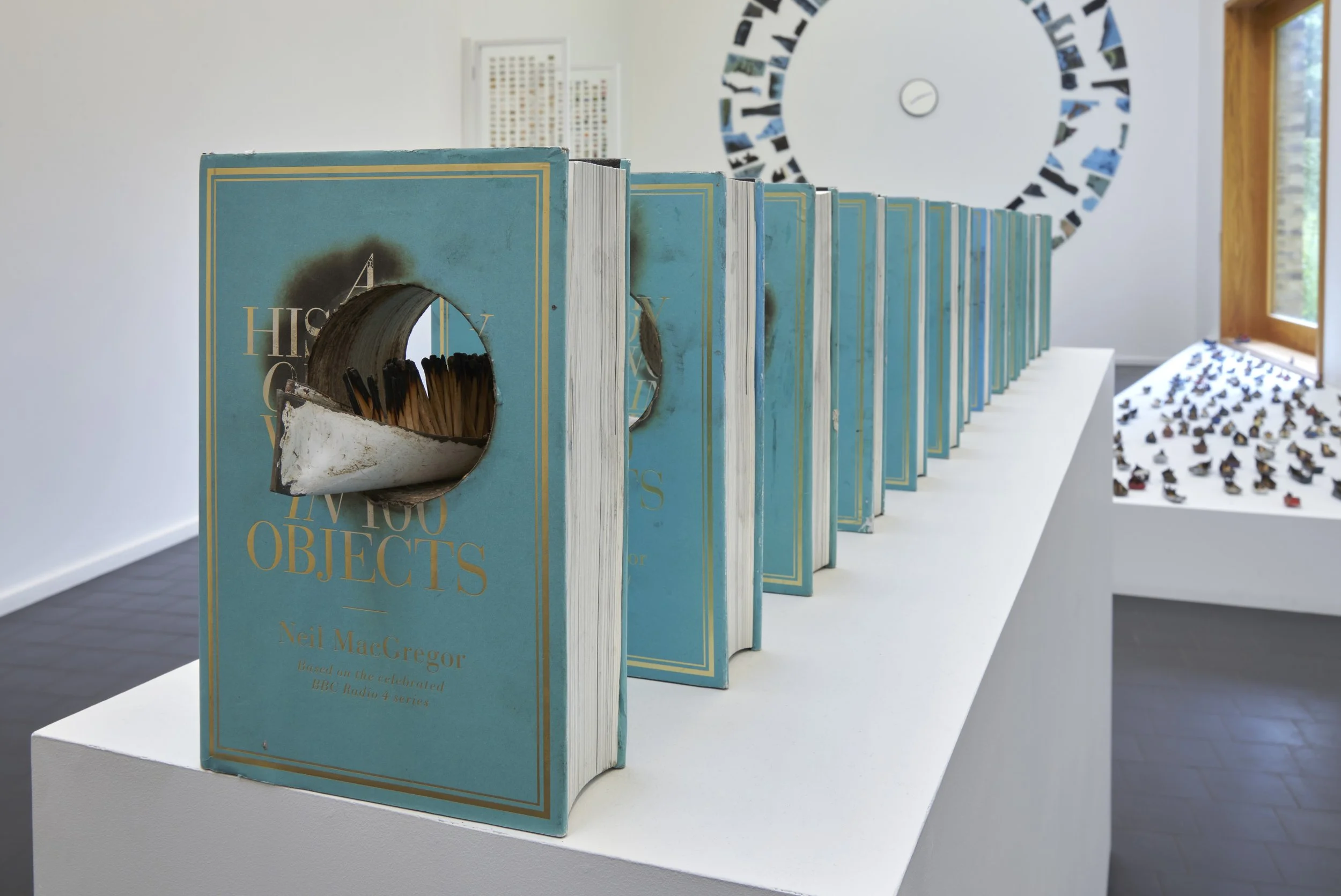
Precarious Passage, thirteen identical books, one for each year of the Syrian uprising
Across geographies, Kourbaj’s installations function as portable architectures of diaspora. By privileging fragility over permanence, his work reframes architecture as an ethical practice—one concerned not with endurance or dominance, but with care, witnessing, and responsibility. This current finds articulation in We Are All Emigrants, a plaster cast of a pregnant woman’s abdomen that reimagines the womb as both sanctuary and point of departure. Displacement is framed not as a condition belonging to refugees alone, but as a universal human inheritance. Birth becomes our first act of emigration—our earliest experience of leaving a place of safety for an uncertain world. Grief is held with reverence. Loss becomes sacred.
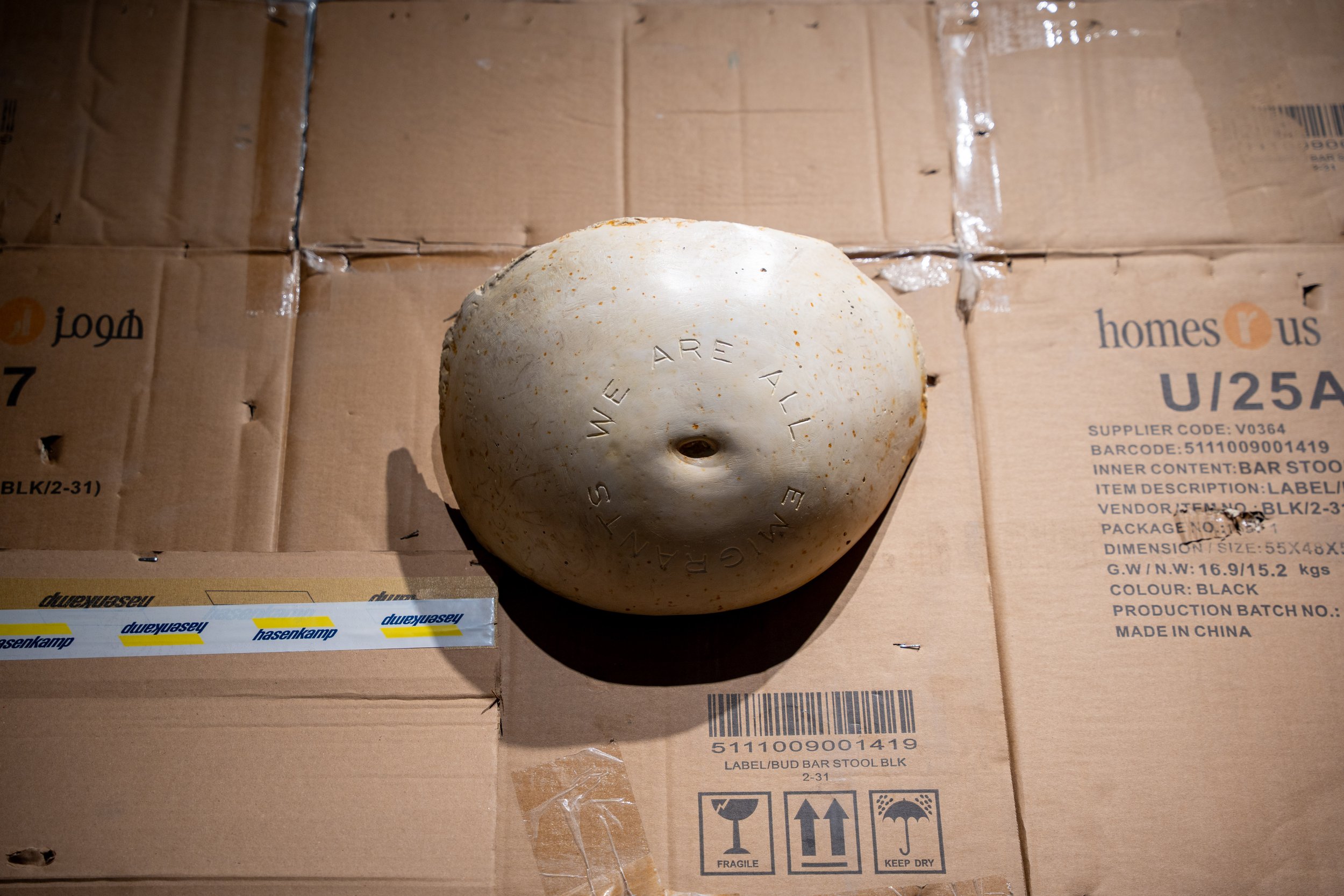
We Are All Emigrants
In The Map of Absence, a perforated 1960s Butka Falcon camping tent is transformed into a fragile cosmos of memory. Tiny punctures trace the map of Kourbaj’s Suweida neighbourhood, drawn by his brother, while a single charred circle marks the family home. It is a map of what cannot be returned to, yet refuses erasure. The tent—a symbol of temporary shelter—becomes both dwelling and wound, holding memory without offering repair.
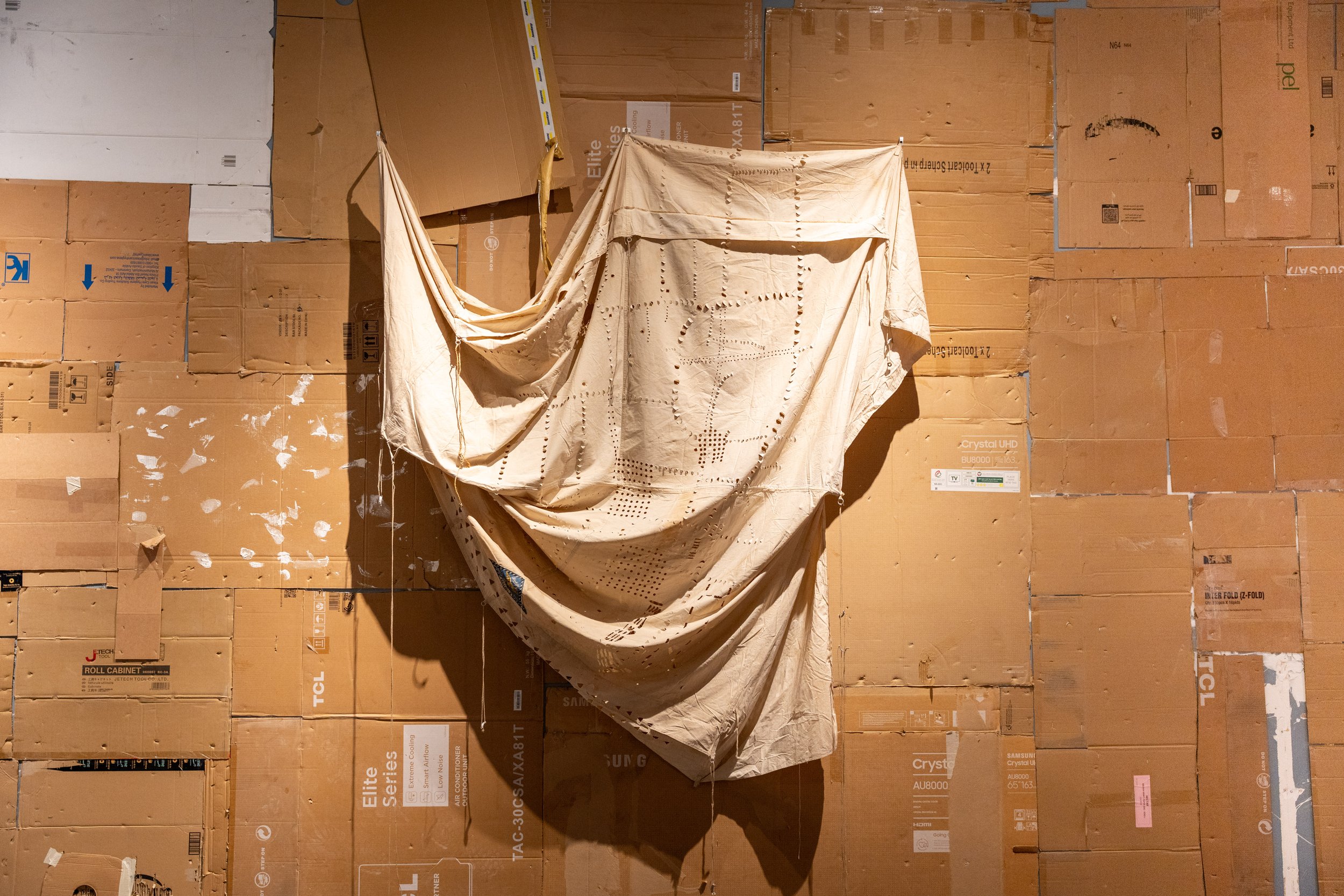
The Map of Absence
Kourbaj’s work does not offer healing, nor does it grant redemption. Instead, it offers something rarer and more necessary: a place where memory can rest without being explained, and where grief is allowed to be. In these suspended architectures, we are not asked to understand loss, but to remain with it, and in doing so, to recognise our own vulnerability within its fragile, unfinished terrain.